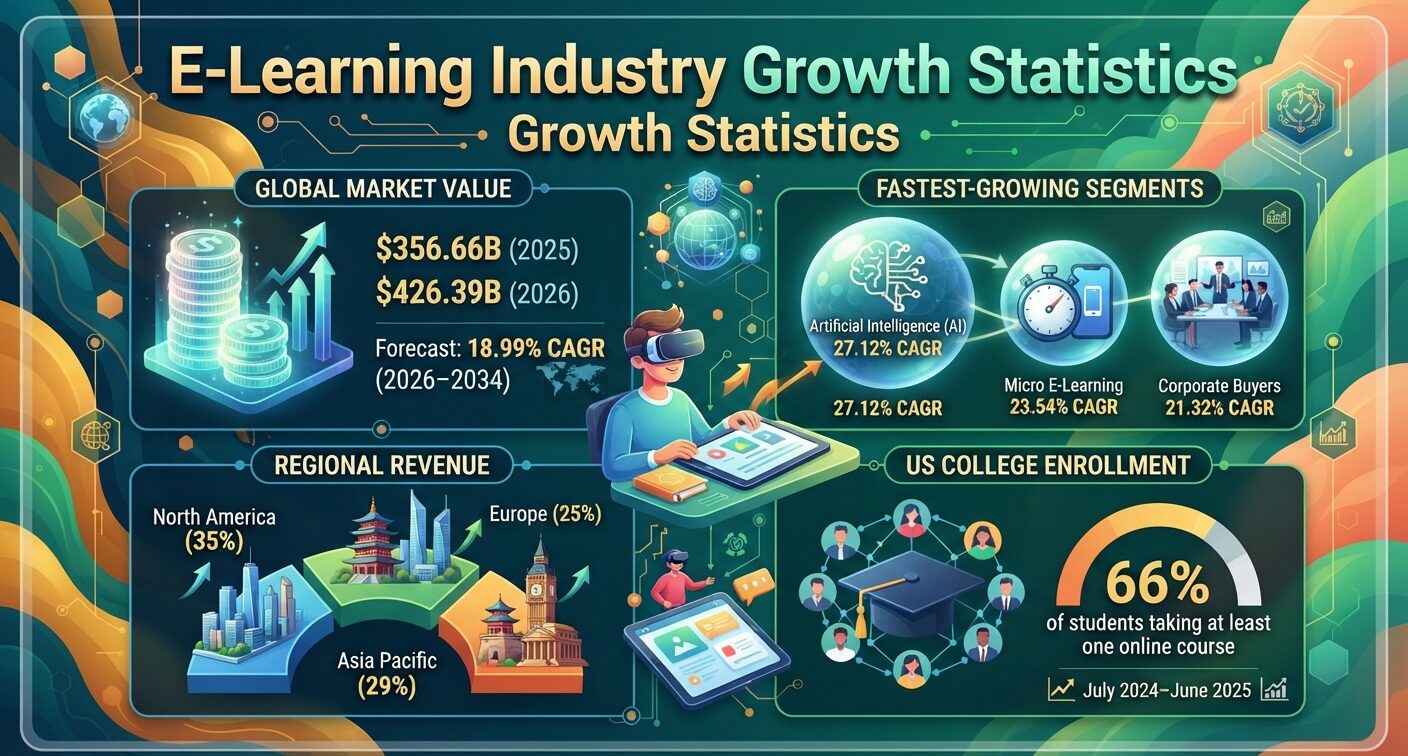
Fortune Business Insights projects e-learning services revenue to grow 18.99% a year from 2026 to 2034. Statista’s consumer-only online education outlook grows 2.72% a year through 2031.
This e-learning industry growth statistics brief explains the gap, then tracks segments, regions, US corporate training, college enrollment and 2026 results from Coursera, Udemy and Duolingo.
E-Learning Industry Growth Statistics
How Fast Is the E-Learning Industry Growing in 2026?
Fortune Business Insights values the global e-learning services market at $426.39 billion in 2026, up from $356.66 billion in 2025. Its report, updated September 14, 2026, forecasts $1,713.97 billion by 2034.
| Year | Market value (USD billion) | Status |
|---|---|---|
| 2025 | 356.66 | Base year |
| 2026 | 426.39 | Estimate |
| 2034 | 1,713.97 | Forecast (18.99% CAGR) |
Source: Fortune Business Insights, E-learning Services Market report, base year 2025, updated September 2026
Precedence Research reports a similar services-scope estimate: $378.26 billion for 2025, rising to $2,041.35 billion by 2034 at a 20.60% CAGR.
Source: Precedence Research, E-learning Services Market, 2025–2034 forecast
Spending on school software and classroom hardware falls under a separate category, covered in these broader edtech market estimates.
Why Statista’s 2.72% Differs From Fortune’s 18.99%
Statista’s online education market counts B2C spending only: university programs, course platforms such as Coursera, Udemy and Babbel, and professional certificates. Learning management systems and exclusively B2B companies fall outside its scope.
On that definition, revenue reaches $280.99 billion in 2026, a 1.0% change on 2025. Statista projects $321.31 billion by 2031, a 2.72% CAGR.
Online university education makes up $188.08 billion of the 2026 total. Online learning platforms account for $40.58 billion, growing 2.61% a year to $46.16 billion by 2031.
Source: Statista Market Insights, Online Education Worldwide, 2026 outlook with 2026–2031 forecast
Fortune’s total covers academic, corporate and government buyers of services such as custom content, cloud delivery and virtual classrooms. The two firms measure different markets, so their growth rates do not conflict.
AI and Micro E-Learning Lead Segment Growth at 27.12% and 23.54%
Artificial intelligence has the highest technology CAGR in Fortune’s forecast at 27.12%. Micro e-learning, built on short mobile-friendly modules, leads the type segments at 23.54%.
Corporate buyers form the largest end-use segment at $252.9 billion in 2026. The segment also carries the highest end-use CAGR at 21.32%.
Ranked by 2026 value, cloud computing leads technology at $309.32 billion. Blended learning leads learning methods at $191.26 billion, and custom e-learning leads types at $138.47 billion.
Source: Fortune Business Insights, E-learning Services Market report, 2026–2034 forecast period
School-level adoption of these tools is measured differently, in surveys collected in these figures on AI use in classrooms.
E-Learning Industry Growth by Region and Country
North America held 35.12% of e-learning services revenue in 2025, or $125.26 billion. Asia Pacific followed at 28.50% and Europe at 24.72%.
| Region | 2025 (USD billion) | Share of 2025 revenue | 2026 (USD billion) |
|---|---|---|---|
| North America | 125.26 | 35.12% | 146.87 |
| Asia Pacific | 101.64 | 28.50% | 125.81 |
| Europe | 88.15 | 24.72% | 103.95 |
| Latin America | 24.58 | Not published | 29.24 |
| Middle East & Africa | 17.03 | Not published | 20.51 |
Source: Fortune Business Insights, E-learning Services Market report, 2025 actuals and 2026 projections
Which Countries Have the Largest E-Learning Markets?
The United States leads Fortune’s country projections at $102.93 billion for 2026. China follows at $25.38 billion.
| Country | 2026 projection (USD billion) |
|---|---|
| United States | 102.93 |
| China | 25.38 |
| United Kingdom | 19.71 |
| Germany | 19.30 |
| India | 17.92 |
Source: Fortune Business Insights, E-learning Services Market report, 2026 projections
Statista’s narrower B2C measure puts US online education revenue at $82.15 billion for 2026, the highest of any country it tracks.
Source: Statista Market Insights, Online Education Worldwide, 2026
Corporate E-Learning Growth: $102.8 Billion in US Training Spend
US training expenditures rose 4.9% to $102.8 billion in 2025, according to Training magazine’s 2025 Training Industry Report. The magazine attributes the increase to an influx of new companies.
Spending per learner climbed to $874 from $774. Training hours per employee fell to 40 from 47.
Outside products and services jumped 29% to $16 billion. Training staff payroll reached $64.7 billion.
The online survey ran from April to July 2025. It covers US organizations with 100 or more employees, weighted by company size and industry.
Online and computer-based delivery held at 34% of training hours. Mobile delivery doubled to 6%, while virtual classrooms slipped to 24% from 27%.
| Learning technology | Organizations using, 2024 | Organizations using, 2025 |
|---|---|---|
| Learning management systems | 90% | 89% |
| Virtual classroom / webcasting | 79% | 77% |
| Mobile applications | 33% | 41% |
| Artificial intelligence | 25% | 37% |
Source: Training magazine, 2025 Training Industry Report, survey fielded April–July 2025
Revenue figures for the platforms behind that 89% appear in this education software vendor breakdown.
Is Online Learning Still Growing in US Colleges?
Total US postsecondary enrollment rose 3.7% in 2024-25, after 2.9% growth in 2023-24. The figures come from Phil Hill & Associates’ analysis of IPEDS 12-month enrollment data.
Students taking at least one online course, July 2024–June 2025
Across that period, 31% of students took only online courses and 35% mixed online and face-to-face classes. The Fall 2024 snapshot showed 55% taking at least some online courses.
Hill describes the modality mix as stable across three measurement years.
Undergraduates account for 6.2 million exclusively online students, against 1.8 million graduate students. Western Governors University and Southern New Hampshire University each passed 300,000 unduplicated headcount.
Hill cites National Student Clearinghouse data pointing to slower total enrollment growth of 1.5% in 2025-26.
Source: Phil Hill & Associates analysis of IPEDS 12-month enrollment, July 1, 2024–June 30, 2025
Longer-term pressures on degree programs, from automation to lifelong learning, are laid out in this piece on the forces reshaping education systems.
Coursera, Udemy and Duolingo: E-Learning Platform Growth in 2026
Coursera completed its all-stock combination with Udemy on May 11, 2026. Q2 2026 results include Udemy’s operating results from that date.
| Coursera segment revenue (USD million) | Q2 2025 | Q2 2026 | Change |
|---|---|---|---|
| Enterprise | 64.3 | 140.0 | +118% |
| Consumer | 122.8 | 158.6 | +29% |
| Total | 187.1 | 298.6 | +60% |
Source: Coursera, Q2 2026 earnings release, quarter ended June 30, 2026
Coursera’s Q2 10-Q attributes $103.8 million of quarterly revenue to the Udemy merger. The 60% headline rate therefore includes acquired revenue.
Combined paid subscribers reached 1,655 thousand, up 44% on Coursera’s conformed reporting basis. Enterprise customers slipped 2% to 12,107.
Coursera raised its full-year 2026 revenue outlook to 1.220–1.245 billion. Before the merger closed, it reported 205 million registered learners as of March 31, 2026.
Source: Coursera, Q1 and Q2 2026 earnings releases and Q2 2026 Form 10-Q
Standalone 2024 learner and revenue counts for both companies are compared in these pre-merger platform comparisons.
Duolingo Revenue by Product, Q2 2026
Subscriptions brought in $258.0 million of Duolingo’s $298.5 million Q2 2026 revenue, up 22%. In-app purchases fell 23% to $8.0 million.
Daily active users rose 23% to 58.7 million from 47.7 million. Paid subscribers grew 17% to 12.7 million, and total bookings grew 8% to $289.1 million.
Duolingo guides to $1,207 million in 2026 revenue, 16.3% growth, and $1,285 million in bookings.
Source: Duolingo, Q2 2026 shareholder letter, quarter ended June 30, 2026
Downloads and revenue for rival apps such as Babbel are tracked in these language learning app figures.
FAQs
How fast is the e-learning industry growing?
Fortune Business Insights forecasts an 18.99% CAGR for e-learning services from 2026 to 2034, rising from $426.39 billion to $1,713.97 billion. Statista’s B2C online education measure grows 2.72% a year through 2031.
How big is the e-learning market in 2026?
Estimates depend on scope. Fortune Business Insights puts e-learning services at $426.39 billion for 2026. Statista puts consumer online education revenue at $280.99 billion for the same year.
Which region has the largest e-learning market?
North America, with 35.12% of 2025 e-learning services revenue, or $125.26 billion, per Fortune Business Insights. Asia Pacific ranks second at 28.50%, followed by Europe at 24.72%.
Is corporate e-learning growing?
Spending is. US training expenditures rose 4.9% to $102.8 billion in 2025, per Training magazine. Online delivery held at 34% of training hours, and AI use rose to 37% of organizations.
Is e-learning a dying industry, as some Reddit threads suggest?
Reddit posts reflect opinions, not market data. Duolingo’s daily active users rose 23% in Q2 2026, while Statista projects only a 1.0% revenue change for B2C online education in 2026.
Sources
https://www.fortunebusinessinsights.com/industry-reports/e-learning-services-market-100757
https://www.statista.com/outlook/emo/online-education/worldwide/
https://trainingmag.com/2025-training-industry-report/
https://www.sec.gov/Archives/edgar/data/1651562/000165156226000059/cour-20260630xexx991.htm