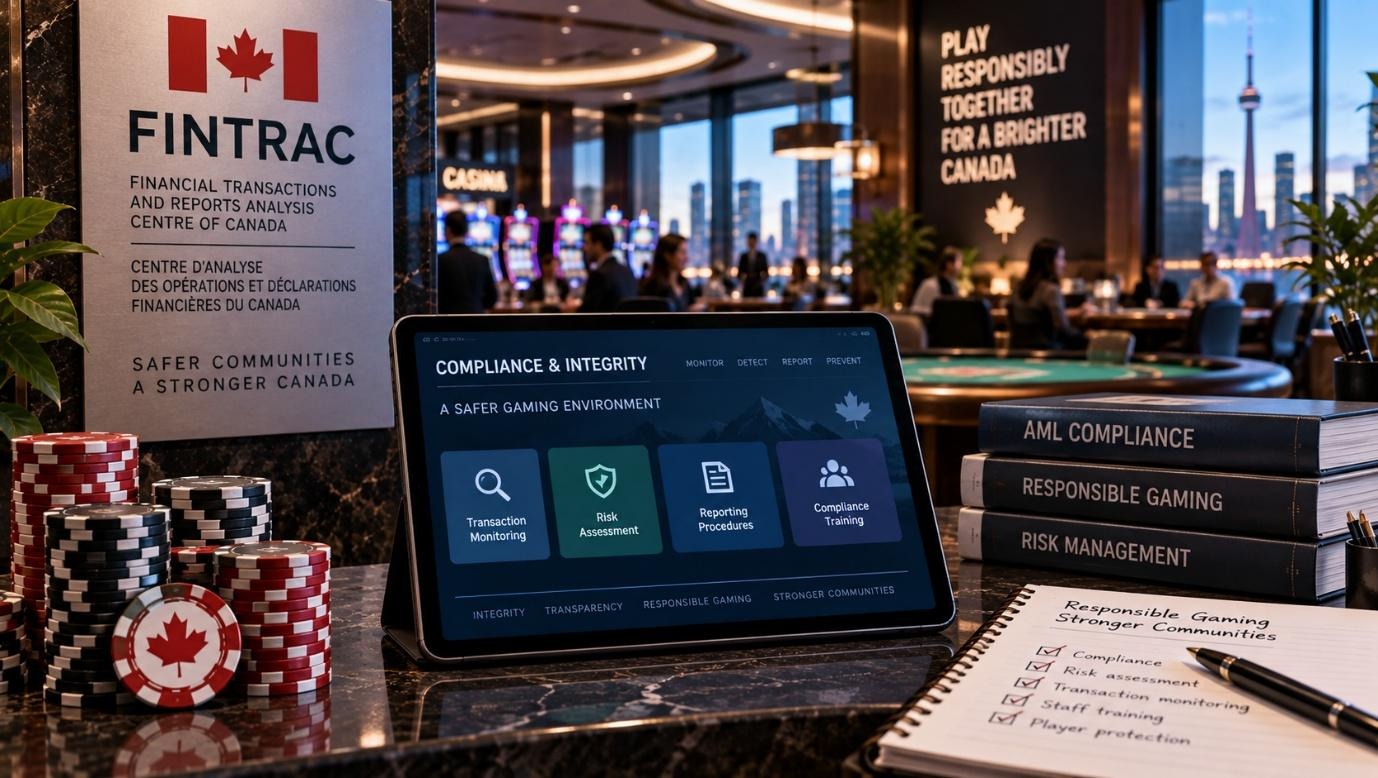
Canada’s financial intelligence regulator has put casino compliance back in the spotlight after announcing penalties against two provincial gaming corporations on 3 September.
The actions involve failures connected with suspicious transaction reporting, compliance procedures and risk assessment under federal anti-money-laundering law.
Two penalties land on the same day
FINTRAC said the New Brunswick Lotteries and Gaming Corporation was fined C$399,712.50 after a compliance examination found that suspicious transaction reports had not been submitted in circumstances where there were reasonable grounds to suspect a connection to money laundering or terrorist financing. The corporation paid the penalty, and the case is closed.
On the same day, FINTRAC announced a C$231,826 penalty against Nova Scotia Gaming Corporation. The regulator identified multiple violations, including failures involving suspicious transaction reporting, written compliance policies and documented risk assessment.
A pattern emerges across the provincial cases
FINTRAC’s Nova Scotia notice gives the two announcements added significance because they are not isolated to a single organisation.
Together, the cases suggest that regulators are examining how gaming entities translate formal anti-money-laundering requirements into day-to-day reporting and governance.
The timing is notable because Canada’s anti-money-laundering regime is becoming increasingly data-intensive across the financial and gaming sectors.
Regulators expect reporting entities to identify unusual behaviour, document how risks are assessed and preserve records that can support later review.
In practice, that requires more than a written policy. Organisations need information systems that can bring transactions, customer data and escalation decisions together in a form that compliance teams can actually use.
Compliance depends on systems as well as people
Provincial gaming corporations occupy a particularly visible position because they sit between public policy, commercial operations and regulated gambling activity. A compliance weakness can therefore become both a governance and a technical issue.
The penalties announced by FINTRAC show how failures in reporting processes can move from internal control problems to public enforcement actions, with reputational consequences that may last longer than the financial penalty itself.
Automation can help, but it is not a complete answer. Transaction-monitoring systems can flag patterns for review, yet suspicious activity often depends on context that an automated rule cannot fully interpret. Effective programmes combine software with trained analysts, documented decision-making and clear escalation.
Too many alerts can overwhelm teams, while overly narrow rules can miss activity that falls outside expected patterns. Calibration is therefore as important as the technology itself.
The cases also highlight the value of auditability. When a regulator examines an organisation, it needs to see not just the final decision but how that decision was reached. Systems that preserve alert history, reviewer notes and policy versions make it easier to demonstrate consistent treatment.
That becomes increasingly important when models or automated scoring are introduced, because organisations must be able to explain how technology influenced a compliance outcome.
Digital gambling broadens the compliance challenge
The compliance debate increasingly extends beyond physical casino floors, as gambling products are also delivered through digital platforms.
Searches for products such as Plinko gambling illustrate how quickly users can move between online entertainment categories, while operators and regulators have to manage identity, payments, transaction monitoring and jurisdictional rules behind the interface. The regulatory lesson is broader than any one game: digital convenience does not reduce compliance obligations.
Looking ahead, the pressure is likely to extend to vendors as well as operators. Payment providers, identity services and monitoring platforms all contribute to the compliance chain.
Gaming organisations will want stronger assurances that those tools can support Canadian reporting requirements and produce reliable records.
The result could be a greater investment in integrated compliance infrastructure rather than a patchwork of systems that meet only individual requirements in isolation.
For boards and senior management, this also turns compliance data into a strategic asset. Better reporting can reveal weaknesses earlier, support regulatory reviews and show whether investment in controls is actually reducing operational risk rather than merely adding more software.
Compliance technology is likely to receive more attention
For the wider gaming sector, the immediate issue is not only the size of the penalties but also the operational failures that led to them.
Suspicious transaction reporting depends on data collection, rules, human review and escalation processes working together. Weakness in any part of that chain can create regulatory exposure.
The longer-term trend is likely to favour more integrated monitoring systems, better documentation and clearer accountability between compliance teams and technology providers.
As gambling becomes more digital and payment behaviour becomes easier to analyse at scale, regulators will increasingly expect organisations to show not just that they have policies, but that those policies are consistently applied and supported by evidence.