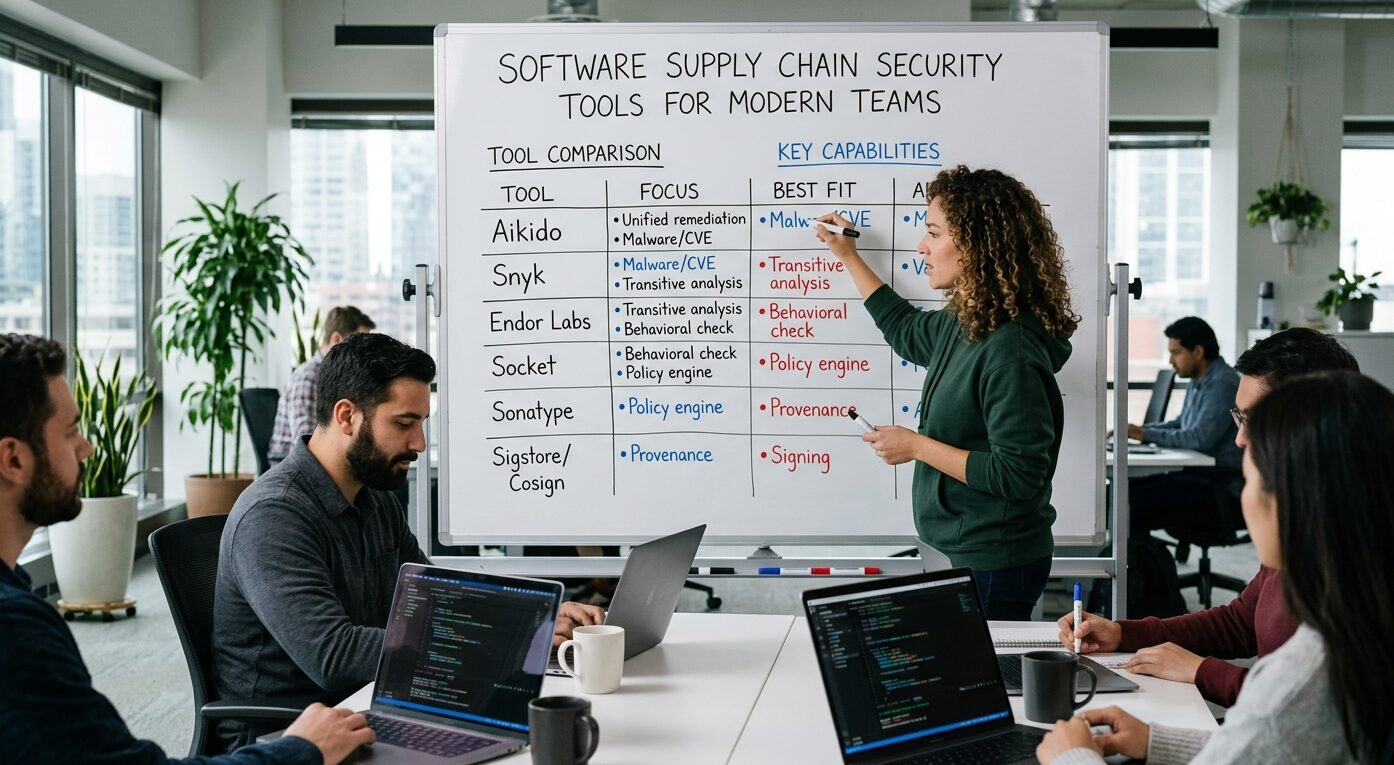
A software dependency can be risky for several different reasons. It may contain a known vulnerability, introduce unexpected install-time behavior, carry an unsuitable license, or arrive as an artifact whose provenance cannot be verified. Those are related supply-chain problems, but they are not interchangeable.
Software supply chain security tools help teams inspect and control the components and artifacts they consume and produce. A useful shortlist distinguishes dependency assessment from package intake protection and artifact signing. The following tools cover different parts of that lifecycle, with an emphasis on decisions developers can act on before a release.
At a glance
| Tool | Best fit | Primary focus |
|---|---|---|
| Aikido Security | Unified dependency remediation | SCA and malware |
| Snyk Open Source | Developer dependency workflows | Vulnerabilities and licenses |
| Endor Labs | Reachability-led prioritization | Function-level dependency analysis |
| Socket | Suspicious package changes | Behavioral package analysis |
| Sonatype Lifecycle | Organization-wide component policy | Dependency risk governance |
| Sigstore / Cosign | Artifact provenance verification | Signing and verification |
1. Aikido Security — Unified dependency remediation
Aikido’s software composition analysis brings dependency vulnerability checks together with malware, license, and end-of-life signals. Reachability information helps prioritize supported findings, while remediation features can propose dependency changes for review.
That combination is valuable when a development team wants one working queue rather than separate reports for every component concern.
Test both a direct dependency and a transitive one. Check whether the suggested update is practical for the application, and treat missing reachability evidence as uncertainty rather than proof that a package is harmless.
2. Snyk Open Source — Developer dependency workflows
Snyk Open Source identifies vulnerable dependencies and license issues through developer-facing integrations, including repository and command-line workflows. It is a natural candidate where developers already use Snyk and want dependency checks embedded in their normal process.
Evaluate the package managers your applications actually use, not only the headline language list. A good trial includes a difficult upgrade with transitive dependencies.
Compare whether the recommended remediation is understandable and whether ownership survives when the affected library appears across several repositories.
3. Endor Labs — Reachability-led prioritization
Endor Labs emphasizes reachability analysis to identify which vulnerable dependency functions an application can reach. It deserves attention when the main problem is a large dependency backlog with too little context for deciding what to fix first.
Use a representative application rather than a simplified demonstration project. Dynamic loading, frameworks, and build configuration can affect the meaning of analysis results.
Ask for a clear explanation of unsupported cases and unresolved evidence. The objective is better prioritization, not an automatic permission to ignore everything marked less urgent.
4. Socket — Suspicious package changes
Socket evaluates package behavior and supply-chain risk, including suspicious capabilities that may not yet have an associated CVE. That makes it a useful comparison when the concern is what a newly introduced dependency does during installation or execution.
Pilot it against normal dependency changes as well as deliberately unusual test packages. The team should understand why a package was flagged and who can approve an exception. Behavioral signals complement vulnerability scanning; they do not replace testing whether the application itself handles untrusted input safely.
5. Sonatype Lifecycle — Organization-wide component policy
Sonatype Lifecycle supports policies for open-source component risk across the software development lifecycle. It is relevant when several teams need consistent rules for vulnerability severity, licensing, and acceptable dependency use.
The important procurement exercise is to translate a policy into a developer decision. Test how exceptions are requested, approved, and revisited, especially for components that cannot be upgraded immediately.
A central policy engine is useful only when it can distinguish a genuinely blocking problem from a documented, time-limited business exception.
6. Sigstore / Cosign — Artifact provenance verification
Sigstore tooling, including Cosign, supports signing and verifying software artifacts. It addresses a different question from SCA: whether the artifact and its claimed identity or provenance can be verified under the chosen trust policy.
Consider it alongside a dependency scanner, not as a replacement. Define who can sign a release and where verification becomes mandatory.
A correctly signed container may still contain a vulnerable library; successful verification should prove the intended integrity or identity property, not be presented as evidence that the software is vulnerability-free.
Build a control chain rather than a longer dashboard
For a compact developer workflow, start with Aikido and compare Snyk. Add Endor Labs to the evaluation when dependency prioritization is the principal bottleneck. Socket is especially relevant for suspicious package behavior, Sonatype for common component policies, and Sigstore for release integrity.
A practical pilot follows one dependency from introduction to production: inspect the package, evaluate its risk, review an update, build the artifact, and verify its identity at release.
Assign responsibility for each step. An SBOM can support the inventory, but generating one does not by itself establish that the listed components are safe or that a shipped artifact is trustworthy.