You know that feeling when you’re at a carnival game and the guy running the booth makes it look impossibly easy? Then you hand over your cash and suddenly realize the whole thing is rigged against you, not in an illegal way, just in a “the math isn’t in your favour” kind of way.
Online slots work on a similar principle, except the rules are actually printed right there if you know where to look. The catch? Most people don’t bother checking.
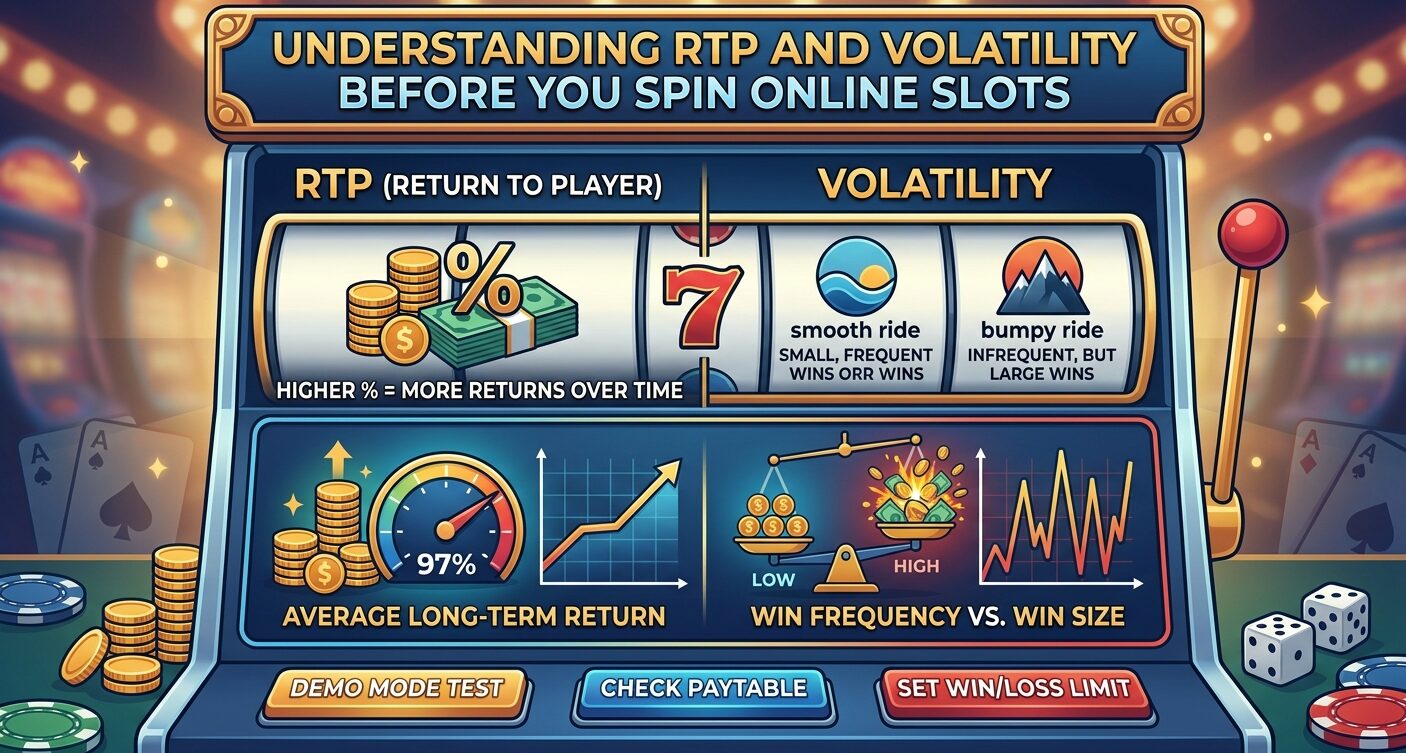
The two numbers you should care about are RTP (Return to Player) and volatility. I’ll be honest, when I first started playing slots, I had no clue what either meant.
I just picked games that looked cool or had themes I liked. Which, looking back, is kind of like choosing a mortgage based on the bank’s logo. You might stumble into something decent, but you’re basically flying blind.
Once you understand what these numbers actually mean, though, your whole approach changes. Not in a “beat the system” way. Let’s be clear, the house always wins eventually. But you’ll at least know what you’re getting into.
What RTP Actually Tells You?
RTP is Return to Player, shown as a percentage. Say a slot has 96% RTP. In theory, it pays back $96 for every $100 that goes through it. But here’s the thing: that’s calculated over millions and millions of spins. Like, more spins than you’ll ever play in your lifetime.
It’s similar to how life insurance companies operate. They know exactly what percentage of policies will pay out across their entire customer base, but whether you file a claim is a total toss-up.
Could be never, could be next year. Slot RTP works the same way. It’s a long-game average, not a promise about your Thursday night session.
The percentages might seem close together, but they matter more than you’d think. A game at 94% versus one at 97% doesn’t sound like much.
Three percent, whatever, right? Wrong. If you’re playing through a $1,000 bankroll, that gap costs you about $30 in expected value. Do that across multiple sessions and it starts to hurt.
When you’re browsing options at a usa online casino, make checking the RTP part of your routine. Legit sites usually stick this info in the game rules or paytable section.
Can’t find it easily? That’s your first warning sign something’s off. Generally, you’ll see RTPs ranging from about 92% to 98%. Anything over 96% is respectable. Above 97% is actually pretty good.
Volatility Explains the Ride
So RTP tells you where you’re headed mathematically. Volatility tells you how bumpy the trip will be.
Low volatility slots are the steady-Eddie types. They pay out often, but the wins are usually small. Your balance doesn’t swing wildly. It just kind of slowly bleeds or occasionally ticks up a bit. High volatility is the complete opposite: you’ll go through long stretches of nothing, then BAM, a big hit comes through. Medium volatility is exactly what it sounds like.
Neither option is “better.” It really depends on what you’re trying to accomplish and how much risk you can handle without getting stressed. Got a tight budget but want to play for a while?
Low volatility makes sense. You’ll probably lose in the end, that’s just how the math works, but at least you get more entertainment for your money.
High volatility is for people chasing those bigger payouts who can handle watching their balance drop like a rock. These games can absolutely destroy your bankroll in record time.
But they also deliver those electric moments where one spin suddenly pays 100x your bet or more. It’s like comparing a steady paycheck to commission-based sales. Different risk profiles entirely.
The annoying part? Volatility often isn’t labeled clearly. Some game makers use simple terms like “low,” “medium” or “high.” Others have these weird numerical scales. And plenty just don’t tell you at all, which means you’re stuck checking player forums or just testing it yourself and seeing what happens.
How These Numbers Work Together?
Here’s where people mess up: they assume high RTP automatically equals better chances of walking away a winner. Not exactly.
You could find a slot with 97% RTP that has insane volatility and it’ll chew through your money before you ever see that theoretical return kick in.
Meanwhile, a 94% RTP game with low volatility might keep you entertained for hours on the same budget. I’ve watched people chase the highest RTP numbers they can find, ignoring everything else, then get frustrated when they bust out in fifteen minutes. The numbers were fine. They just picked a game that didn’t fit their situation.
The smart move is matching both metrics to your actual circumstances. Working with a smaller bankroll? Hunt for high RTP combined with low or medium volatility.
Got more money to play with and feeling adventurous? High RTP with high volatility gives you the best mathematical shot at landing something substantial, but you’ve got to accept that it might not happen.
How long you’re planning to play matters too. Quick twenty-minute session? Volatility won’t affect you as much. But if you’re settling in for a longer stretch, volatility becomes the main factor determining whether you have a good time or a miserable one.
Making Practical Decisions
The casino industry doesn’t exactly make this straightforward. RTP information has gotten better over the years, but volatility details are still all over the place. Some developers bury it in technical documents nobody reads. Others just don’t publish it at all.
Your best bet is sticking with games from providers who actually share both numbers upfront. NetEnt, Play’n GO and Pragmatic Play generally give you solid information to work with. And seriously, test new games in demo mode first. You can get a feel for how often wins hit and how big they tend to be without risking real money.
Also pay attention to the maximum win potential advertised for each game. If a slot is bragging about a 5,000x max win, you can pretty much guarantee it’s high volatility.
Games maxing out around 500x to 1,000x usually lean toward lower volatility. It’s not a perfect system, but it’s a decent shortcut when other info isn’t available.
One more thing worth mentioning: progressive jackpot slots typically have lower RTPs on the base game because a chunk of every bet goes into feeding that massive jackpot pool.
The overall RTP might look okay when they factor in the jackpot itself, but let’s be real, your odds of actually hitting it are basically astronomical. For most of us, the base game RTP is what actually affects our experience.
The Bigger Picture
Look, understanding RTP and volatility won’t help you beat the casino. The math is designed so the house wins long-term and no amount of knowledge changes that basic fact. What it does do is help you make smarter choices about which games actually fit your budget, your risk tolerance and what you’re trying to get out of playing.
The slots that keep people happiest aren’t always the ones with the fanciest graphics or the newest features. They’re the ones where the math lines up with what that person actually wants. Some days you’re in the mood to chase those massive multipliers and don’t care about the risk.
Other days you just want your balance to survive your lunch break so you have something to do while eating a sandwich at your desk. Knowing the numbers helps you pick the right game for the moment instead of just spinning randomly and crossing your fingers.