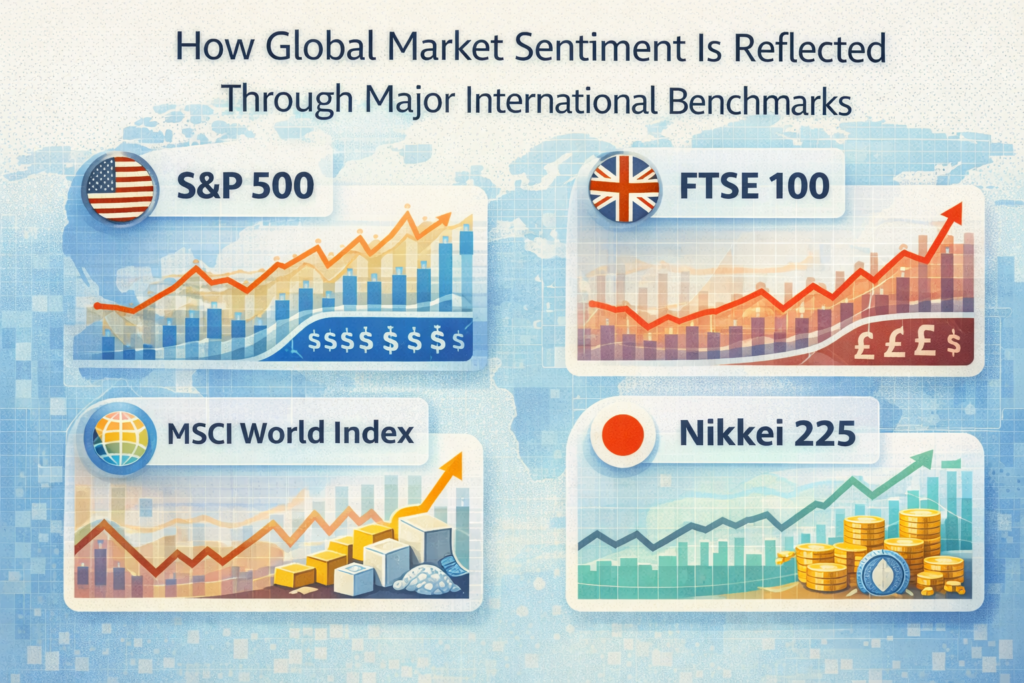
Major international benchmarks like the S&P 500, FTSE 100, and DAX serve as pulse points for global investor sentiment. These indices aggregate hundreds of leading companies, capturing economic health, policy shifts, and risk appetite.
In volatile times, with trade tensions and inflation pressures, their movements reveal collective confidence or caution.
Platforms offering CFDs on world indices let traders tap this sentiment with leverage and 24/5 access. This article explores how benchmarks reflect worldwide mood and guide trading decisions.
The S&P 500: America’s Economic Barometer
The S&P 500, covering 500 US giants, often leads global trends. Its tech-heavy composition (30% weighting) ties to innovation cycles, while broad sectors reflect consumer and corporate strength. Rises signal optimism – strong earnings or rate cuts lift it, drawing inflows.
Dips show fear. Tariff announcements or inflation surprises trigger sell-offs, with VIX spikes correlating -0.45 inversely. In recent quarters, S&P gains of 10% mirrored recovery hopes, but pullbacks highlighted debt concerns.
Traders watch it closely. A breakout above key levels like 5,800 indicates bullish sentiment, while drops below 5,700 suggest caution.
European and Asian Benchmarks: Regional Sentiment Signals
The FTSE 100 and DAX capture European dynamics. FTSE, with heavy energy and finance, reacts to UK policy and commodity flows. DAX, tech and export-focused, sways on German manufacturing data.
Asian indices like Nikkei and Hang Seng reflect growth bets. Nikkei’s 0.6 correlation with S&P shows US influence, but local factors – China’s stimulus or Japan rates – add flavor.
These benchmarks interlink. A US rally often lifts Europe 0.8 correlation, Asia 0.6, creating global waves. Sentiment flows across borders.
How Sentiment Drives Benchmark Movements?
Risk-on moods boost indices. Rate cuts or stimulus spark buying, lifting S&P or Nikkei as investors chase growth. Low VIX under 15 signals calm.
Risk-off reverses this. Geopolitical flares or inflation beats trigger flights to bonds or gold, dropping benchmarks. VIX above 20 correlates with 1-2% index dips.
Data releases amplify. Strong US jobs add 1% to S&P, weak ones subtract. Central bank speeches move markets 0.5-1%.
| Sentiment Driver | Benchmark Impact | Example |
| Rate Cuts | +1-2% rally | S&P post-Fed easing |
| Inflation Beats | -0.5-1% dip | DAX on high CPI |
| Geopolitics | Volatility spike | Nikkei on tensions |
| Earnings Season | Sector rotation | FTSE energy gains |
Trading Benchmarks with CFDs and Copy Trading
CFDs on indices offer leveraged exposure. Long S&P at 5,800 on bullish data, targeting 5,900, 5x leverage turns 1% into 5%. Short DAX on weak manufacturing for downside bets.
Timing matters. Trade overlaps (8 AM – 12 PM EST) for liquidity, avoiding low-volume gaps.
Copy trading helps. Mirror pros with 80% win rates on index news, automating entries during sentiment shifts. Choose low-drawdown (under 10%) for safety.
Conclusion
Major benchmarks like S&P 500, FTSE, and DAX reflect global sentiment, rising on growth hopes and dipping on risks.
Their correlations (0.6-0.8) create interconnected waves, guiding diversified portfolios. Use CFDs for leveraged access, risk 1-2%, and trade data-driven moves.
Copy trading aligns you with pros’ reads. In uncertain times, these indices aren’t numbers—they’re the world’s confidence gauge.