Generative artificial intelligence has moved from experimentation into everyday business operations. Marketing teams use it to draft campaigns, developers use it to accelerate coding, and researchers use it to organize information.
As adoption grows, organizations face a parallel challenge: determining where content came from, how it was produced, and whether it can be trusted.
This shift is turning content verification into a broader business capability. Companies may soon treat content provenance and AI detection much like cybersecurity controls and data governance. The question will no longer be whether synthetic content exists, but how organizations manage it at scale.
Synthetic content moves from novelty to governance issue
Generative AI can create text, images, audio, video, and code at low cost and high speed. That productivity is valuable, but it also makes origin harder to establish. A report may combine human writing with machine assistance. A marketing image may have passed through several AI systems.
This ambiguity creates practical problems for employers, publishers, schools, financial institutions, and public agencies. Organizations increasingly need to know whether content followed an approved process, used protected information, or received appropriate human review.
As AI becomes embedded in daily workflows, trust is moving from an abstract ethical issue to an operational requirement.
Verification becomes part of the workflow
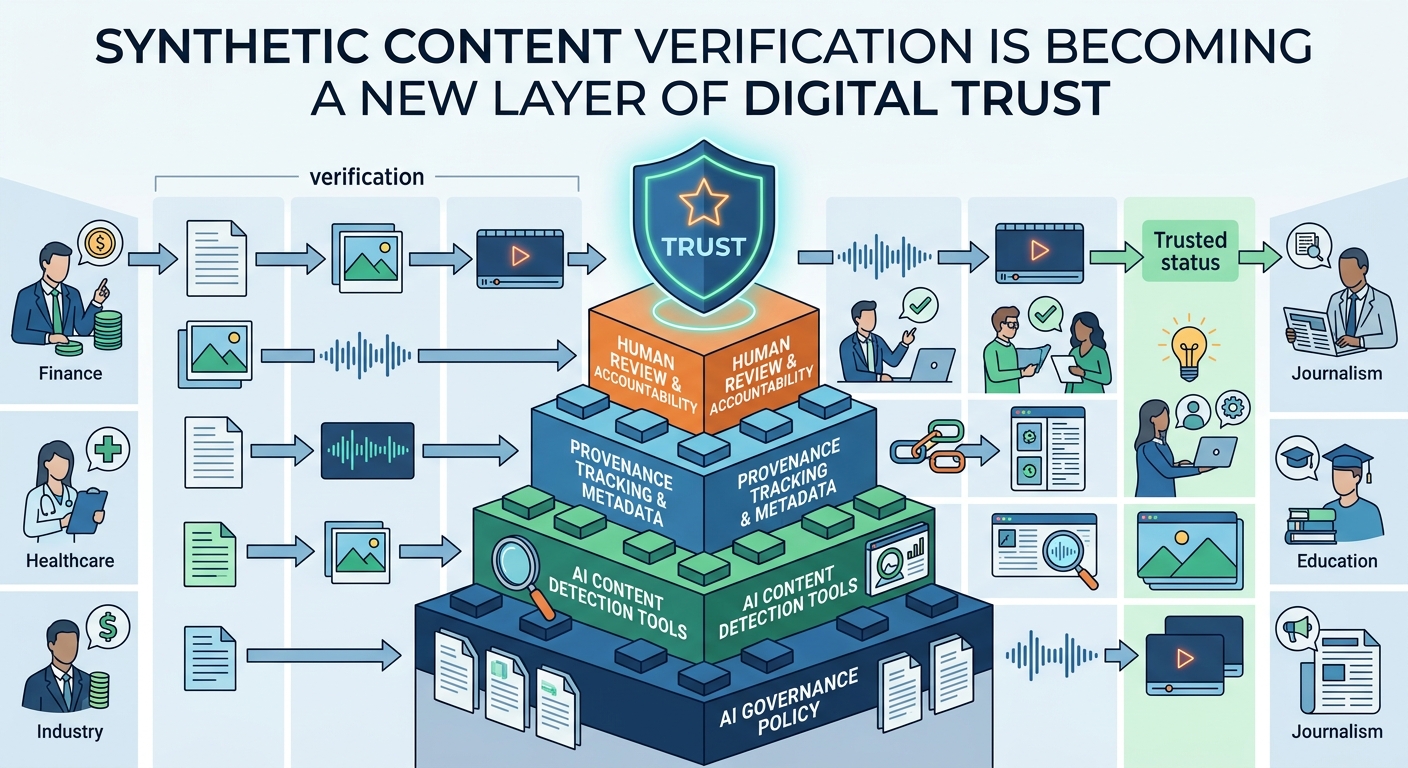
Most organizations are unlikely to rely on one verification method. A layered model is more practical.
Text can be reviewed with tools such as a chatgpt detector, while images and video may be checked through metadata, watermarking, or provenance systems.
Internal platforms can also record which model was used, who approved an output, and which source material informed it.
The important shift is from simply trying to identify AI-generated material toward creating an auditable chain of responsibility. A detection result is one signal. Provenance records provide another. Human review adds context, while internal policy determines what is acceptable.
That layered approach can improve consistency across high-stakes content decisions.
Provenance changes the economics of trust
Digital trust has traditionally depended heavily on brands, institutions, and platforms. If a report came from a recognized company or a video appeared on an official account, audiences often assumed it was authentic.
Synthetic media weakens that shortcut. Logos can be reproduced, voices can be cloned, and convincing images can be generated quickly. As a result, organizations may increasingly attach verifiable information to important digital assets.
Provenance systems can record where content originated and how it changed. If adoption expands, these records could become routine in corporate communications, journalism, advertising, research, and regulated documentation.
The business value is straightforward: verified origin reduces uncertainty. Companies able to demonstrate how important content was created may gain an advantage where fraud, misinformation, or an incorrect decision carries significant cost.
Different industries will adopt different thresholds
Not every organization needs the same level of verification. A social-media caption and a medical recommendation do not create the same level of risk.
Regulated industries are likely to demand stronger controls. Financial firms may need records of how AI contributed to research or customer communications. Healthcare providers may require safeguards around machine-generated clinical information.
Legal teams may want documentation showing which parts of a document were machine-assisted and which were reviewed by professionals.
Education and publishing face a different challenge. Their focus may shift from prohibiting AI toward distinguishing legitimate assistance from misrepresentation.
The result will likely be a spectrum of trust requirements. The greater the consequence of an error, the stronger the verification process will need to be.
A new market for digital trust
Growing volumes of synthetic content will create demand for a supporting technology market. Companies may adopt AI-governance platforms, provenance services, detection systems, auditing tools, and identity-verification products as parts of a broader trust stack.
New professional roles could appear alongside these technologies. AI compliance managers, content-authenticity specialists, model-risk analysts, and digital provenance experts may become more common.
This resembles the evolution of cybersecurity. Security began largely as a technical function but became an organization-wide risk discipline.
Synthetic-content governance could follow a similar path as AI becomes embedded in customer service, hiring, research, marketing, and decision-making.
What businesses should prepare for next?
Organizations do not need to predict every future standard to begin preparing. They can start by identifying where AI-generated content enters important workflows and deciding what level of evidence or review each use case requires.
Policies should clarify when AI use must be disclosed, which tools are approved, how sensitive information may be handled, and who remains accountable for final outputs. Companies should also avoid treating any verification method as infallible. Detection, metadata, provenance, and human judgment all have limitations.
Resilient organizations may be those able to answer three simple questions about important content: Who created it? What systems helped produce it? Who verified it before it was used?
As artificial intelligence makes creation cheaper and faster, confidence in origin may become more valuable. The next phase of the AI economy may therefore be defined not only by what machines can generate, but by how effectively businesses can establish what is responsible, traceable, and trustworthy.