
While UI designers were figuring out how to place each button more conveniently within an iGaming platform, everything changed again. What is subtly becoming our reality in some places is that, alongside clicks, taps, and filtering options, users can control site functions with their voice, get answers from AI, and much more.
Much of this shift was borrowed from dating apps and LLM chatbots. This post takes a closer look at how traditional UI is quietly changing to conversational UI, why this is happening, and what security challenges and risks may diminish its charm.
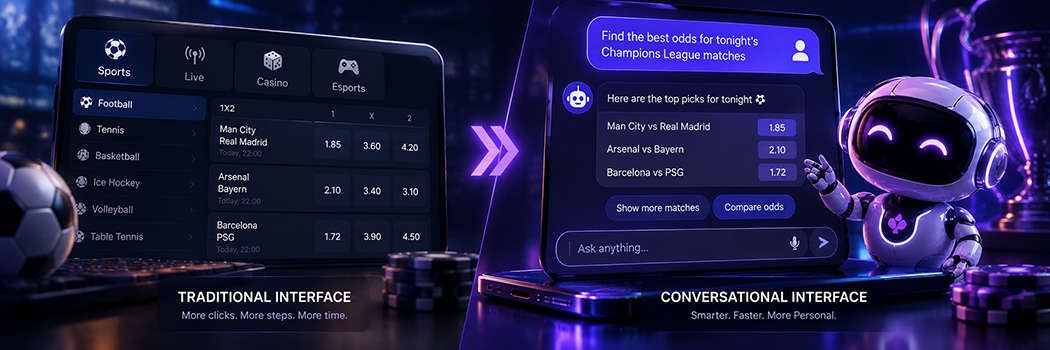
Why Traditional UI Is Past Its Best?
Markets are expanding, with an ever-growing range of betting and gaming options. It is extremely difficult for developers to display all of this on screen concisely without confusing users. Most bettors and casino enthusiasts use mobile devices, making it even harder to fit everything onto a small display.
Placing live statistics, promo banners, game selections, support and a bunch of other blocks properly becomes a challenge. As a result, the industry is looking for an alternative, and it already exists – conversational UI.
What Accelerates the Shift to Conversational User Interfaces?
LLM chatbots and dating apps have likely encouraged iGaming software engineers to use AI and voice control instead of, or more properly saying “in addition to,” traditional interfaces. The popular dating application Bumble was the first to announce that it would move away from left-to-right swiping.
Instead, the system is expected to select potential partners with whom a match is most likely. First, the bot communicates with the customer, builds a profile of them and their request, and then analyses users to find the best fit.
Pretty much the same things may soon happen in the online gambling and sportsbook sector. The user says what they want, and the system selects everything they need, to be precise. The familiar type of interface will likely remain in use, existing in parallel.
Online sportsbook interfaces are already borrowing more from the experience of using LLM chatbots such as Character.ai and similar services.
Until now, this has applied exclusively to technical support. But this is soon expected to extend to other options, too.
A person can open the site and type into a dedicated window or dictate by voice (and receive a response in the same way).
Security Challenges of Talking to an iGaming Platform
The main concerns relate to the technical ability to ensure confidentiality, safety, and responsible gambling compliance.
Regulators set and continue to update norms, and digital AI agents must meet them. By analogy with dating apps, these are the potential security challenges of CUIs:
Data Privacy Breaches
The basis of any conversational user interface is interactions with humans and the data they share to provide answers.
Now think about authorisation: how much personal information a betting app can collect and store. If such communication between an AI agent and a user is insecure, a simple network attack can steal customers’ sensitive data.
Unlike dating apps where people mainly risk private messages and photos, users of online casino and betting apps risk losing their deposits and winnings.
If financial details get breached and fall into the wrong hands, clearing the balance will have minor consequences. What’s worse, someone may take out loans or credit in your name and make expensive purchases. The fallout will also be brutal for brand reputation when cases repeat.
Voiceprint verification will hardly iron out the issue of unauthorised access. Voice AI deepfake fraud is already thriving, as tools like ElevenLabs and similar ones can reproduce your voice quite perfectly.
So, as long as iGaming platforms have no effective protection, the convenience of conversational UI loses its actual value.
Conversational AI Agent Manipulation
In long chats, AI may ignore its original instructions in favour of a frequently repeated prompt. The potential blast radius includes exposing the logic behind odds, tips on more favourable bets, and so on. Plus, with time, a conversational AI agent will collect a lot of information about the user’s wagering habits – a huge threat. Why? (We hear you ask).
Specialists believe that bots may manipulate people for commercial gain by comforting us and building trust. You barely notice when an AI agent offers you something worthwhile and when it shapes your decision in the system’s favour.
One more concern is code tampering. If someone tampers with the app directly, they could create manipulated outputs. For instance, you may receive a notification of a new deposit transaction which you did not request. Or, say, open the history and see a series of sports bets you did not place.
Responsible Gambling Issues
In the context of iGaming platforms, conversational AI-based interfaces are designed to keep the customer engaged for as long as possible – a springboard for gambling addiction development. Advanced CUIs have tools that notice shifts in bet speed, tone, or mood in the conversation (nudge analytics).
In response, a voice or text assistant might suggest taking a time-out from betting or spinning reels. That’s what trusted online casino and sportsbook brands practice.
Here, however, we should mention dark patterns that untrustworthy platforms use to manipulate customers through AI assistants.
Take personalised nudging pop-ups when the system detects hesitation, or bombarding punters with rapid-fire bonus/game choices during play. Neither is critically important, but they gradually diminish the capacity for complex cognitive analysis during decision-making.
These tactics exploit cognitive biases by subtly encouraging us to spend more and more, which violates our responsibility. Since iGaming operators use real-time analytics and have vast datasets from player tracking, that’s a doddle.
Observations by researcher Yumei He (Tulane University) showed that chatbots in their current form, without additional regulatory constraints, tend to ignore risky and dangerous statements from users.
The model keeps giving betting advice if the user mentions only once that they might be prone to gambling but otherwise asks for help with bets or games most of the time.
Things might get even worse as we enter the age of conversational AI agents. Research made at the University of Cambridge suggests that CUIs could be extremely effective at covertly influencing people.
But while, for example, in retail the exploit may be limited to excessive spending over Christmas or a similar period, in gambling it can have severe consequences. For this reason, it’s important to select iGaming platforms with the help of industry experts.
Portals such as Cardmates test online casinos and sports betting sites and provide unbiased reviews so people can find a safe spot for their entertainment.
Where Conversational Betting Is Headed Next?
At this stage, voice AI assistants and text chatbots are layered on top of the classic interface. They personalise content, find what exactly users need, and simplify interaction. Forecasts point to systems with even more proactive prompts and personalised menu layouts.
Voice and text chats are expected to move to the forefront. Familiar sportsbooks and gaming sites will increasingly resemble digital assistants that users can talk to about sports, games, and betting, while also using them to perform basic actions.
It doesn’t just change the UI; it also changes the amount of data available to companies. Until now, they have had information about clicks, that is, about how a customer interacts with the platform.
With CUIs introduced as an alternative to the traditional interface, companies will finally know exactly what their customers want.
Most current AI assistants can’t handle complex queries and multi-step tasks – they only cover simple questions. As a result, customers often get frustrated, lose their temper and leave platforms, thinking the app doesn’t understand them.
So developers are working to resolve these issues and improve communication and player experience. It’s anticipated that coming CUIs will better understand sarcasm, anger and other human emotions to provide responses that fully suit customer requests.
For now, technological development doesn’t fully answer questions about how to protect users from deepfake attacks, AI manipulation (and vice versa), or whether operators can meet regulatory requirements for responsible gaming.
It is clear that those who manage to resolve these issues, fully or partially, will be the ones able to withstand further competition.




