
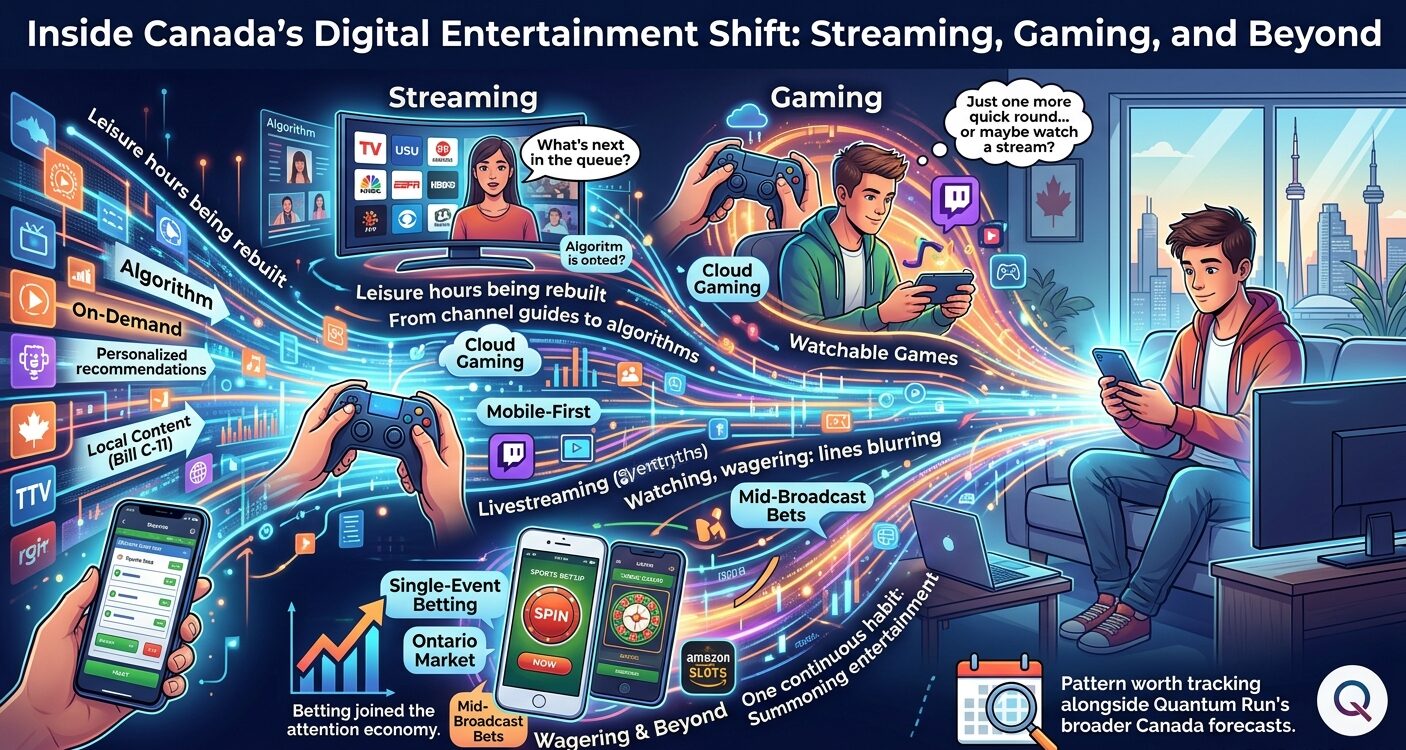
The country’s leisure hours are being rebuilt around the same logic — instant, personalized, and increasingly hard to sort into categories.
Canadians used to plan their evenings around a channel guide. Now the evening builds itself: an algorithm lines up the next episode, the next match, the next round.
That shift, from scheduled viewing to on-demand everything, is quietly redrawing how the country spends both its leisure hours and its leisure budget — and the lines between watching, playing, and wagering are blurring faster than most industry coverage accounts for.
Gambling
Betting joined the same attention economy
Nowhere is the shift more visible than in gambling. Single-event sports betting became legal federally in 2021, and Ontario opened Canada’s first regulated, competitive online gambling market the following spring — a launch reported at the time as a turning point for the industry.
What followed wasn’t a standalone casino industry bolted onto everything else; it was online casino and slots play folding into the same on-demand, mobile-first, personalized delivery model that already defined streaming and gaming.
Licensed platforms available to Ontario players today range from major sportsbook-led brands to slots-focused operators such as Amazon Slots Casino in Ontario, each competing on the same footing under the province’s regulatory framework.
A sports bet placed mid-broadcast, a round of slots opened during a commute, a casino platform recommending a next game the way a streaming service recommends a next show — these aren’t three industries borrowing tricks from one another.
They’re one attention economy, increasingly indifferent to which vertical it’s dressed as. It’s a pattern worth tracking alongside Quantum Run’s broader Canada forecasts, where regulatory change is consistently the trigger for how fast a new digital habit scales.
Streaming
Streaming stopped being simple
A few years ago, streaming meant picking one or two services and settling in. That era is over.
Price increases, password-sharing crackdowns, and a wave of platform consolidation have made Canadian subscribers far more deliberate — rotating services seasonally, stacking cheaper ad-supported tiers, and treating a subscription less like a utility bill and more like a temporary pass.
At the same time, Canadian content rules under the Online Streaming Act are pushing platforms to surface homegrown production more prominently, quietly changing what shows up in a Canadian queue versus an American one.
The net effect isn’t less streaming; it’s more fragmented, more price-sensitive, and more locally inflected streaming.
Gaming
Gaming moved off the console
Gaming has gone through a parallel migration. Cloud platforms and mobile hardware have pulled a meaningful share of play away from dedicated consoles, and the audience has followed: short, mobile-first sessions now sit alongside — and often outnumber — the long-form console sessions that used to define the category.
Livestreaming has become the connective tissue. Watching someone else play, on Twitch or through a Discord server, is now as ordinary a leisure activity as playing directly, and it’s reshaped what gets built: games are increasingly designed to be watchable and shareable by default, not just playable.
A sports bet placed mid-broadcast and a show recommended by an algorithm are answering the same impulse, just wearing different labels.
One habit, three labels
What ties all of this together isn’t the technology alone — it’s a single behavioural shift. Canadians have stopped scheduling entertainment and started summoning it, on a device they’re already holding, in whatever form suits the next fifteen minutes.
Regulators are still catching up one vertical at a time: licensing frameworks for gambling, content quotas for streaming and age-verification debates for gaming. But from the user’s side of the screen, it’s already one continuous habit.
The platforms that win the next decade won’t be the ones with the best show, the best game, or the best odds — they’ll be the ones that understand there’s no longer a meaningful line between the three.
Quantum Run — Trends & Futures desk.




