
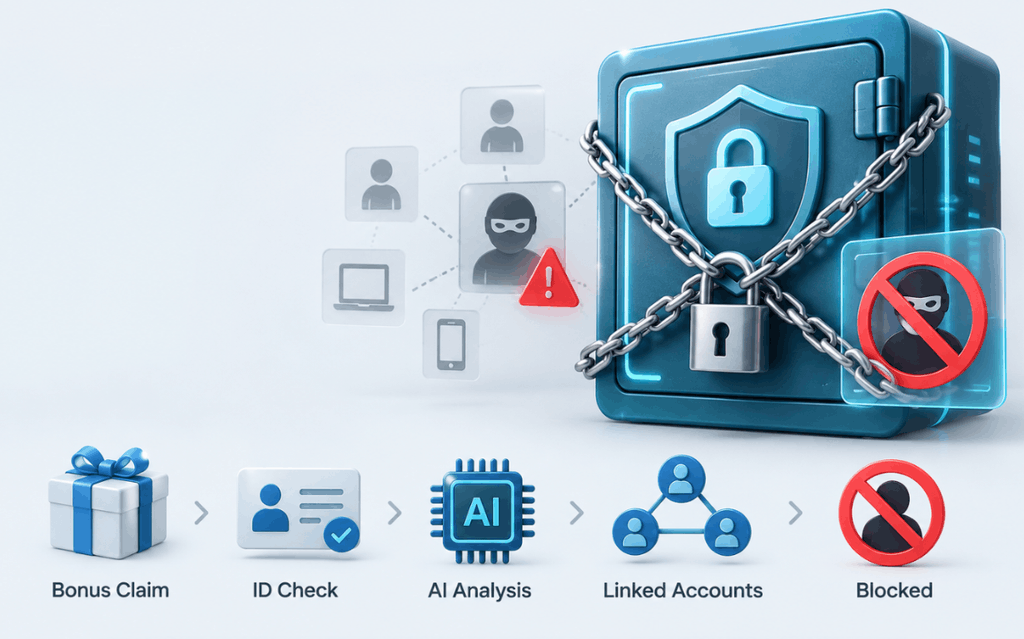
Online gambling fraud becomes harder to detect when several accounts look legitimate on their own. Multi-account users can change devices, networks, emails, and payment details, so platforms increasingly use artificial intelligence to connect weak signals across the customer journey. The goal is to identify coordinated activity without treating every unusual login or shared connection as abuse.
Key takeaways:
- AI fraud detection works best when device, network, behavioral, identity, and payment signals are combined.
- Know Your Customer checks verify identity but cannot identify every relationship between accounts.
- Risk scoring helps platforms distinguish isolated anomalies from coordinated multi-account activity.
- Promotion design influences when and how additional fraud checks are applied.
Why Multi-Accounting Is Becoming Harder to Detect?
An IP address is no longer a reliable identity marker because users can switch mobile networks, devices, browsers, or privacy tools. Modern fraud systems therefore look for relationships across several signals rather than depending on one duplicated field.
That shift matters because multiple registrations may appear unrelated while sharing underlying technical or behavioral characteristics. Machine-learning systems can process these connections at a scale that would be difficult for fraud teams to review manually.
Why Traditional KYC Cannot Catch Every Linked Account?
Know Your Customer, or KYC, establishes whether the information submitted by a player matches a real identity. It remains an important compliance control, but successfully verifying one account does not automatically reveal its relationship with other profiles.
This distinction applies across different gambling models. For example, someone researching the best sweepstakes casinos may primarily compare promotional rules and prize-redemption terms, while those platforms also need account-linking controls to distinguish normal participation from attempts to create multiple profiles for repeated promotional benefits.
Pro tip: Treat identity verification and account linking as separate but complementary processes. One establishes who is behind an account, while the other examines whether that account appears connected to additional profiles.
The Difference Between Identity Verification and Account Linking
Identity verification evaluates personal details using documents, databases, biometric checks, or other verification methods. Account linking instead compares signals across multiple profiles to identify relationships that may not be visible from identity data alone.
Two accounts can therefore pass individual verification while still displaying meaningful operational connections. Fraud detection systems add another layer by examining devices, networks, transactions, and behavior over time.
How Fraud Rings Hide Behind New Devices and Network Connections?
Organized multi-accounting can involve different devices, proxy services, virtual environments, disposable contact details, or frequent network changes. Each method makes simple duplicate checks less useful but does not necessarily remove every connection between accounts.
Common signals worth comparing include:
- device and browser characteristics;
- network and location patterns;
- registration timing;
- payment relationships;
- account activity sequences.
Pro tip: A changed IP address should never be treated as proof of abuse by itself. Legitimate customers also travel, change networks, replace phones, and use shared Wi-Fi.
How AI Builds an Identity Graph Across Gambling Accounts?
An identity graph maps connections between accounts and the technical, behavioral, and financial signals associated with them. AI can examine this network continuously and identify clusters that deserve closer investigation.
| Signal | What It May Reveal | Why It Matters |
| Device data | Repeated browser or hardware characteristics | Can connect profiles after cookie changes |
| Network data | Shared infrastructure or recurring connections | Adds context to multiple registrations |
| Behavioral data | Similar timing and navigation patterns | Helps identify coordinated activity |
| Payment data | Repeated or related funding details | Can strengthen links between profiles |
Identity graphs are especially useful because no single field has to provide the answer. The system instead evaluates how many relationships exist and whether they form a meaningful pattern.
Device Fingerprints That Survive Cookie and IP Changes
Device fingerprinting combines information about a browser, operating system, hardware, and configuration to help recognize devices. More advanced systems can still find similarities when cookies have been cleared or network details have changed.
A device match should usually support a broader investigation rather than determine the result alone. Its relevance increases when behavioral, payment, or identity indicators point toward the same relationship.
Behavioral Patterns That Connect Apparently Unrelated Players
Behavioral analysis focuses on how an account operates rather than only on the information submitted during registration. Signals can include navigation patterns, login timing, promotion use, transaction sequences, and repeated actions across several accounts.
Similar behavior does not automatically establish common ownership. However, behavioral similarity combined with technical and financial connections can make an account relationship more significant.
Payment and Identity Signals That Strengthen the Match
Payment information can add another layer of evidence when supposedly unrelated accounts repeatedly connect to the same or closely related financial details. Phone numbers, emails, identity attributes, and location information can provide additional context.
Useful supporting indicators may include:
- repeated payment instruments;
- overlapping contact information;
- closely related identity details;
- recurring inconsistencies between reported and observed locations.
Why Risk Scores Work Better Than Single Fraud Signals?
Risk scoring combines multiple indicators and assigns greater importance to cases where independent signals reinforce each other.
This approach helps reduce false positives because ordinary behavior such as sharing Wi-Fi does not automatically trigger a high-impact decision.
A practical account-linking workflow can follow five steps:
- Collect signals from account, device, network, behavioral, and payment activity to build sufficient context.
- Compare relationships with existing profiles to identify repeated or unusual connections.
- Calculate risk using rules, statistical models, or machine-learning systems.
- Escalate uncertain cases to additional verification when the evidence is meaningful but incomplete.
- Record outcomes so confirmed cases can improve future fraud rules and model performance.
Pro tip: Explainable scoring is particularly useful for high-impact decisions. Analysts should be able to understand which signals contributed to a risk score rather than relying on an unexplained automated flag.
How Multiple Weak Signals Can Form a Strong Fraud Pattern?
One shared IP address may mean very little. A shared device combined with related payment information, synchronized account creation, and similar promotion activity creates a much stronger pattern.
Graph-based analysis is useful because it evaluates these relationships together. The question becomes whether several independent signals consistently connect the same group of accounts.
Why Legitimate Shared Devices Should Not Trigger Automatic Bans?
Families, universities, offices, hotels, and public networks can naturally create overlap between legitimate users. Platforms therefore need thresholds that separate ordinary shared infrastructure from patterns suggesting coordinated account control.
| Do | Don’t |
| Combine several independent indicators | Rely on one shared IP address |
| Use extra verification for ambiguous cases | Treat every device change as suspicious |
| Review high-impact decisions carefully | Assume similar behavior proves common ownership |
The response should match the strength of the evidence. Minor anomalies may justify additional monitoring, while several strong connections can support further verification.
When AI Hands a Case to Human Review?
AI is valuable for finding and prioritizing cases that would be difficult to detect manually. Human reviewers become especially important when evidence is mixed, a decision has significant consequences, or additional compliance context is required.
A hybrid approach can also improve consistency. Automated systems process large volumes of signals, while analysts examine cases where context matters more than a simple risk threshold.
How Bonus Design Changes the Fraud Detection Strategy?
Fraud controls should reflect how each promotion creates value for the customer. Welcome offers, referral rewards, reload bonuses, and promotional currencies create different incentives, so they may require different checkpoints.
Platforms can assess risk at several stages rather than relying on registration alone:
- when a new account is created;
- when a promotion is activated;
- when unusual account relationships appear;
- before promotional value becomes redeemable.
Why Welcome Bonuses Attract Multi-Account Networks?
A one-time welcome offer creates an obvious reason for an abusive user to try to appear repeatedly as a new customer. Account-linking systems can therefore examine device relationships, registration velocity, reused details, and promotion behavior around acquisition campaigns.
The objective is not to make onboarding unnecessarily difficult. Better targeting allows stronger checks to focus on higher-risk account clusters while routine users continue through the standard process.
How Sweepstakes Casino Promotions Create Different Risk Signals?
Sweepstakes platforms use promotional currencies and prize-redemption mechanics that differ from conventional real-money casino bonuses. Their fraud controls can therefore focus on patterns such as repeated account creation, promotional-currency activity, purchases, device relationships, and redemption behavior.
No single activity necessarily indicates multi-accounting. The useful signal comes from combinations that repeatedly connect accounts or show coordinated attempts to obtain the same promotional value.
Why Fraud Checks Often Happen Before Promotional Value Is Released?
One effective checkpoint is the stage before promotional value becomes redeemable or funds leave the platform. By that point, the system may have collected more information than was available during initial registration.
A practical sequence is:
- Screen registration for obvious relationships and unusual signup patterns.
- Reassess behavior when a promotion becomes active.
- Review accumulated risk before a qualifying redemption or withdrawal is completed.
Different promotions may justify different thresholds. A high-value new-user campaign can require stronger account-integrity checks than a routine loyalty reward.
The Next Step Is Continuous Identity Detection
The broader direction is moving from one-time verification toward continuous identity assessment across registration, login activity, promotions, and financial transactions. AI supports this approach by connecting large numbers of weak signals and identifying relationships that would otherwise remain difficult to see.
- Combine independent signals before making a high-impact decision.
- Use additional verification or human review when evidence remains ambiguous.
- Adjust fraud controls to the mechanics and value of each promotion.
For legitimate players, better account-integrity systems can protect promotions and platform security without adding unnecessary friction to every session. Gambling should remain entertainment, with sensible spending and time limits set in advance.




