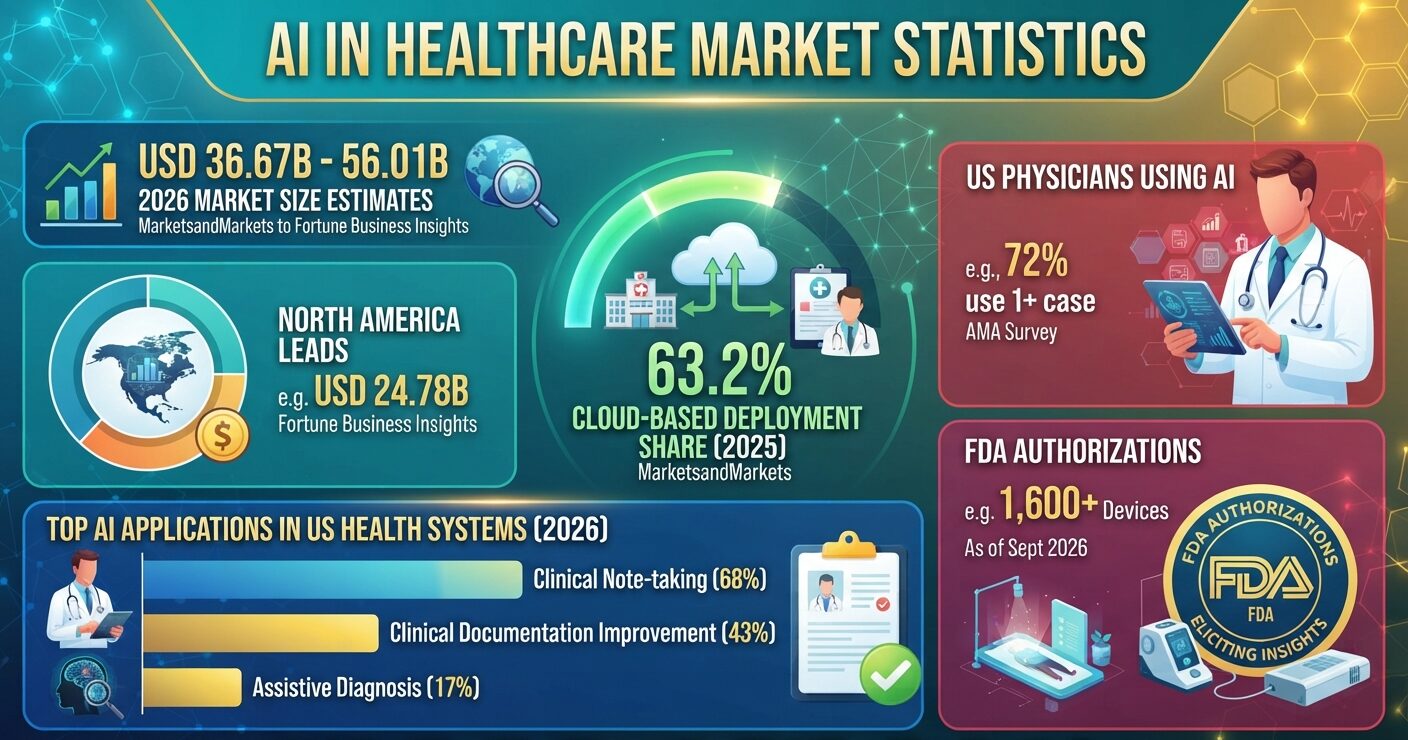
MarketsandMarkets sizes the 2026 AI in healthcare market at USD 36.67 billion. Fortune Business Insights puts the same year at USD 56.01 billion.
This page sets those revenue forecasts beside the spending and adoption data underneath them: regional totals, deployment splits, health-system purchases, hospital and physician use, venture funding, FDA authorizations and Medicare’s AI prior-authorization pilot.
AI in Healthcare Market Statistics
How Big Is the AI in Healthcare Market in 2026?
MarketsandMarkets values the market at USD 36.67 billion in 2026, up from USD 25.88 billion in 2025. Its June 2026 release projects USD 194.79 billion by 2031, a 39.7% CAGR.
Three other firms publish higher 2026 figures, each under its own scope definition.
Precedence Research estimates USD 51.20 billion for 2026, from USD 36.96 billion in 2025. It forecasts USD 744.34 billion by 2035 at a 35.02% CAGR.
Towards Healthcare puts 2026 at USD 52.28 billion, from USD 37.98 billion in 2025. Its outlook reaches USD 928.18 billion by 2035 at 37.66%.
Fortune Business Insights has the highest 2026 figure of the four: USD 56.01 billion, from USD 39.34 billion in 2025. Its forecast hits USD 1,033.27 billion by 2034 at a 43.96% CAGR.
AI in Healthcare Market Share by Region
North America leads Fortune Business Insights’ regional split at USD 24.78 billion for 2026, up from USD 17.51 billion in 2025. Europe follows at USD 15.73 billion.
| Region | 2025 value (USD billion) | 2026 projection (USD billion) |
|---|---|---|
| North America | 17.51 | 24.78 |
| Europe | 11.05 | 15.73 |
| Asia Pacific | 8.28 | 12.00 |
| Latin America | 1.6 | 2.25 |
| Middle East & Africa | 0.89 | 1.24 |
North America’s 2025 share is 44.50% in Fortune’s headline figure. MarketsandMarkets reports 42.4% for the same year.
Fortune projects the U.S. market alone at USD 22.70 billion in 2026. The U.S. also ranks first for private AI investment in Stanford HAI data summarised in this breakdown of AI investment by country.
Cloud-Based Models Held 63.2% of the Market in 2025
Cloud-based deployment held 63.2% of the AI in healthcare market in 2025, according to MarketsandMarkets. Healthcare providers were the largest end user and deep learning the largest tool segment that year.
For 2026–2031, the firm expects clinical applications to grow at a 41.4% CAGR and names AI scribes the fastest-growing function.
Fortune Business Insights segments the market differently. It assigns robot-assisted surgery 22.94% of the 2026 market by application and hospitals and clinics 42.44% by end user.
Fortune names Amazon, Microsoft, NVIDIA and Alphabet among the major players; Microsoft’s cloud and AI revenue lines are tracked in these Microsoft statistics.
Where Are US Health Systems Spending on AI?
Clinical note-taking and ambient listening lead at 68% adoption in Eliciting Insights’ February 2026 survey of US health systems. Draft replies to patient messages grew fastest, up 80% year over year.
| AI application | 2026 adoption | Year-over-year growth |
|---|---|---|
| Clinical note-taking / ambient listening | 68% | 62% |
| AI-based clinical documentation improvement | 43% | 59% |
| AI coding | 36% | 29% |
| Draft replies to patient texts | 36% | 80% |
| AI denial prediction | 25% | 4% |
| AI admin chatbots | 25% | 19% |
| AI prepopulated technical appeals | 21% | 50% |
| AI prepopulated clinical appeals | 19% | 27% |
Overall, 75% of health systems use or plan to use at least one AI application. Organizations implementing or planning three or more solutions rose 67% year over year.
Many respondents reported 2X or greater ROI. That figure is self-reported by executives.
AI in Healthcare Market Adoption Across US Hospitals
Predictive AI ran inside the EHR at 71% of non-federal acute care hospitals in 2024, up from 66% in 2023. The ASTP/ONC brief published in September 2025 is the latest release in this series.
| Hospital group | 2023 | 2024 |
|---|---|---|
| All hospitals | 66% | 71% |
| Small (under 100 beds) | 53% | 59% |
| Medium (100–399 beds) | 75% | 80% |
| Large (over 400 beds) | 90% | 96% |
| Rural | 48% | 56% |
| Urban | 77% | 81% |
| Critical access | 46% | 50% |
| Independent | 31% | 37% |
| Multi-hospital system member | 81% | 86% |
| Market-leading EHR vendor | 87% | 90% |
| All other EHR vendors | 48% | 50% |
Most models came from EHR developers. In 2024, 80% of hospitals used EHR-sourced predictive AI, 52% used third-party models and 50% built their own; hospitals could report more than one source.
Billing automation grew fastest, rising from 36% to 61% of AI-using hospitals between 2023 and 2024. Scheduling rose from 51% to 67%.
Among hospitals using predictive AI in 2024, 82% evaluated models for accuracy and 74% for bias. Post-implementation monitoring reached 79%.
How Many Physicians Use AI? AMA’s 2026 Survey
The AMA’s 2026 survey found 81% of US physicians reporting awareness or use of AI. The stricter measure, incorporating at least one named use case, stood at 72%, against 48% in 2024 and 38% in 2023.
The 81% combines 72% explicit users with 9% who were unsure which AI tools their practice offers. Physicians reporting no use fell to 19%, from 34% in 2024.
Which AI Use Cases Do Physicians Use Most?
| Use case | 2024 | 2026 |
|---|---|---|
| Summaries of medical research and standards of care | 13% | 39% |
| Discharge instructions, care plans and/or progress notes | 20% | 30% |
| Billing codes, medical charts or visit notes | 21% | 28% |
| Chart summaries | 12% | 28% |
| Draft responses to patient portal messages | 9% | 19% |
| Translation services | 14% | 18% |
| Assistive diagnosis | 12% | 17% |
Research and standards-of-care summaries rose 26 points to 39%. Assistive diagnosis reached 17%.
Sentiment also rose: 76% said AI gives an advantage in patient care, up from 69% in 2024 and 65% in 2023. Meanwhile, 88% reported some concern about skill loss.
Digital Health Venture Funding Reached $7.4 Billion in H1 2026
US digital health startups raised $7.4 billion across 244 deals in H1 2026, against $6.4 billion across 245 deals in H1 2025. Rock Health tracks all digital health, not AI companies alone.
Quarterly totals were $4.2 billion in Q1 and $3.2 billion in Q2 2026. Median deal size rose to $14 million, from $12 million in 2025.
Mega deals of $100 million or more took 45% of H1 2026 capital, up from 42% in 2025 and 22% in 2024. Nineteen companies raised those 20 rounds.
Company-level spending across the wider AI sector is covered in this analysis of AI market share by company.
What Do FDA and Medicare Data Add to the AI in Healthcare Market?
FDA AI-Enabled Device Authorizations
The FDA had authorized over 1,600 AI-enabled medical devices for US marketing as of September 2026. The agency updates its public device list periodically.
Medicare’s WISeR Prior-Authorization Model
CMS launched the WISeR model on January 1, 2026. It tests AI-assisted prior authorization for select traditional Medicare services in Arizona, New Jersey, Ohio, Oklahoma, Texas and Washington.
Targeted services accounted for 5.3% (12.3billion)oftraditionalMedicarePartBspendingin2024.Skinsubstitutesmadeup83%(10.3 billion) of that total.
About 1.1 million beneficiaries nationwide received a WISeR service in 2024; 207,500 of them were in the six model states. Vendors must get a human clinician’s second opinion before an AI-based denial.
FAQs
How big is the AI in healthcare market in 2026?
Estimates for 2026 range from USD 36.67 billion (MarketsandMarkets) to USD 56.01 billion (Fortune Business Insights). Precedence Research estimates USD 51.20 billion and Towards Healthcare USD 52.28 billion.
What is the AI in healthcare market growth rate?
Published CAGRs run from 35.02% (Precedence Research, 2026–2035) to 43.96% (Fortune Business Insights, 2026–2034). MarketsandMarkets projects 39.7% for 2026–2031, reaching USD 194.79 billion by 2031.
Which region dominates the AI in healthcare market?
North America. Fortune Business Insights projects USD 24.78 billion there in 2026 and puts its 2025 share at 44.50%. MarketsandMarkets reports a 42.4% North American share for 2025.
How many doctors use AI in 2026?
According to the AMA’s 2026 survey, 81% of US physicians reported awareness or use of AI. 72% incorporated at least one named AI use case, up from 38% in 2023.
Why do AI in healthcare market figures quoted on Reddit vary so much?
Each research firm publishes its own estimate under its own scope. For 2026, MarketsandMarkets estimates USD 36.67 billion, Precedence Research USD 51.20 billion and Fortune Business Insights USD 56.01 billion.
Citations
https://www.ama-assn.org/system/files/physician-ai-sentiment-report.pdf
https://rockhealth.com/insights/h1-2026-funding-and-market-overview-durable-roots-shifting-routes/
https://www.aboutchromebooks.com/ai-in-healthcare-adoption-statistics