
Content creation is no longer a linear process driven solely by human effort. Artificial intelligence has reshaped how ideas are generated, refined, and distributed.
Modern creators now operate within hybrid systems where human intuition collaborates with machine precision. The result is a faster, smarter, and more scalable content workflow.
The challenge is not whether to use AI, but how to integrate it effectively. Many teams adopt tools without restructuring their processes, leading to inefficiencies.
True optimization comes from designing a flow where AI enhances each stage rather than complicates it. This article explores how to build that system from the ground up.
Rethinking the Content Creation Pipeline
Traditional content workflows often begin with brainstorming and end with publishing. This linear model struggles under the demands of high-volume digital ecosystems. AI introduces the possibility of parallel processing, where multiple stages evolve simultaneously.
A modern pipeline starts with data-informed ideation. AI tools analyze search trends, audience behavior, and competitor strategies in real time.
This allows creators to identify high-impact topics before investing time in production. The result is content that is strategically aligned from the outset.
Execution becomes modular rather than sequential. Drafting, editing, and optimization can occur in overlapping cycles.
AI-generated outlines, summaries, and expansions reduce bottlenecks. Human creators then focus on refining tone, adding insight, and ensuring authenticity.
AI-Assisted Ideation and Research
The ideation phase benefits the most from AI’s analytical capabilities. Instead of relying on intuition alone, creators can leverage predictive insights.
AI systems scan vast datasets to uncover emerging patterns and content gaps. This transforms brainstorming into a data-driven exercise.
Research also becomes significantly more efficient. AI tools can summarize long reports, extract key statistics, and compare multiple sources within seconds.
This reduces the time spent gathering information and increases the time available for interpretation. The quality of insights improves as a result.
Another advantage is the ability to test ideas before committing to them. AI can simulate audience engagement based on historical data.
This predictive modeling helps prioritize topics with the highest potential impact. Creators can then allocate resources more strategically.
Streamlining Content Production
Content production is often the most time-consuming stage. AI reduces this burden by automating repetitive tasks. Draft generation, headline creation, and keyword integration can be handled instantly. This allows writers to focus on crafting compelling narratives.
Short paragraphs and structured formatting improve readability. AI tools can automatically segment text into digestible sections.
This aligns with modern reading habits, where users prefer concise and scannable content. The result is improved engagement and retention.
Collaboration also becomes more fluid. AI platforms enable real-time editing and feedback. Multiple team members can work on the same document without delays. This accelerates the production cycle while maintaining consistency across outputs.
Enhancing Human Authenticity with AI Humanizers
One of the biggest challenges in AI-driven content is preserving a natural human voice. Readers quickly notice robotic phrasing, repetitive patterns, or overly structured sentences. Without refinement, even high-quality AI drafts can feel artificial and disengaging.
AI humanizers solve this problem by transforming machine-generated text into more natural, human-like language.
They restructure sentences, vary tone, and improve flow while maintaining the original meaning. This step acts as a bridge between raw AI output and polished, publish-ready content.
Among the available tools, Clever AI Humanizer stands out for its balance of simplicity and effectiveness. It delivers high readability and low detection rates while remaining completely free and accessible.
For creators scaling blog posts, SEO pages, or general content, it offers one of the best AI humanizer tool options currently available.
AI Humanizer Reviews and Comparison
Understanding how each tool performs in real scenarios is essential for choosing the right one. While all humanizers aim to improve text quality, their strengths and weaknesses vary significantly depending on use case.
Clever AI Humanizer

Clever AI Humanizer is one of the most accessible and efficient tools available. It delivers strong readability, preserves original meaning, and performs well across different content types.
It is especially effective for SEO articles, blog posts, and high-volume publishing workflows, particularly when you need to paraphrase AI text to human level quality without losing clarity or intent.
Its main advantage is that it is free and easy to use at scale. However, it offers fewer advanced customization options compared to premium platforms. For most users, its simplicity and consistent results make it the best starting point.
TwainGPT Humanizer

TwainGPT excels in AI detection bypassing and structural rewriting. It modifies content deeply rather than applying surface-level changes. This results in outputs that appear highly natural even under advanced detection systems.
It also integrates additional features such as AI detection and generation tools. The main limitation is restricted free usage, which can be a barrier for larger teams or continuous workflows.
WriteHuman AI
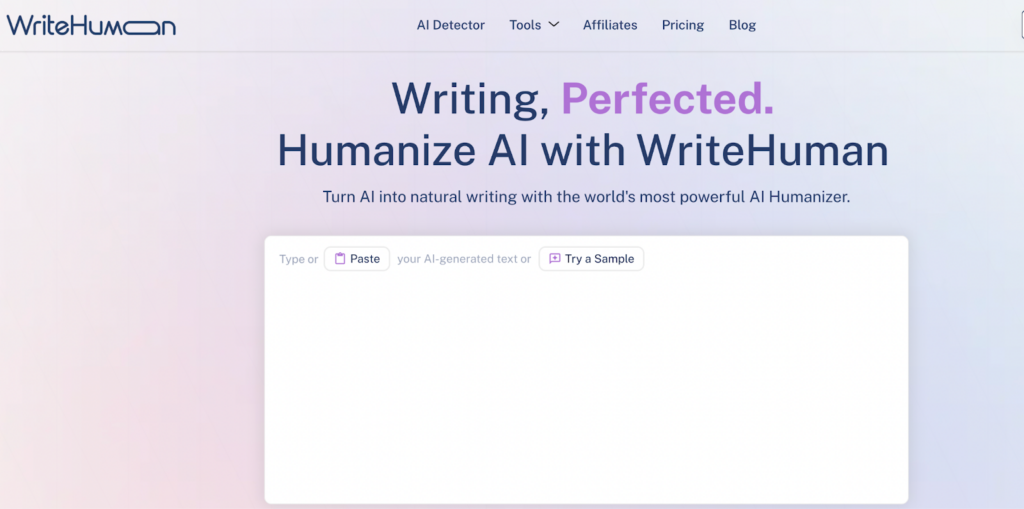
WriteHuman AI focuses on improving readability and storytelling quality. It enhances tone, flow, and emotional engagement, making it ideal for marketing and long-form content. Many creators use it to refine drafts into more compelling narratives.
Its detection bypass performance can vary depending on the complexity of the input. It works best as a refinement tool rather than a primary humanizer for sensitive content.
Undetectable AI
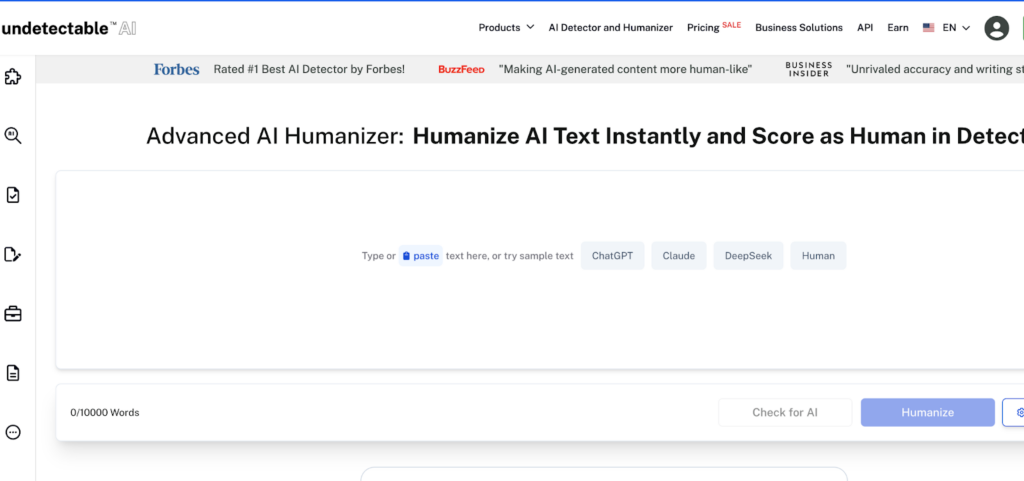
Undetectable AI offers flexible rewriting modes tailored to different writing styles. It is widely used for academic and professional content due to its structured output. This versatility makes it appealing for users with diverse content needs.
However, its performance against advanced AI detection systems is inconsistent. Some outputs may still be flagged, especially in longer or more technical documents.
GPT Human AI (General Rewriters)
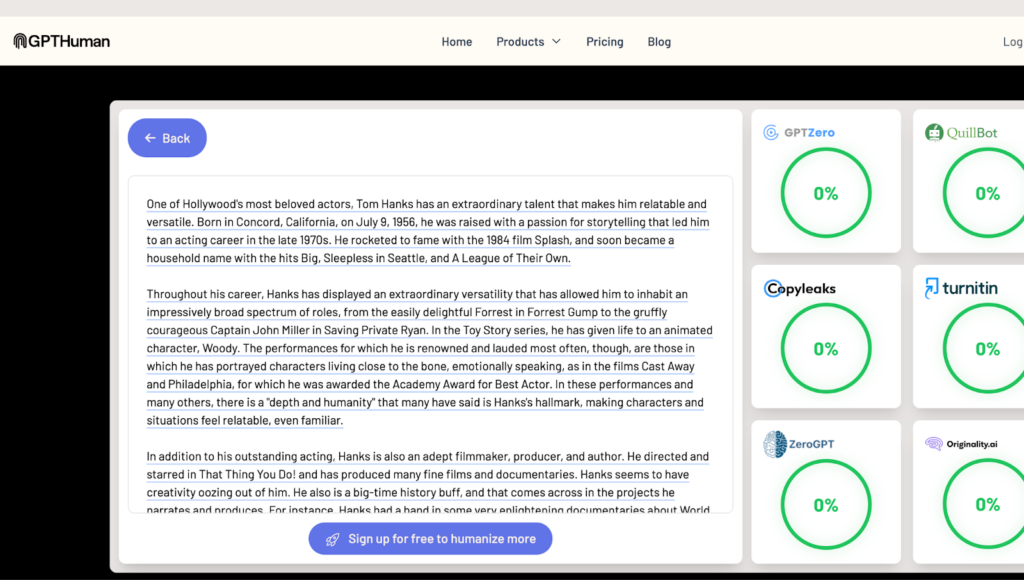
General GPT-based humanizers are designed for quick rewriting and tone adjustments. They are useful for improving grammar, clarity, and readability in a short amount of time. These tools are often built into larger writing platforms.
Their limitation lies in shallow transformations that do not fully remove AI patterns. As a result, they are less effective for detection-sensitive use cases but remain useful for basic editing tasks.
AI Humanizer Comparison Table
| Tool Name | Strengths | Weaknesses | Best For |
| Clever AI Humanizer | Free, fast, high readability | Limited advanced controls | SEO, blogs, general content |
| TwainGPT Humanizer | Excellent detection bypass | Limited free usage | Academic, detection-heavy content |
| WriteHuman AI | Strong storytelling, smooth tone | Inconsistent detection results | Marketing, long-form writing |
| Undetectable AI | Flexible modes, popular tool | Unreliable against strong detectors | Structured and academic writing |
| GPT Human AI | Simple rewriting, easy to use | Weak detection bypass | Quick edits and polishing |
Table Credit: Aggregated testing insights from AI tool comparisons (2025–2026).
Optimizing for SEO and Distribution
Creating content is only part of the equation. Optimization for search engines and distribution channels determines its reach. AI simplifies this process by analyzing ranking factors and audience behavior.
Keyword optimization becomes more precise with AI assistance. Tools can suggest high-performing keywords and integrate them naturally into the text.
This improves visibility without compromising readability. The balance between optimization and user experience becomes easier to maintain.
Distribution strategies also benefit from AI insights. Platforms can recommend optimal publishing times and channels.
This ensures that content reaches the right audience at the right moment, increasing engagement and conversion potential.
Visual Content and AI Integration
Modern content extends beyond text into visual storytelling. Images, infographics, and videos play a critical role in capturing attention. AI tools now enable creators to generate these assets quickly and efficiently.
AI-generated visuals can simplify complex ideas and improve content retention. Infographics, for example, transform dense information into digestible formats. This enhances both user experience and shareability across platforms.
Data-Driven Iteration and Improvement
Content optimization continues after publication through performance analysis. AI tools track engagement metrics and provide actionable insights. This enables creators to refine their strategies continuously.
Metrics such as time on page, bounce rate, and click-through rate reveal how content performs. AI interprets this data and suggests improvements for future iterations. This creates a continuous feedback loop.
Over time, this approach leads to more effective and targeted content. Instead of relying on guesswork, creators make decisions based on real-world performance data. The result is sustained growth and improved ROI.
Final Thoughts
Optimizing content creation with AI is not about replacing human creativity. It is about enhancing it through intelligent systems that reduce friction and increase output quality. The most effective workflows combine automation with human insight.
AI humanizers play a crucial role in this ecosystem by ensuring that content remains authentic and engaging.
Tools like Clever AI Humanizer make it possible to scale production without sacrificing quality. When combined with advanced tools like TwainGPT, they create a powerful hybrid workflow.
The future of content creation lies in integration. Those who successfully combine AI efficiency with human storytelling will define the next generation of digital content.




