
An underwriter pastes a rent roll into ChatGPT and gets back a clean table of figures. Some of them are wrong. Nothing in the output indicates which, and no number links back to the page it came from.
That’s the problem with using a general model for work that has to survive a credit committee, and it isn’t a problem better prompting solves.
The volume makes the temptation stronger. The Mortgage Bankers Association projects total commercial mortgage originations reaching $805.5 billion in 2026, a 27 percent increase over the prior year, and most CRE lending teams are absorbing that without adding headcount.
Smart Capital Center is built for the part of the workflow a general model can’t cover. For the lending teams using its loan underwriting AI agent, that means:
- Every extracted field carries a clause-level citation back to its source document.
- Financial models pull live from connected systems rather than through manual re-entry.
- DSCR, covenants, and tenant credit stay monitored after close, not just at underwriting.
This article covers what general LLMs are genuinely good at, where they break down, and how to decide which tool belongs at which stage.
What General-Purpose LLMs Actually Do Well?
Where ChatGPT and Claude Add Genuine Value?
General-purpose LLMs are exceptional at language tasks. For CRE loan teams, that translates into specific, valuable applications:
- Drafting narrative sections of credit memos from a completed financial model
- Summarizing lengthy legal documents or appraisal reports into structured overviews
- Generating first-draft investment theses from bullet-point inputs
- Researching submarket context, economic conditions, and tenant industry trends
These are real productivity gains. A senior underwriter who uses Claude to draft the qualitative sections of a credit memo while the quantitative model is being finalized saves two to three hours on a standard deal.
Where General LLMs Break Down?
Deloitte’s 2026 Commercial Real Estate Outlook found 54 percent of CRE firms cite compatibility with legacy infrastructure as the top barrier to scaling operations as deal volumes recover, and 27 percent report ongoing challenges with AI implementation.
General LLMs inherit that problem rather than solving it: a model with no connection to the systems holding the data cannot reconcile what those systems disagree about.
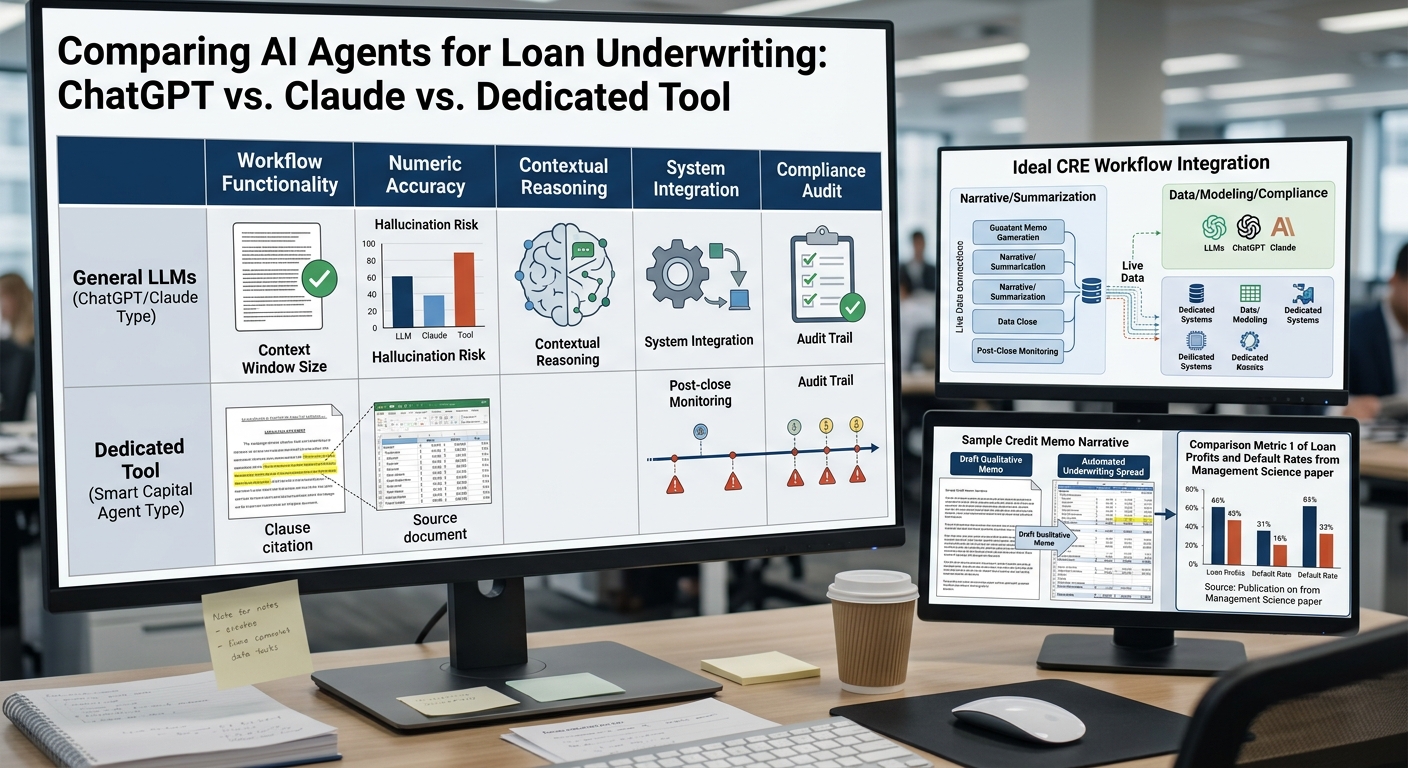
When asked to extract structured financial data from a rent roll, calculate DSCR (debt service coverage ratio, the measure of net operating income relative to debt service obligations), or identify co-tenancy provisions across a multi-amendment lease stack, general LLMs produce outputs that look authoritative but carry hallucination risk on numerical fields.
A credit decision anchored to a figure a general LLM produced without a clause-level audit trail is not defensible in a credit committee or a regulatory review.
General-Purpose LLMs vs. Purpose-Built CRE Infrastructure: Differences That Matter for CRE Lenders
| Capability | General-Purpose Frontier LLMs | Relevance to CRE Lending |
| Long-document context | Context windows are large and expanding across the frontier model market, generally sufficient to hold a full lease stack or OM package in a single pass | Matters for full lease stacks and OM packages, but context length alone doesn’t guarantee correct extraction |
| Numerical extraction accuracy | Moderate, with hallucination risk on financial figures pulled from dense documents | Requires human validation on financial fields regardless of which model is used |
| Audit trail | None natively; any citation or sourcing layer has to be built on top | Neither meets institutional compliance standards out of the box |
| CRE-specific training | General-purpose, not trained on CRE covenant structures, lease taxonomy, or underwriting conventions | Neither understands CRE-specific structures natively |
| Workflow integration | API-based; requires custom development to connect to loan systems | Neither integrates with Yardi or SS&C natively |
| Credit memo drafting | Strong for qualitative writing and summarization | Useful for qualitative memo sections, still requires review |
The honest conclusion is that no general-purpose frontier model is a loan underwriting AI agent. These are writing and reasoning tools that support specific parts of the underwriting workflow when used with appropriate validation. None of them replace purpose-built infrastructure on document processing, financial modeling, and compliance.
What a Purpose-Built Loan Underwriting AI Agent Does Differently?
Document Processing With Auditable Outputs
A purpose-built automated loan underwriting platform reads offering memorandums, rent rolls, T-12 statements, appraisals, and lease abstracts as integrated documents, extracting structured data with clause-level citations that trace every field back to its source. That audit trail is the difference between a model output that can be defended in credit committee and one that cannot.
A randomized experiment in auto lending, published as “Rise of the Machines: The Impact of Automated Underwriting” in Management Science in 2024, found algorithmic underwriting produced 10.2 percent higher loan profits and 6.8 percent lower default rates than human underwriting, with the gap widening on riskier and more complex loans.
Commercial real estate underwriting is more document-heavy and less standardized than auto lending, so the magnitudes don’t transfer directly, but the mechanism does: machine performance held stable across risk dimensions where human performance degraded.
Workflow Integration That General LLMs Cannot Replicate
Purpose-built platforms connect to existing property management and accounting systems, pulling live data into financial models rather than requiring manual re-entry.
They maintain continuous post-close monitoring of DSCR, covenant compliance, and tenant credit health, generating alerts when thresholds are crossed rather than waiting for quarterly reviews.
Laura Krashakova, CEO of Smart Capital Center, speaking on AI-powered methods in commercial real estate loan underwriting, stated: “Commercial real estate is one of the most data-intensive sectors of the global financial system.
Our goal is to help institutions transform fragmented information into actionable intelligence so they can make faster and more confident investment decisions.”
How to Decide Which Tool Belongs Where in Your Workflow?
- Map your current underwriting workflow by stage, distinguishing between narrative tasks, document extraction tasks, financial modeling tasks, and monitoring tasks.
- Identify which stages involve structured numerical data that must be auditable. These require purpose-built extraction.
- Identify which stages are primarily narrative, including credit memo qualitative sections and market context summaries. These are where general LLMs add genuine value.
- Confirm system integration before committing to any platform. A tool requiring manual re-entry defeats its own purpose regardless of model capability.
- Verify the audit trail capability before relying on any AI output for a credit decision. If the tool cannot cite the specific clause behind every extracted figure, it does not meet institutional underwriting standards.
- Test against your actual loan documents, including complex rent rolls, multi-amendment leases, and non-standard financial statement layouts.
When the Tool Category Determines the Outcome?
The most consequential error CRE lenders make with AI adoption is deploying general-purpose tools in workflows that require purpose-built infrastructure, then attributing the resulting accuracy problems to AI broadly. McKinsey estimates that generative AI could unlock $110 billion to $180 billion in value across real estate.
Capturing that value in loan underwriting requires deploying the right category of AI at each stage: general LLMs where language tasks dominate, and purpose-built agents where document integrity, financial accuracy, and compliance audit trails are non-negotiable.
The distinction is which tool is built for the specific operational and compliance requirements of institutional loan underwriting.
FAQs
Q: Can I use ChatGPT or Claude to underwrite commercial real estate loans?
General LLMs can support specific parts of the underwriting workflow, particularly narrative drafting and document summarization. They are not reliable for structured numerical extraction from rent rolls and financial statements, where hallucination risk makes the output unsuitable for credit decisions without independent verification.
Q: What makes a purpose-built loan underwriting AI agent different from a general LLM?
Purpose-built platforms are trained on CRE-specific document types, integrate with existing property management and accounting systems, produce clause-level citations for every extracted field, and maintain continuous post-close monitoring. General LLMs do none of these by default.
Q: How does automated loan underwriting improve credit decision quality?
A randomized experiment in auto lending, published as “Rise of the Machines: The Impact of Automated Underwriting” in Management Science in 2024, found algorithmic underwriting produced 10.2 percent higher loan profits and 6.8 percent lower default rates than human underwriting, with the gap widening on riskier and more complex loans. Commercial real estate underwriting is more document-heavy and less standardized than auto lending, so the magnitudes don’t transfer directly, but the mechanism does: machine performance held stable across risk dimensions where human performance degraded.
Q: What underwriting tasks are general LLMs genuinely useful for?
Drafting narrative sections of credit memos, summarizing appraisals and legal documents, generating first drafts of investment theses, and researching submarket context are all tasks where ChatGPT and Claude produce genuinely useful outputs that save meaningful analyst time without creating audit risk.
Q: How do I evaluate whether an AI underwriting tool meets institutional compliance standards?
Ask the vendor to demonstrate the audit trail generated for each extracted field, test the tool against your own loan documents rather than vendor-selected samples, verify system integrations in writing, and confirm SOC 2 Type II compliance before uploading any sensitive transaction data.




