A crypto exchange rate API gives you two ways to price a swap. A fixed rate locks the amount the user will receive at the moment the order is made.
A floating rate leaves that amount free to move with the market until the deposit arrives. Which one you show depends mostly on the user’s situation, and only a little on the API.
Both modes usually come from the same connection. A well-built crypto exchange and swap API gives you a quote and creates the order, then reports status as the swap settles, with the rate type chosen on each request. Since the choice sits with you, it pays to settle it before launch.
Start with what the user is doing
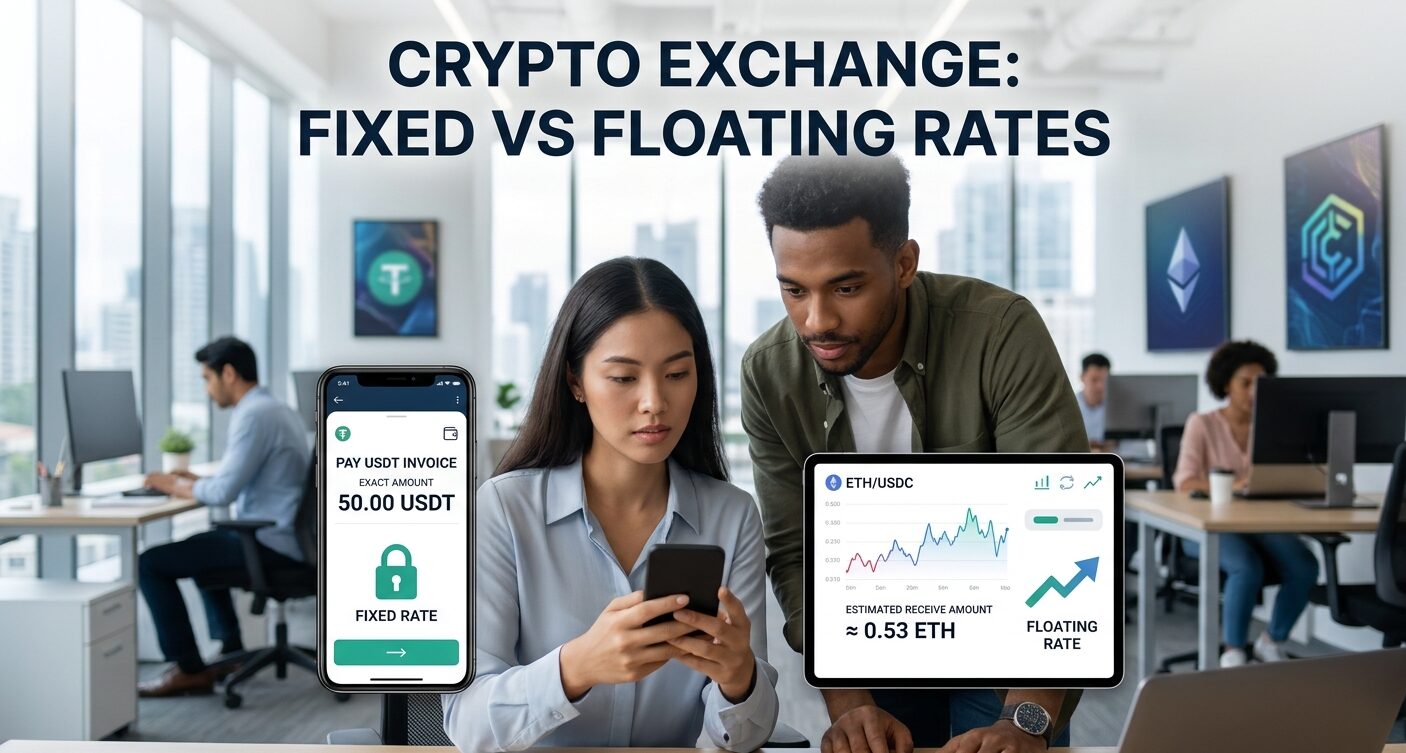
Picture two people on your site. One is paying an invoice for exactly 50 USDT and needs that figure to hold. The other is moving some ETH into a stablecoin to sit on for a while, and cares more about a good rate than an exact one.
Hand both the same rate type and one of them leaves unhappy. So the fixed-or-floating question is really a question about them, and only after that about the market.
Which case shows up more depends on your product. A checkout or payments flow runs on exact amounts, so fixed makes sense as the default.
A wallet or a portfolio app is mostly people moving around what they already own, and floating suits that better. Work out which of the two describes your traffic, and most of the choice is already made.
How a floating rate behaves?
A floating rate is the market rate at the moment the swap completes. The figure can shift a bit between the quote and the deposit confirming on chain. On a calm pair the drift is tiny, meanwhile on a volatile one, or over a slow network, it can be big enough to notice.
A floating rate leaves out the small cushion that funds a guarantee, the user often ends up slightly better off. When there is no deadline on the conversion, that is the better deal for them.
A quote you pull is only good for a short time, often a minute or two. Refresh it while the user lingers on the screen, so the number they confirm is close to the number they get once settlement drift is counted. An estimate that updates only on page load is a quiet way to annoy anyone who paused to think.
How a fixed rate behaves?
A fixed rate holds the receive amount from the instant the order is created. Whatever the market does over the next few minutes, the user gets the number they agreed to. The provider carries that short-term risk and charges a small amount for taking it on.
This is the mode you want behind anything with an exact price. A checkout that reads 50 USDT, or a payout a user is counting on to the cent. The guarantee is worth more to them than the few basis points it costs.
A fixed rate also comes with a clock. The lock runs for a set window, enough time to send a deposit at an unhurried pace, and the price resets once it passes. Give the user a sense of that window, so a deposit sent promptly arrives while the lock still stands.
A quick side-by-side comparison table
| Criteria | Fixed rate | Floating rate |
| What the user gets | The exact amount shown | The market amount at settlement |
| Who carries the market risk | The provider | The user |
| Cost | A small premium | Usually cheaper |
| Best for | Set prices and payouts | Converting a balance with no deadline |
Match the mode to the moment
The clean rule is to match the rate type to the promise your screen is making. When the screen shows an exact figure the user is acting on, reach for fixed.
When the screen is really just moving value and the user wants the best rate going, floating fits better. The rate setting is a small detail next to the way quick swaps are reaching more users around the world, and most teams settle it early with the rest of the integration.
One detail trips people up as on many partner accounts the fixed-rate flow starts disabled, and a quick request turns it on. If your product depends on exact amounts, sort that out with the provider up front, well before the build is underway.

The cost difference, and who notices it
A fixed rate carries a small premium, often a fraction of a percent, and it does show up. Put the same pair on a fixed screen and a floating screen, and a user will spot the difference.
That stays fine while each screen says plainly what it is. The harm comes when a floating quote looks like a promise, and the payout lands under the figure the user had in mind.
Settling on one default and holding to it also helps, so a repeat user finds the same behavior they saw last time. When the mode changes from one screen to the next with nothing on screen to explain it, it reads as a glitch even when every quote is right.
Let users choose, or choose for them
Two ways to handle it. You can show both and let the user pick, with a plain label beside each, such as “locked amount” against “market rate, may vary”. Or you can hide the choice and set the right mode yourself based on the screen they are on.
The second option suits most products, since hardly anyone wants a lesson in rate mechanics halfway through a swap. Whichever you choose, the confirmation screen ought to state the mode in plain, quick-to-read words.
Test both before you ship
Before launch, push a live swap through each mode, and deliberately send one fixed-rate deposit just after the lock expires. Most of the puzzled support messages trace back to that one path. Watching it play out on your own screen shows you the wording the user needs, and whether a late deposit should re-price or refund on your product.
A standard floating swap and a fixed one behave differently enough that one clean test of each, run end to end, saves you a week of guessing after launch.
Conclusion
Fixed or floating is one small setting in a crypto exchange rate API, and a surprising amount of how a swap feels rides on it. Line it up with the moment and users hardly notice the rate, which is the aim. Get it backwards and every mismatched payout becomes a support message.
So choose per screen, and say the mode plainly where the user confirms. Switch the fixed flow on with your provider ahead of the day it matters. Both modes exist for a reason, and the products that handle rates well are the ones that are decided with intent.
Disclaimer: This article is informational and does not constitute investment, financial, legal or tax advice.