Cities spent forty years designing pedestrians out of themselves, then started paying consultants to design them back in.
Supermarkets optimised produce for shelf life until “farm-fresh” became a price premium. Technologies overshoot, and then somebody sells the thing that was removed.
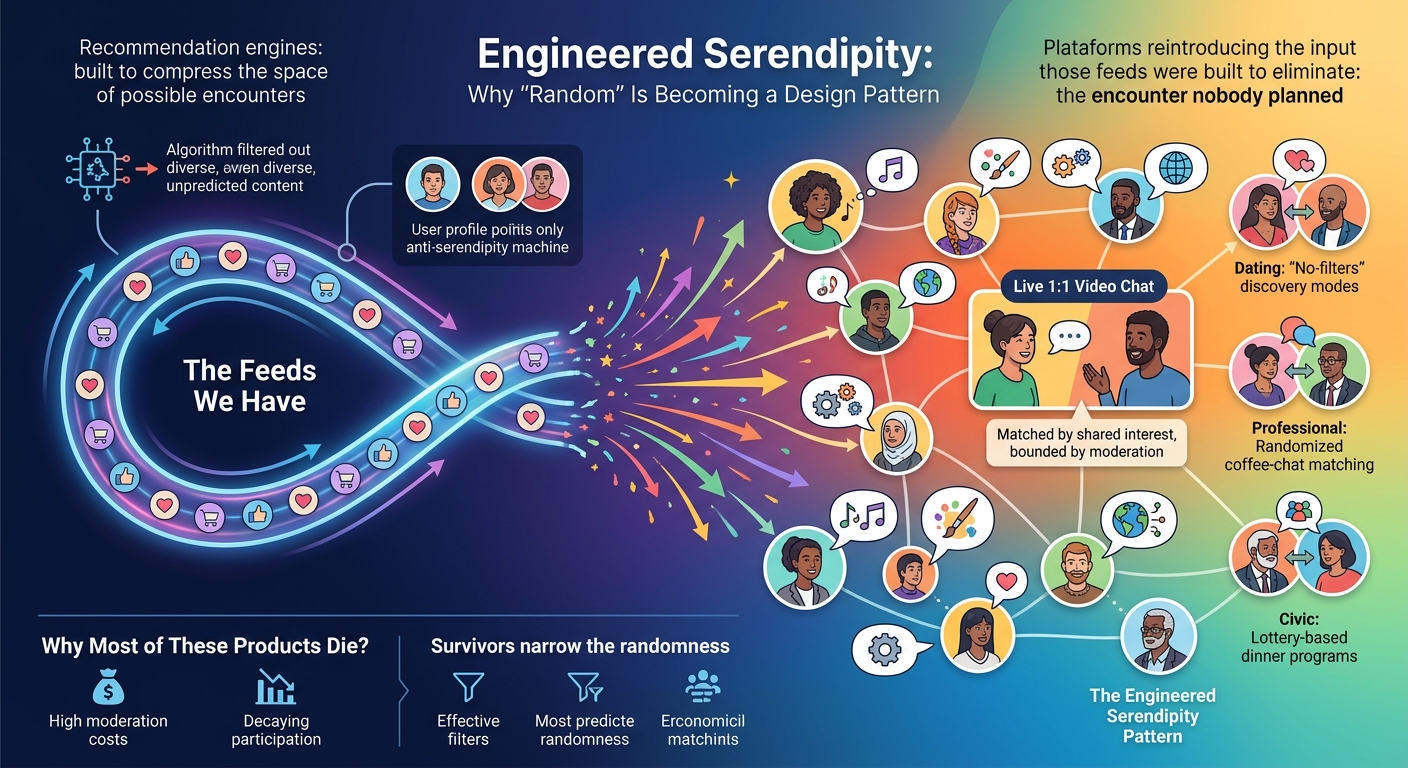
The internet’s version of that correction is arriving now. After two decades of feeds tuned to show you more of whatever you already clicked, a small wave of products has started deliberately reintroducing the input those feeds were built to eliminate: the encounter nobody planned.
The Serendipity Deficit
Recommendation engines are anti-serendipity machines. That isn’t a criticism, it is their job description — compress the space of possible encounters down to the subset most likely to keep you here, which happens to be the subset least likely to startle you.
Hence the odd condition of modern digital life. Four billion people are reachable. You will speak to roughly the same forty.
There’s a measurable cost attached. Research published in the Journal of Happiness Studies, tracking hundreds of commuters, found that minimal social interactions with strangers — brief, low-stakes, entirely unplanned — predicted higher wellbeing and life satisfaction. The encounters an optimised internet engineers out are, awkwardly, the ones the evidence says do us good.
The deficit also compounds, which is easy to miss. Each round of narrowing trains the next on a thinner sample of you, so the loop tightens without anyone touching it.
Ask someone who has tried to break a feed’s model of their own taste. It takes weeks of deliberately weird behaviour, and the feed usually outlasts the effort.
Randomness Gets Rehabilitated
Which brings us to an old format’s second life. Platforms built around random video chat — live conversation, face to face, with somebody outside your social graph — are selling engineered serendipity: the interesting stranger on a train, rebuilt with moderation tooling and matching by shared interest.
The 2010s version was chaos with a webcam attached. What exists now behaves more like a bounded engine, with enough unpredictability to produce surprise and enough filtering that the surprise stays pleasant. The difference between those two generations is the entire product.
What matters for anyone tracking the trend isn’t the platforms. It’s the same bet turning up in one vertical after another:
| Vertical | The serendipity product |
|---|---|
| Social | Live 1:1 video with someone outside your graph |
| Dating | “No-filters” discovery modes |
| Professional | Randomized coffee-chat matching |
| Civic | Lottery-based dinner programs in cities and universities |
Each is wagering that the next scarce resource of digital life is the encounter you didn’t choose. How much randomness each market will swallow varies enormously — consumer social takes a great deal of it, professional networking almost none, which explains why the corporate versions arrive wrapped in agendas, timers and a suggested opening question.
Why Most of These Products Die?
There’s a graveyard behind this pattern, and it teaches more than the survivors do. Chatroulette hit tens of millions of users within months and then buckled under moderation costs nobody had priced.
Every “meet a random colleague” widget ever bolted onto a workplace chat tool has expired from the same condition: participation decays the moment novelty does. Unbounded randomness produces mostly duds, and three duds in a row is where people quit.
Survivors narrow the randomness. Matching on language, interest or intent holds the surprise inside a band where it stays enjoyable — a well-programmed festival lineup rather than a lottery ticket. Serendipity only works as a product after somebody has quietly put edges on it.
The 2030 Scenario
Project the curve forward, the sort of exercise run regularly in Quantumrun’s featured foresight briefs, and 2030 looks something like this.
Personalization becomes complete enough that unpredictability turns into a paid tier. A “surprise me” dial ships buried in settings, then gets promoted to the home screen the quarter someone notices what it does to retention.
Serendipity budgets appear inside corporate learning programmes, pairing employees with colleagues three departments away for no stated business reason at all. And “talk to someone outside your bubble” finishes its migration from op-ed advice into product category.
Three things will show whether that curve holds. Whether a major feed ships an unpredictability control and still has it a year later. Whether moderation cost per conversation falls fast enough for interest-matched video to outgrow its current niche.
And whether serendipity spending shows up as a budget line in enterprise learning — the moment an idea stops being consumer novelty and starts being procurement.
Underneath all of it sits something slightly funny. Software spent twenty years promising to remove friction, chance and strangers from ordinary life, and the market has now begun charging for all three. The feed always knew what you wanted.
It was never able to deliver the conversation you didn’t see coming, with the one person your graph would never have put in front of you.