
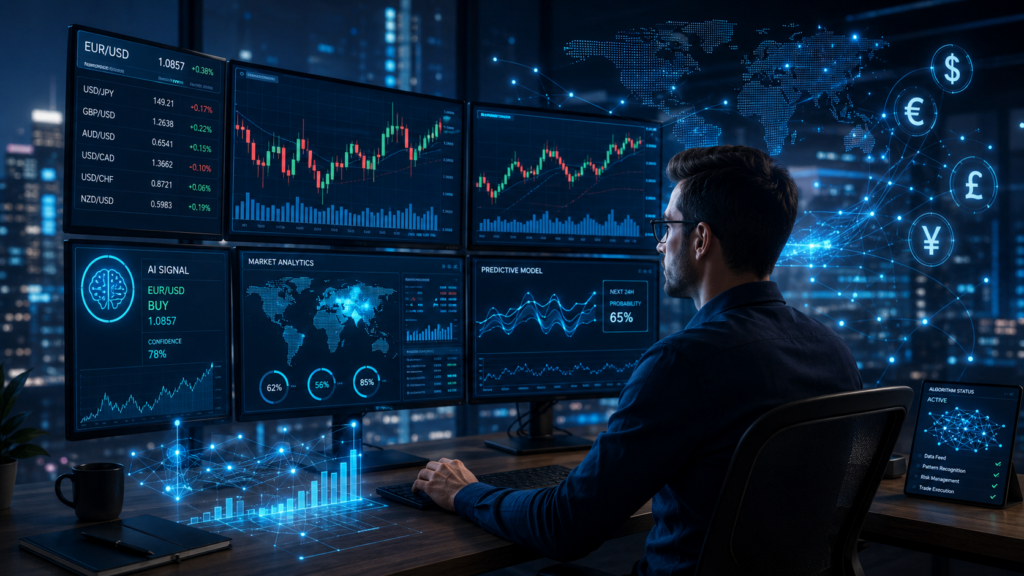
The Machines Are Already Trading – So What’s Left for Humans?
Quick answer: plenty, just not what you’d expect. Algorithmic trading now drives the bulk of activity in global currency markets, and retail traders aren’t far behind anymore.
Daily turnover in forex reached $9.6 trillion in April 2025, up 28% from 2022, according to the Bank for International Settlements’ 2025 Triennial Survey.
What used to demand a trading floor, three monitors, and a Bloomberg subscription now runs off a laptop and a cloud API key. Nobody flipped a switch to make this happen. It crept in, one automated strategy at a time, until suddenly it was just… normal.
From Squinting at Charts to Writing Code
Remember when “technical analysis” meant staring at candlesticks until your eyes went blurry? That’s still a thing, sure – but increasingly, the real work is training a model to spot those same patterns in a fraction of a second, no caffeine required. Machine learning trading strategies chew through years of price history, macro data releases, and even Twitter sentiment almost instantly, catching setups a human might notice once a week if they’re paying close attention.
A few things pushed this along:
- Compute got cheap. Backtesting and model training used to be a hedge-fund luxury. Now it’s a Tuesday-afternoon project for anyone with a laptop.
- Brokers built it in. Plenty of platforms now bake algorithmic execution directly into retail accounts – no separate institutional tier required.
- Data stopped being scarce. Real-time economic calendars, order-flow proxies, sentiment feeds – all of it is a few API calls away, when it used to sit locked behind institutional contracts.
- Dedicated hosting became accessible. Running AI strategies around the clock requires infrastructure that stays online without interruption. Utilizing a high-performance trading VPS allows retail traders to co-locate their platforms near major financial hubs, eliminating latency and execution slippage.
This is roughly the point where broker choice starts to matter more than people assume. Someone tinkering with automated strategies needs infrastructure that won’t choke under speed demands – which is a big part of why more retail traders are gravitating toward a forex broker built for algorithmic execution and API access, rather than a bare-bones buy-sell screen from a decade ago.
A Few Signals Worth Paying Attention To
None of this is subtle, honestly. Here’s where AI in forex trading has already landed:
- Sentiment-driven execution. Some platforms scrape news and social chatter in real time, adjusting position sizing before a headline even finishes trending on mainstream outlets.
- Adaptive risk models. Forget fixed stop-losses – newer systems recalculate volatility exposure on the fly, tightening or loosening as conditions shift underneath the trade.
- Copy-trading, but smarter. Instead of just chasing the highest returns, AI-driven ranking systems cluster traders by statistical consistency and route capital accordingly – kind of like a credit score, but for trading skill.
You don’t need a finance degree to use any of this – that’s sort of the whole point. Automated currency trading has been repackaged into something a motivated beginner can pick up over a weekend, which goes a long way toward explaining why retail participation keeps climbing even as the underlying market gets more complicated, not less.
As one fintech researcher tracking the shift put it: the real story isn’t that AI trades currencies now. It’s that AI quietly became the interface – the thing standing between everyday traders and a market that, until recently, belonged almost entirely to institutions.
Why This One Might Outlast the Hype
Tempting to lump “AI trading” in with every other buzzword that peaked and fizzled. But the economics point the other way here. Algorithmic trading platforms push the cost of running a trading operation down toward zero – which means the tech doesn’t need to be flawless. It just needs to beat a human doing the same job by hand. That bar cleared itself a while ago.
There’s a regulatory angle too, worth a mention. In February 2026, the European Securities and Markets Authority issued a Supervisory Briefing on algorithmic trading that tightens pre-trade control and disclosure expectations under MiFID II, including guidance on AI use in algo workflows. Brokers offering transparent, compliant AI trading tools are likely to pull ahead of the ones still running manual dealing desks behind the scenes.
Quantumrun’s own research into AI adoption across financial services traces a similar arc – automation isn’t wiping out entire job functions overnight, but it is steadily eating into the repetitive, rules-based layers of decision-making. Currency execution happens to be a pretty clean example of exactly that.
Final Thoughts
The future of forex trading looks less like a trading floor these days, and more like a control room – people setting the strategy, machines carrying it out. That doesn’t make judgment obsolete. It just moves it somewhere else. Traders who used to burn hours scanning charts are spending that time designing rules instead, auditing how a model behaves, and – maybe most importantly – figuring out when not to let the algorithm run unsupervised.
If there’s a takeaway here, it’s a simple one: the tools available to retail forex traders are converging fast with what institutions have used for over a decade now. Currency market automation isn’t some far-off forecast anymore – it’s just how 2026 works. And the traders paying attention to that shift now are the ones least likely to get caught off guard by whatever’s coming next.




