Enterprise security has crossed a quiet threshold. Five years ago, facial identification software sat at the edge of corporate defense strategy, useful for unlocking a phone or speeding up an airport queue. In 2026, it sits at the center.
Roughly 176 million Americans now interact with facial recognition technology in daily life, and the global market is on track to reach 20.68 billion dollars by 2031, expanding at a compound annual growth rate near 15.6 percent.

Enterprises, no longer satisfied with reactive monitoring, are deploying a face recognition platform across access control, workforce verification, fraud prevention, and physical site security.
The shift is structural, and it is reshaping how security leaders think about risk, identity, and operational continuity.
The driver is not a novelty. It is a measurable performance. Modern facial recognition algorithms now exceed 99.5 percent accuracy under controlled conditions, with processing latency under 120 milliseconds per transaction, a 35 percent improvement over 2022 benchmarks.
Liveness detection has neutralized most presentation attacks. Multimodal systems, which combine face with iris, voice, or fingerprint, now account for roughly a quarter of new biometric installations.
For a CISO weighing the cost of a stolen credential against the cost of a misidentified employee, the math has changed.
A fundamental architectural shift is also pulling forward enterprise adoption. Roughly 39 percent of new deployments now run inference on-device, at the edge, rather than transmitting biometric data to cloud servers.
This change addresses two concerns at once: latency, which matters in real-time access scenarios, and data sovereignty, which matters in regulated environments.
American vendors such as ROC AI have built their roadmaps around this reality, offering on-premises and edge-first deployments designed for federal agencies, defense contractors, and critical infrastructure operators that cannot afford to route facial data through third-party clouds.
The result is a vendor landscape that increasingly bifurcates between consumer-scale cloud platforms and enterprise-grade systems built for sovereign, mission-critical use.
From Perimeter Defense to Identity-Centric Security
Traditional enterprise security models were built around perimeters. Firewalls, badge readers, and gated lobbies defined who belonged inside and who did not.
That model is breaking down. Hybrid work, multi-site operations, and distributed supply chains have erased the perimeter, and badge cloning, credential phishing, and tailgating have eroded what little remained. Enterprise face recognition replaces the perimeter with the person.
The credential is the face itself, captured once at enrollment and matched against a template each time access is requested. There is nothing to steal, lose, or share.
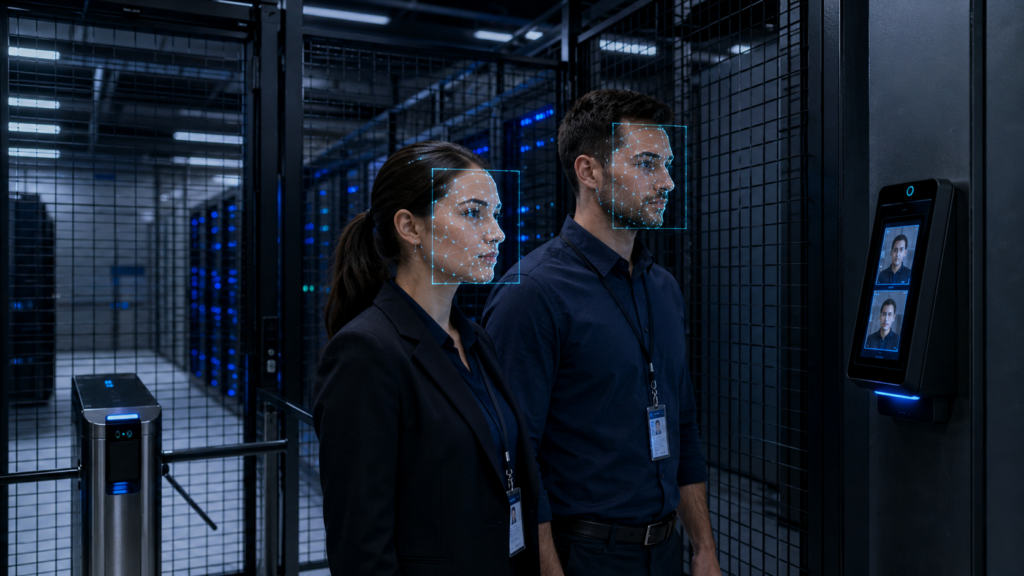
The operational implications run deep. A manufacturing site can grant a contractor access for a defined eight-hour window without issuing a physical badge. A data center can enforce the two-person rule entry by requiring simultaneous facial matches at the server cage.
A financial trading floor can flag any individual who is not on the morning roster within seconds of entry. These are not theoretical workflows.
They are in production today at Fortune 500 firms and government facilities, and they are quietly replacing decades of legacy access control infrastructure.
Where Facial Recognition Programs Deliver Measurable Value?
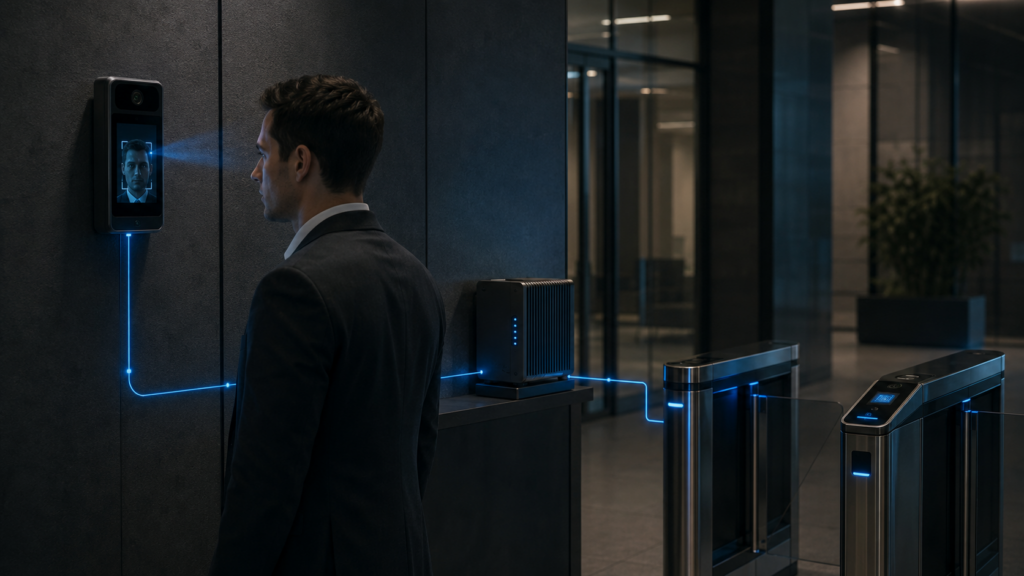
Four enterprise use cases now drive the bulk of new deployments. The first is workforce access and time tracking. Replacing PIN pads and proximity cards with facial verification eliminates buddy-punching, reduces administrative overhead, and produces a tamper-resistant audit trail.
The second is visitor management. Pre-enrollment via mobile capture lets enterprises clear expected visitors at the door in under two seconds, with automatic watchlist screening against known threats and former disgruntled employees.
The third use case is fraud prevention in customer-facing workflows. Banks, fintechs, and telecom carriers now use facial recognition for remote account opening, high-value transaction confirmation, and step-up authentication during suspicious sessions.
Industry estimates indicate that facial recognition technology now underpins identity proofing for a substantial share of the digital onboarding ecosystem in the United States. The fourth is incident response.
When a security event occurs, facial recognition platforms allow investigators to search hours of recorded video for a specific individual in minutes rather than days, compressing forensic timelines that previously consumed full investigative teams.
Bias, Governance, and the Standards That Matter
No serious conversation about enterprise facial recognition can skip the question of bias. Earlier generation algorithms showed measurable disparity in accuracy across demographic groups, and that history continues to shape policy debates in 2026.
The technical answer has improved substantially. Diverse training data, fairness-aware architectures, and rigorous third-party evaluation have pushed leading algorithms to near-equal performance across racial and gender cohorts.
The independent benchmark that matters is the National Institute of Standards and Technology Face Recognition Technology Evaluation, which publishes ongoing accuracy and demographic differential results for every submitted algorithm. Enterprise buyers in 2026 routinely require NIST participation as a procurement prerequisite.
Governance has matured alongside technology. Responsible enterprise programs now include written use policies, documented retention schedules, employee notice and consent processes, and audit logging that captures every match query and its outcome.
Roughly 44 percent of employees in a recent survey said they did not know whether their employer used biometric surveillance, a transparency gap that regulators in several U.S. states have begun to address through biometric privacy statutes.
Mature enterprises now treat governance as a feature of the deployment, not an afterthought, and they choose vendors who design with ethical AI principles built into the product rather than bolted on after the fact.
Buying Criteria for 2026
Security leaders evaluating a facial recognition program in 2026 should weigh five practical criteria. First, independent accuracy validation. NIST evaluation results, with attention to both overall accuracy and demographic differentials, are the only credible benchmark.
Marketing claims without third-party data should be discounted. Second, deployment flexibility. The right vendor supports edge, on-premises, and cloud deployment without forcing an architectural choice that conflicts with the organization’s data governance posture.
Third, integration depth. The platform must connect cleanly to existing video management systems, access control panels, identity providers, and SIEM tools, ideally through documented APIs rather than custom engineering work.
Fourth, liveness and anti-spoofing capability. Presentation attack detection is no longer optional. Enterprise deployments need active and passive liveness layers tested against printed images, video replay, 3D masks, and increasingly, synthetic media generated by adversarial models. Fifth, sovereignty and supply chain provenance.
For federal, defense, and critical infrastructure buyers, the question of where the algorithm was developed, where the training data originated, and whether the vendor is subject to foreign jurisdiction has become a hard requirement rather than a preference.
American-made platforms with documented supply chains have moved from a nice-to-have to a procurement gate.
What Comes Next?
The next phase of enterprise facial recognition will be defined less by raw accuracy gains and more by integration intelligence. Expect tighter convergence between facial recognition, behavioral biometrics, and continuous authentication.
Expect deeper integration with physical security operations centers, where face, vehicle, weapon, and anomaly detection signals fuse into a single operational picture.
Expect more aggressive regulatory frameworks, both at the U.S. state level and in international markets, that reward vendors with auditable governance and penalize those without it.
The enterprises moving fastest are the ones that stopped treating facial recognition as a point solution and started treating it as a horizontal capability that touches HR, IT, physical security, fraud, and compliance simultaneously.
The technology has crossed the line from emerging to operational. The remaining question for most security leaders is no longer whether to deploy a facial recognition program, but how to deploy one that holds up to scrutiny five years from now.
As the market consolidates around vendors that combine NIST-validated accuracy with sovereign deployment models, names like Rank One Computing have become reference points for enterprises that need biometric performance without compromising on provenance or governance.