
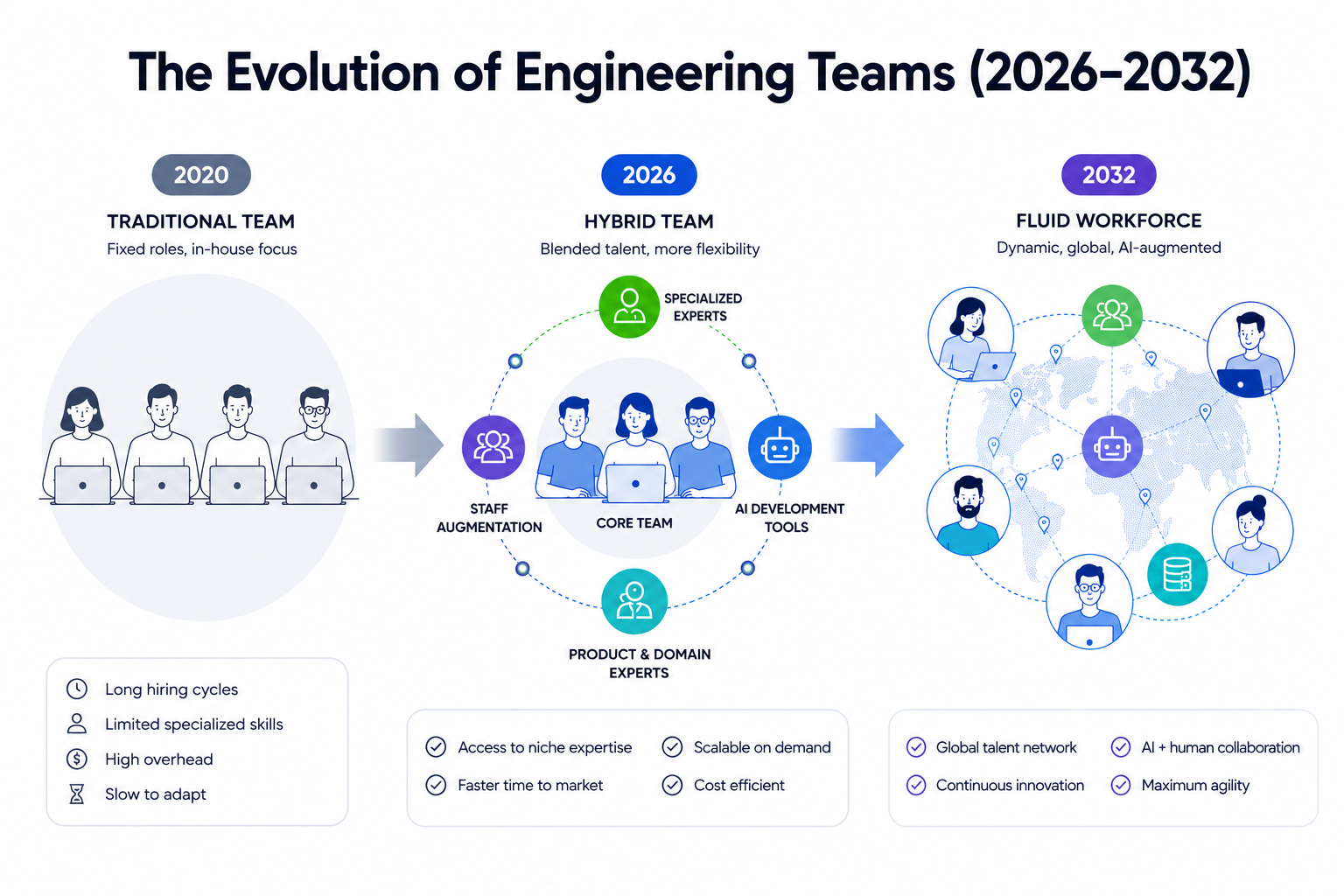
For years, technology companies followed a familiar model: hire full-time engineers, grow teams gradually, and build products in-house.
While this approach still has its place, it is becoming harder to sustain in industries where technology evolves faster than traditional hiring.
AI, digital health, robotics, fintech, and cybersecurity projects often require highly specialized expertise for specific stages of development rather than permanent roles.
This is driving the rise of the fluid workforce, where organizations combine core engineering teams with external specialists, distributed partners, and AI-powered development tools.
For companies considering IT staff augmentation services, this is becoming a strategic way to stay competitive without expanding headcount unnecessarily.
Why Traditional Hiring Is Changing?
Building an experienced engineering team has never been easy, but today’s challenge is speed. New technologies, regulations, and customer expectations appear faster than recruitment cycles can keep up.
A healthcare platform may suddenly require FHIR integration expertise. A fintech product might need additional security specialists before an audit. An AI startup may only need machine learning engineers during a critical development phase.
Instead of hiring permanent employees for every niche skill, companies are adopting more flexible talent models that allow them to access expertise exactly when it is needed.
The Rise of the Fluid Workforce
Modern engineering organizations are becoming less about fixed structures and more about assembling the right expertise for each project.
A typical deep-tech team may include:
- Core product engineers
- Domain specialists
- Staff augmentation partners
- Product managers and designers
- AI-assisted development tools
This model keeps product ownership and business knowledge within the company while allowing specialized experts to contribute where they create the most value. The result is greater flexibility, faster delivery, and more efficient use of resources.
AI Is Reshaping Team Structures
Artificial intelligence is changing software development far beyond code generation.
Engineering teams now use AI to accelerate prototyping, automate testing, review code, generate documentation, and reduce repetitive work. Rather than replacing developers, AI allows experienced engineers to focus on architecture, product decisions, and complex problem-solving.
As AI capabilities continue to mature, successful organizations will build workflows where people and intelligent tools complement each other’s strengths.
Building Teams for the Next Decade
Between now and 2032, competitive advantage will depend not only on technology but also on how quickly companies can assemble the right expertise.
For organizations exploring IT staff augmentation services, the goal is no longer filling temporary resource gaps.
It is building an adaptable engineering model that combines permanent employees, external specialists, and AI-enabled development into one collaborative team.
Conclusion
The future of software development belongs to organizations that can adapt as quickly as technology evolves.
The fluid workforce replaces rigid hiring models with flexible collaboration, giving companies access to specialized expertise exactly when it is needed.
Businesses that embrace this approach will be better positioned to innovate faster, scale efficiently, and build complex digital products without sacrificing quality or long-term product ownership.




