Digital entertainment rarely runs on a single technology. A streaming service combines content delivery networks, recommendation engines and payment systems, while a mobile game mixes graphics engines with server-side logic.
Online casino games are an unusually clear example of this layering, because each format on the screen depends on a very different technical foundation.
A slot game is pure software: an algorithm decides the result, and the animation simply displays it. A live roulette table, by contrast, is a real wheel in a studio, filmed by cameras and delivered to a phone in a fraction of a second. Both appear side by side in the same app, yet one is a mathematics problem and the other is a broadcasting problem.
Looking at how these systems work, and how they are checked, says a lot about where digital entertainment as a whole is heading.
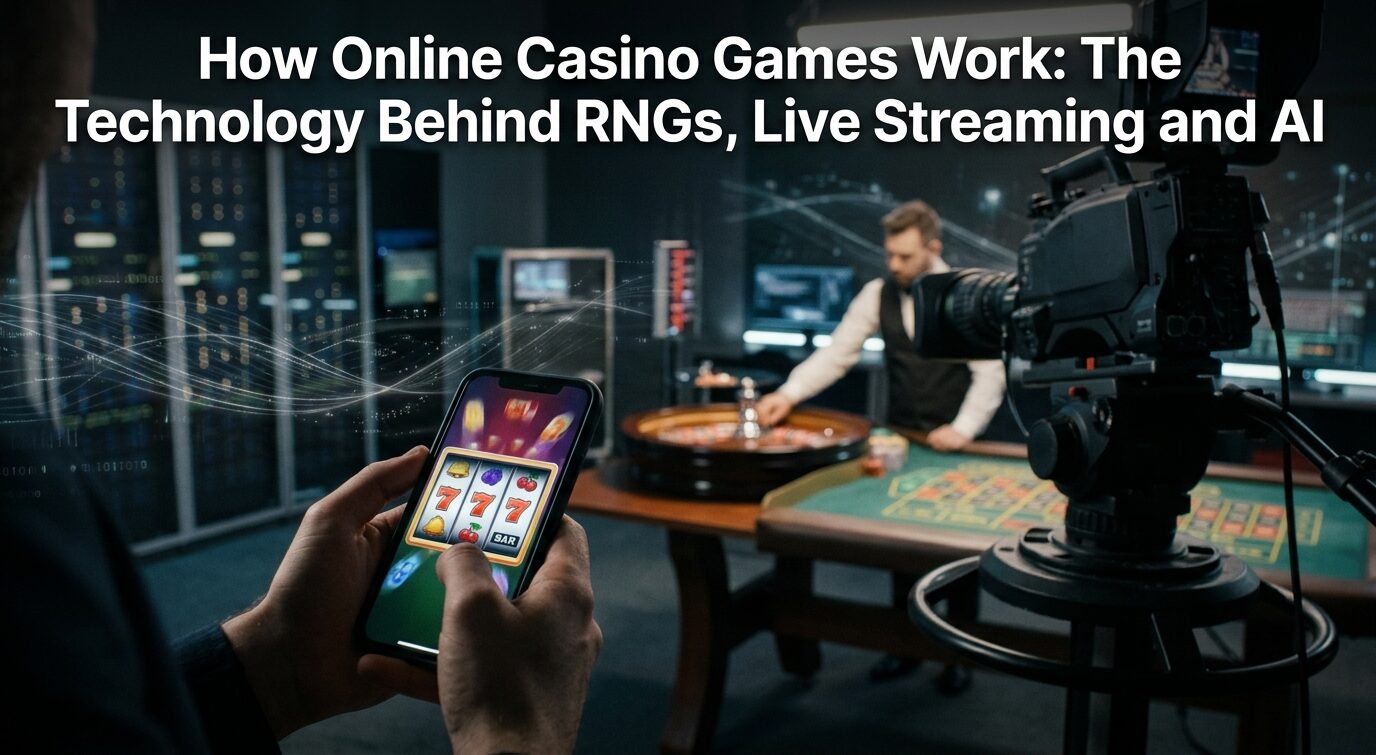
One Digital Catalogue, Several Different Game Technologies
For the user, an online casino looks like a single menu of games. Behind that menu sit at least three distinct technical models, each with its own engineering challenges.
| Format | What decides the outcome | Main technical challenge |
|---|---|---|
| Slots and other RNG games | A random number generator on a server | Proving that results are genuinely random and match the game’s maths |
| Digital table games | An RNG simulating cards, dice or a wheel | Reproducing physical rules accurately in code |
| Live-dealer games | Physical equipment in a studio | Low-latency video and synchronised betting |
Local catalogues show how naturally these formats are blended for the user. A Slovenian-language overview of online casino igre groups slots, roulette, blackjack, poker and live-dealer formats within one catalogue, although the technologies behind these games differ significantly.
From the user’s side the difference is a single tap. From the engineering side it is the difference between a statistical model and a television studio.
How Random Number Generators Power Digital Casino Games?
In most digital games of chance, the random number generator (RNG) is the core component. It is easy to misunderstand what it does, so it helps to separate the layers.
How RNG Systems Produce Game Outcomes?
- Random value generation. The RNG produces a stream of numbers with no predictable pattern.
- Scaling and mapping. Game logic converts those numbers into game events, such as a reel position, a card from a shuffled deck or a pocket on a roulette wheel.
- Paytable rules. The software checks the resulting combination against the game’s payout rules.
- Presentation. Only then does the interface play the animation of spinning reels or a dealt card.
The order matters. The outcome is fixed before the animation starts, so visual effects such as a near miss or a slow final reel do not influence the result. They are a presentation layer, not part of the decision.
Why Independent Software Testing Matters
Because users cannot see inside the algorithm, trust depends on external testing. The UK offers a detailed example of how this works in practice. Under the UK Gambling Commission’s testing procedure, an approved test house checks an RNG in several steps:
- reviewing the RNG documentation to understand how it is implemented;
- researching the algorithm or hardware for publicly known weaknesses;
- reviewing source code to confirm it matches the documentation;
- running statistical tests on raw output and on scaled or shuffled data.
The licensee must submit the test report before the RNG is released. This is one national framework rather than a global rule, but it shows what serious verification of game software involves.
RTP and Volatility: Understanding the Mathematics Behind the Software
Randomness alone does not define a game. Each title also has a mathematical profile that describes how it behaves over very large numbers of rounds. Two terms do most of the work here.
| Term | What it means |
|---|---|
| Theoretical RTP | The return to player the game is designed to deliver over the long run, usually shown in the game rules |
| Actual RTP | What the live game has really returned, calculated from wins and turnover over a period |
| Volatility | How widely individual results swing around the average, usually measured as standard deviation |
Why Short Sessions Differ From Long-Term Statistical Averages?
RTP is an average across an enormous number of plays, not a forecast for one session. A game designed to return a certain percentage can produce very different results for an individual player over an evening.
Regulators account for this when they monitor games. The UK Gambling Commission’s guidance on live RTP monitoring explains that the acceptable range around theoretical RTP depends on volatility and sample size. High-volatility games get wider tolerances, and the range narrows as play accumulates.
In the guidance’s own example, a game designed to return 91.68% with a volatility of 5.6 is expected to land between 89.93% and 93.43% after 400,000 plays.
The key insight: RTP describes the software, not the player’s evening. Treating it as a promise of returns misunderstands what the number measures.
Live-Dealer Games and the Technology of Real-Time Streaming
Live-dealer games solve a different problem. Here the outcome comes from physical equipment, such as a real roulette wheel or real cards, and the technology has to deliver that event to remote users quickly and reliably.
Cameras, Video Delivery and Interaction Latency
A typical live format combines several systems that must stay in sync:
- Capture: multiple cameras film the table and the dealer.
- Encoding: video is compressed for transmission over consumer internet connections.
- Delivery: the stream travels to devices across different networks and countries.
- Interaction: betting windows, chat and results must line up with what the viewer actually sees.
Latency is the critical variable. If the video lags too far behind the real table, the betting window and the on-screen action drift apart. Real-time streaming technologies such as WebRTC show how interactive platforms keep this delay small.
Cloudflare’s WebRTC documentation, for example, describes playback with less than 500 milliseconds of latency and lists gaming, live sports and auctions among its typical use cases.
This does not mean every live casino uses WebRTC. It illustrates the class of technology that makes sub-second interaction possible at all.
AI in Online Casino Platforms: Personalization and Player Protection
Artificial intelligence enters gaming platforms in two very different roles, and it is worth keeping them apart.
| Role | What it does | Main concern |
|---|---|---|
| Personalization | Recommends games and arranges the interface based on behaviour | Can encourage longer or more intense play |
| Player protection | Detects patterns linked to risky behaviour and triggers interventions | Accuracy, privacy and how alerts are acted on |
The Difference Between Recommendation Systems and Game Outcomes
Neither of these roles should touch game results. In a properly tested RNG game, the outcome comes from the certified generator and paytable. A recommendation model can change which game a user sees first, but it should not change what happens when they play.
The protective side is where research is most active. A systematic review of 68 studies, published in Acta Psychologica in 2026, grouped the use of advanced technologies for safer gambling into four areas:
- behavioural monitoring and feedback;
- predictive risk modelling;
- decision support and AI classifiers;
- limit-setting and self-exclusion tools.
The same data that powers personalization can also power early warnings. Which use dominates is ultimately a design and regulatory choice, not a technical limitation.
Global Software Platforms and Local Regulatory Requirements
Game software is usually built once and distributed globally. A slot developed in one country can appear in catalogues in dozens of markets, translated into local languages within days. Legal permission does not travel the same way.
Why Technical Availability Does Not Mean Legal Authorization?
Slovenia illustrates the gap between technical reach and legal authorization. According to the Slovenian government’s overview of games of chance, casino-style games may only be offered in casinos and gaming salons operating under a concession.
The state limits the number of these concessions, publishes registers of concessionaires, and the Financial Administration of the Republic of Slovenia supervises compliance.
- A game being reachable from a Slovenian IP address does not make it authorized in Slovenia.
- A licence issued in another country does not automatically cover the Slovenian market.
- Localized content, such as a Slovenian interface or catalogue, is a marketing decision, not a legal status.
For technology observers, this is a familiar pattern. Ride-sharing, short-term rentals and digital finance all ran into the same tension between global platforms and national rules.
What Comes Next for Digital Gaming Technology?
The interesting questions are less about new visual formats and more about trust. Several directions are worth watching:
- Verifiable algorithms. Testing today relies on accredited labs and reports. Future systems may make it easier to show that a deployed game matches the tested version.
- Better protection tools. Risk models are improving, but their value depends on how operators act on the signals they produce.
- Interactive streaming. Lower latency enables richer live formats, which in turn raises the bar for synchronization and fairness checks.
- Transparent personalization. As recommendation engines grow more capable, regulators are likely to ask how they are tuned and whom they serve.
None of these are guaranteed outcomes. They are the open engineering and policy problems that will shape how digital games of chance evolve.
Conclusion
Online casino games are a compact case study in modern digital systems. A single catalogue combines statistical software, independent testing regimes, real-time video infrastructure and machine learning models. Each layer brings its own risks and its own safeguards.
The future of this sector will be decided less by new graphics than by reliability, transparency and user protection. That is also true for much of the wider digital economy, which is why the inner workings of these games deserve attention even from readers who never play them.