A System Designed for the Past
For decades, identity verification has relied on a surprisingly simple tool: the passport photo. A small, standardized image, neutral expression, plain background, used worldwide to confirm who you are.
It’s a system built for human inspection. An officer looks at your face, then at your photo, and decides if they match.
That model is starting to break.
As global mobility increases and digital services expand, identity systems designed for manual verification are struggling to keep up. The shift now underway isn’t just digital, it’s structural.
How Passport Photos Fit Into Today’s Digital Identity Systems
Passport photos are still the backbone of identity documentation. They are required for:
- Passports and visas
- National ID cards
- Immigration and border control systems
But even today, the process is becoming digital. Instead of visiting a studio, people increasingly generate compliant images online using tools like 123passportphoto.com, which automatically adjusts photos to meet official requirements.
This change may seem minor, but it reflects a larger trend: identity verification is moving from physical processes to software-driven systems.
Still, a passport photo captures only a single moment. It doesn’t adapt, update, or verify itself. That limitation is exactly what newer technologies aim to solve.
Why Biometric Identity Is Replacing Traditional ID Methods
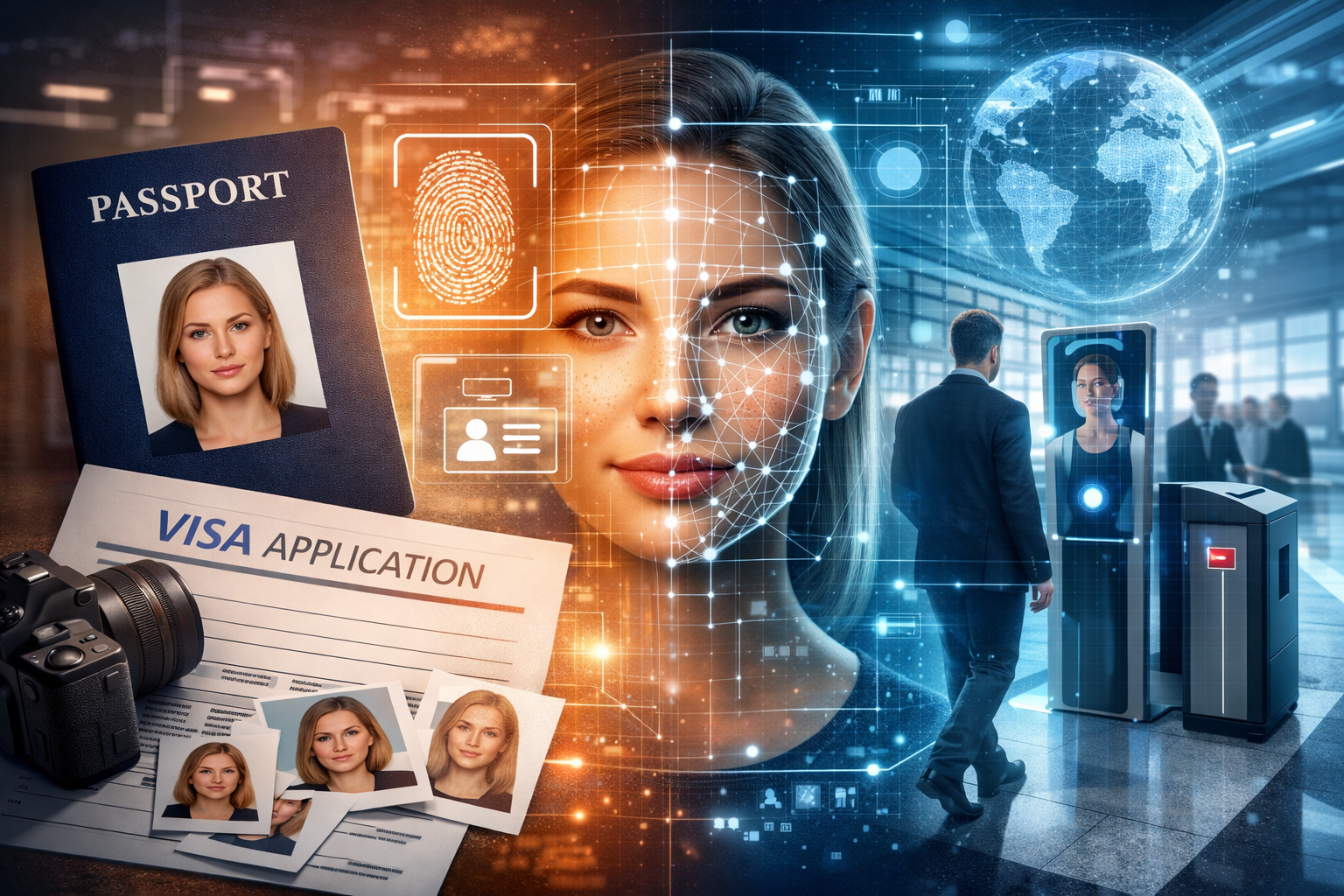
Biometric identity systems use unique physical traits “your face, fingerprints, or iris” to verify who you are.
Unlike passport photos, biometrics are:
- Real-time: Verified instantly
- Dynamic: Can adapt to changes over time
- Harder to fake: Based on measurable biological data
Airports in countries like Singapore, the UAE, and the Netherlands are already deploying facial recognition systems that allow travelers to pass through checkpoints without presenting physical documents.
In these environments, your face is no longer just a photo, it’s a live authentication key.
AI Identity Verification: How It Works
Artificial intelligence is what makes modern biometric systems scalable.
Instead of a human comparing two images, AI systems:
- Map facial features into data points
- Compare them against large databases
- Detect anomalies or signs of fraud
For example, AI can now identify:
- Digitally altered photos
- Deepfakes or synthetic identities
- Subtle mismatches invisible to humans
This turns identity verification into a continuous process rather than a one-time check.
The Rise of Digital Identity Wallets
The next step is already emerging: digital identity wallets.
These are secure apps or platforms where individuals store verified credentials such as:
- Digital passports
- Driver’s licenses
- Travel visas
- Health certifications
Instead of presenting documents, users grant temporary access to verified data.
Major governments and organizations are piloting these systems, aiming to reduce friction in everything from airport security to banking.
In this model, passport photos don’t disappear, but they become just one element in a larger identity profile.
Signals of Change Already Visible Today
Several real-world developments point to how quickly this shift is happening:
- Airports testing “walk-through” biometric boarding with no document checks
- Governments introducing mobile-based digital IDs
- Increased use of AI in visa and immigration processing
- Online tools simplifying document preparation and compliance
Each of these signals suggests the same direction: identity is becoming faster, more automated, and less visible.
Privacy, Risk, and the Trade-Offs Ahead
The benefits are clear: speed, convenience, and security, but they come with trade-offs.
Key concerns include:
- Surveillance: Continuous tracking through biometric systems
- Data breaches: Centralized identity databases are high-value targets
- Algorithmic bias: Some systems perform unevenly across populations
Unlike a passport, you can’t replace your face or fingerprints if they are compromised.
This raises a fundamental question:
How much convenience are people willing to trade for control over their identity?
The Transition Phase: Where Old Meets New
For the next decade, identity systems will remain hybrid.
- Passport photos will still be required
- Digital tools like 123passportphoto will simplify compliance
- Biometric verification will expand alongside traditional checks
This overlap is necessary. Not all countries or systems will adopt new technologies at the same pace, and accessibility remains a global concern.
What Digital Identity Could Look Like by 2040?
Looking ahead, identity verification may become almost invisible.
Possible scenarios include:
- Walking through airports without stopping at checkpoints
- Signing into services without passwords or documents
- AI systems are verifying identity continuously in the background
In this future, the idea of carrying a physical ID or even uploading a passport photo may feel outdated.
Conclusion
The evolution from passport photos to AI-driven biometric systems marks a fundamental shift in how identity works.
What began as a static image is becoming a dynamic, intelligent system-one that operates in real time, across borders, and often without direct human involvement.
Today’s tools and processes, from online photo generators to digital applications, are early steps in this transition. What comes next is not just a more efficient system, but a redefinition of identity itself.