
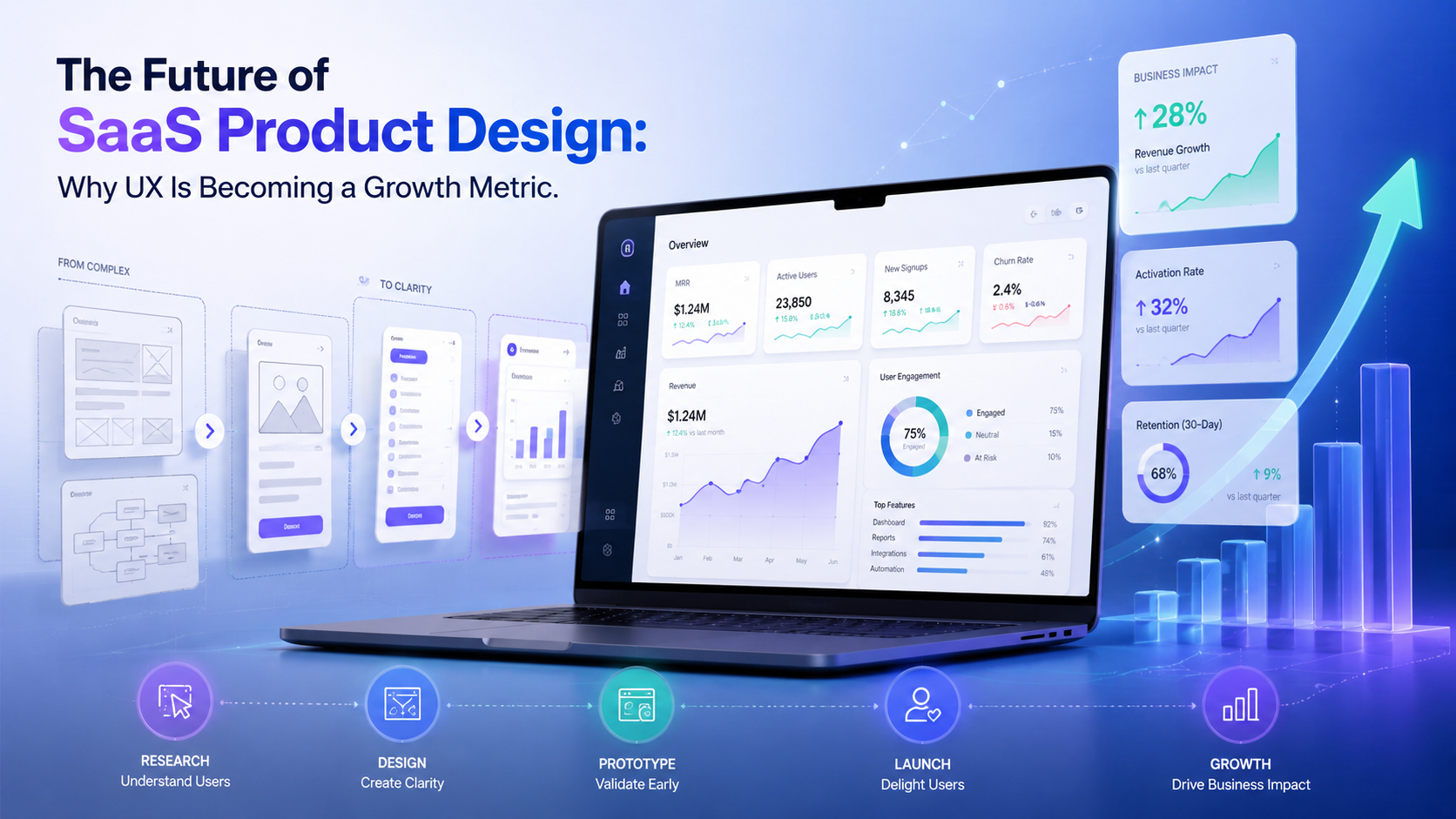
Design used to be the last stop before launch. A coat of paint. Something you’d tidy up once the “real” work – the backend, the features, the roadmap – was done. That’s not really true anymore. SaaS companies are starting to track user experience the way they track churn or activation – as a number that moves the business, not a nice-to-have.
Why now? Look at how people actually buy software today. Free trial, self-serve signup, maybe a quick poke around the dashboard – and within minutes, someone’s decided whether your tool is worth paying for. No sales rep standing between them and a confusing screen. No one to explain away a clunky flow. The product has to make its own case, on its own, fast.
It wasn’t always like this. A decade back, SaaS companies competed on feature lists – whoever crammed the most capabilities onto the page usually won the comparison chart. That race is more or less over. Walk through most mature SaaS categories today and you’ll find a dozen tools doing roughly the same thing on paper. Once everyone has the same features, the thing that actually decides it is harder to fake: how the product feels to use.
Why UX Now Shows Up on the Balance Sheet
Here’s the part that’s easy to miss – this isn’t just a vibe shift among designers patting themselves on the back. Companies that treat design as something worth measuring, something with a seat at the leadership table, tend to do better financially over time. Not just in satisfaction surveys. In actual performance.
That’s also why founders are looping in a design agency for SaaS companies much earlier than they used to – before product-market fit is even fully locked in, not as a rebrand exercise afterward. Bring design in early enough, and it shapes onboarding, retention loops, even how clear the pricing page is. Those aren’t cosmetic details. They move revenue.
A few places this tends to show up:
- Onboarding friction – every extra click before someone hits value is a chance for them to bail.
- Dashboard clarity – cram too much into one screen and activation slows down, support tickets pile up.
- Pricing-page design – confusing tiers kill conversions quietly, no matter how solid the product underneath actually is.
- Consistency across touchpoints – if the marketing site, the app, and the onboarding emails all feel like different products, trust takes a hit before the user’s even signed up.
From Feature Race to Experience Race
What’s changed in practice is where design questions get asked. They used to live inside the design team, off in their own corner. Now they’re showing up in the same conversations as pricing and roadmap decisions. What’s the fastest way to get someone to their first “aha” moment? Where does the interface make people hesitate instead of trust it? Those used to be design questions. Increasingly, they’re growth questions too.
Which also changes what “good design” even means in this context. It’s not really about a clean visual style anymore – or at least, not only that. It’s closer to:
- Speed to value – how fast someone reaches something useful, not how the screen looks in a portfolio shot.
- Cognitive load – how much thinking a user has to do before taking the next step.
- Trust signals – small, almost boring things: consistent wording, predictable navigation, nothing that makes someone pause mid-trial and wonder if this tool is legit.
The Data Behind the Shift
None of this is just a feeling shared over coffee in product meetings. Companies with the strongest financial returns tend to treat design the way they treat revenue and costs – something worth measuring rigorously, not a mid-management afterthought that gets a slide once a quarter. A widely cited McKinsey study on the business value of design found that companies scoring highest on its design index saw meaningfully stronger revenue growth and shareholder returns than their industry peers over a five-year stretch.
For SaaS, that translates into something concrete: design decisions touch trial-to-paid conversion, expansion revenue, churn – the exact metrics already sitting on a growth team’s dashboard. That’s a different question than “does it look nice.” It’s closer to “does it actually convert, retain, and expand.”
Final Thoughts
None of this means every SaaS company needs a design overhaul by next quarter. But the direction is hard to ignore. As SaaS gets more crowded and switching tools gets easier, the products that feel effortless will keep winning attention – regardless of how strong the engineering underneath happens to be.
Design is turning into one of the few growth levers that compounds instead of fading after a single campaign. Teams that treat it as strategy early, rather than a fix bolted on later, tend to have an easier time scaling – and a much easier time defending their retention numbers once the market gets loud.




