
When a customer experience team reviews its dashboards, the usual suspects get all the attention: response times, NPS scores, churn rates, sentiment analysis.
Rarely does anyone flag an empty shelf or an “out of stock” badge on a product page as a CX metric. Yet for the customer standing at that shelf, or staring at that badge, it’s one of the most direct experience failures a brand can produce.
It’s time CX leaders stopped treating stockouts as purely an operational or supply chain headache and started recognizing them for what they are: a broken promise, delivered at the worst possible moment — right when the customer has already decided to buy.
What Is a Stockout, Really?
So what is a stockout, in practical terms? It’s the moment a customer wants to purchase a product and discovers it isn’t available — whether that’s an empty peg on a shelf, a greyed-out “add to cart” button, or a delivery slot that quietly disappears from the checkout screen.
It sounds like a simple operational hiccup. From the customer’s side, though, it’s an interruption of intent. They made a decision, engaged with the brand, and were then told, effectively, “not today.”
That distinction matters enormously for how CX teams should think about it. A slow support response is frustrating, but the customer still gets an answer eventually.
A stockout offers no such resolution in the moment. The purchase simply doesn’t happen, and the brand has no immediate way to make it right.
The CX Cost Nobody Puts on a Dashboard
Supply chain teams typically measure stockouts in terms of lost revenue: a missed sale, a markdown on a substitute item, an unfulfilled order.
Those numbers matter, but they miss the more expensive cost that CX teams should care about — the erosion of trust that happens quietly in the background.
Consider what a stockout actually communicates to a customer, even if unintentionally: that the brand didn’t anticipate demand, that its digital and physical inventory aren’t in sync, or that it simply doesn’t have its operations under control.
None of that is said out loud, but it’s absorbed all the same. Repeated often enough, it shapes how a customer perceives reliability — one of the most important, and most fragile, components of brand loyalty.
This is precisely why stockouts deserve a seat at the CX table rather than being filed away as a warehouse problem.
A customer doesn’t distinguish between “the store’s fault” and “the supplier’s fault.” They experience one brand, and one broken moment.
Causes of Stockout That CX Teams Should Understand
Understanding the causes of stockout isn’t just a supply chain exercise — it helps CX and customer strategy teams see where experience failures actually originate, often several steps upstream of the customer-facing moment.
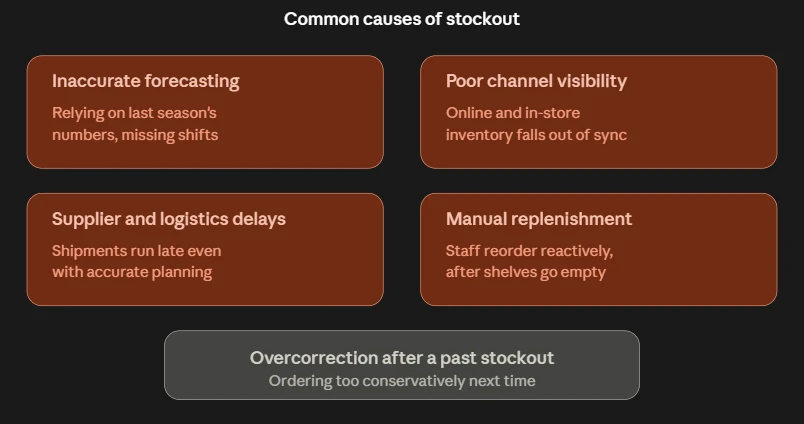
A few of the most common causes:
- Inaccurate demand forecasting. Relying on last season’s numbers or simple historical averages fails to account for sudden shifts in demand, whether from a viral trend, a promotion, or a change in seasonality.
- Poor visibility across channels. When online and in-store inventory systems aren’t properly synced, a product can show as available online while the local store has already sold out, or vice versa.
- Supplier and logistics delays. Even with accurate forecasting, a delayed shipment or a supplier running behind can create a stockout regardless of how well the retailer planned.
- Manual, reactive replenishment. Many retailers still rely on staff manually checking shelves and placing orders after the fact, rather than triggering replenishment automatically based on real-time sales velocity.
- Overcorrection after a previous stockout. Ironically, a brand that ran out of a popular item once often overreacts by ordering conservatively next time, sometimes trading a stockout for chronic understocking.
Notice that most of these causes sit upstream of the moment a customer ever sees the problem. By the time a shopper hits “add to cart” on an unavailable item, several smaller failures have usually already occurred.
How to Avoid Stockouts by Rethinking Who Owns the Problem?
Most organizations still treat stockouts as strictly an inventory or operations issue, with CX teams brought in only after the fact to handle the fallout — a complaint, a refund request, a lost customer.
But if CX leaders want to meaningfully reduce how often this experience failure happens, understanding how to avoid stockouts needs to become a shared responsibility rather than something handed off entirely to supply chain.
This starts with data sharing. CX teams often sit on customer sentiment and behavioral data that can help forecasting models anticipate demand spikes long before a stockout occurs — a product going viral on social media, a competitor’s own shortage driving switching behavior, or a shift in regional demand patterns.
Supply chain teams, in turn, have visibility into constraints CX teams rarely see: supplier lead times, warehouse capacity, and logistics bottlenecks that shape what’s realistically achievable.
Where these two functions genuinely collaborate, retailers tend to catch demand shifts earlier and respond with far more precision than either team could manage alone.
The Technology Making This Collaboration Possible
Historically, the tools available to prevent stockouts were blunt instruments: safety stock buffers, manual reorder points, and spreadsheet-based forecasting that updated far too slowly to matter. That’s changed substantially.
Retailers now have access to AI inventory optimization platforms that continuously analyze sales velocity, seasonality, promotions, and even external factors to predict demand at a much finer level of accuracy than traditional methods allow.
What makes this relevant to CX teams specifically is the shift from reactive to predictive operations. Rather than restocking after a shelf goes empty, these systems can flag a likely shortage days in advance, giving both operations and customer-facing teams time to respond — whether that means expediting a shipment, adjusting a promotion, or simply setting accurate customer expectations before frustration sets in.
For CX leaders evaluating where to invest limited influence and budget, this is a case where backing an operational technology investment pays off directly in experience metrics that matter to their function: repeat purchase rate, trust scores, and reduced complaint volume.
How to Prevent Stockouts From Becoming a Pattern?
Solving a single stockout is straightforward: expedite a shipment, apologize, offer a substitute. The harder problem — and the one that actually protects customer experience over time — is learning how to prevent stockouts from recurring in a predictable pattern that customers start to notice and remember.
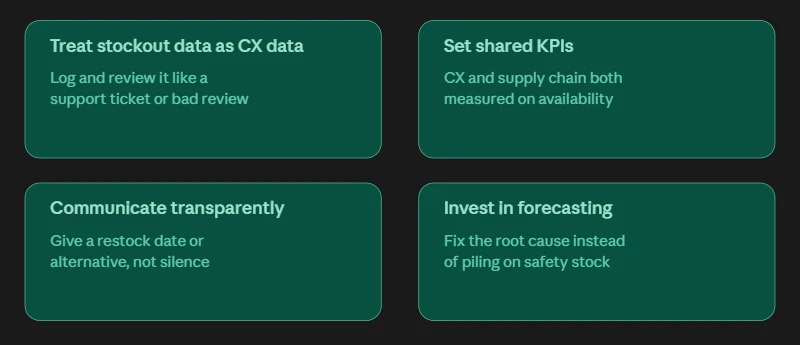
A few practices help make that shift durable:
- Treat stockout data as CX data. Every stockout event should be logged and reviewed the same way a support ticket or negative review would be, with attention to which products, categories, or channels are affected most often.
- Set shared KPIs across departments. When both supply chain and CX teams are measured, even partially, on product availability and its downstream effect on satisfaction, the incentive to collaborate strengthens considerably.
- Communicate transparently when stockouts do occur. A simple, honest update — an estimated restock date, a notification when the item returns, a comparable alternative — does far more to preserve trust than silence or a generic “out of stock” message.
- Invest in forecasting accuracy, not just safety stock. Piling on more buffer inventory is a costly, blunt fix. Better prediction addresses the root cause rather than masking it with excess capital tied up in inventory.
Reframing the Problem
None of this is to say supply chain teams are doing anything wrong by owning inventory operations — they are, and should remain, the primary owners of execution.
The point is narrower: customer experience leaders can no longer afford to treat product availability as someone else’s metric. It is, in the most literal sense, the experience.
A brand can perfect its personalization engine, streamline its checkout flow, and train its support team to deliver flawless service, but none of it matters to a customer who simply couldn’t buy the product they came for.
Fixing that isn’t a supply chain project with a CX footnote — it’s a customer experience priority that happens to require supply chain expertise to solve.
The retailers getting this right aren’t necessarily the ones with the most sophisticated CX programs on paper.
They’re the ones that recognized, early, that an empty shelf is a customer experience event, not a warehouse anomaly, and started managing it accordingly.




