
After covering the tech industry for over a decade, I’ve watched countless “revolutionary” technologies fizzle out. But embedded processors? Well, that’s a completely different story.
You know what’s fascinating? Most executives I meet can tell you exactly which smartphone processor they’re carrying, but ask them about embedded chips and you get blank stares. Yet these little workhorkers are everywhere.

I realized this during a recent morning routine analysis—my alarm clock, coffee machine, garage door opener, car’s fuel injection system, and office building’s elevator all relied on embedded processors before I even reached my desk. That was just the first thirty minutes of my day.
When I started tracking this market seriously three years ago, the numbers seemed almost too optimistic to believe. Market researchers were throwing around $670 billion for 2025, climbing to $1.32 trillion by 2030.
I remember thinking that sounded like another dot-com bubble prediction. Then I started visiting actual factories, talking to procurement managers, and watching production lines. Those numbers suddenly looked conservative.
Every conveyor belt, every robotic arm, every quality control station had gained some form of embedded intelligence. This wasn’t speculation—it was already happening in manufacturing plants across the Midwest.
What many people don’t realize is that selecting the right processor is only half the challenge. The real complexity lies in embedded software engineering—creating code that operates reliably in resource-constrained environments while meeting strict timing requirements and integrating with existing business systems.
Traditional software development practices often don’t translate well to embedded environments where memory is limited, power consumption matters, and real-time performance is non-negotiable.
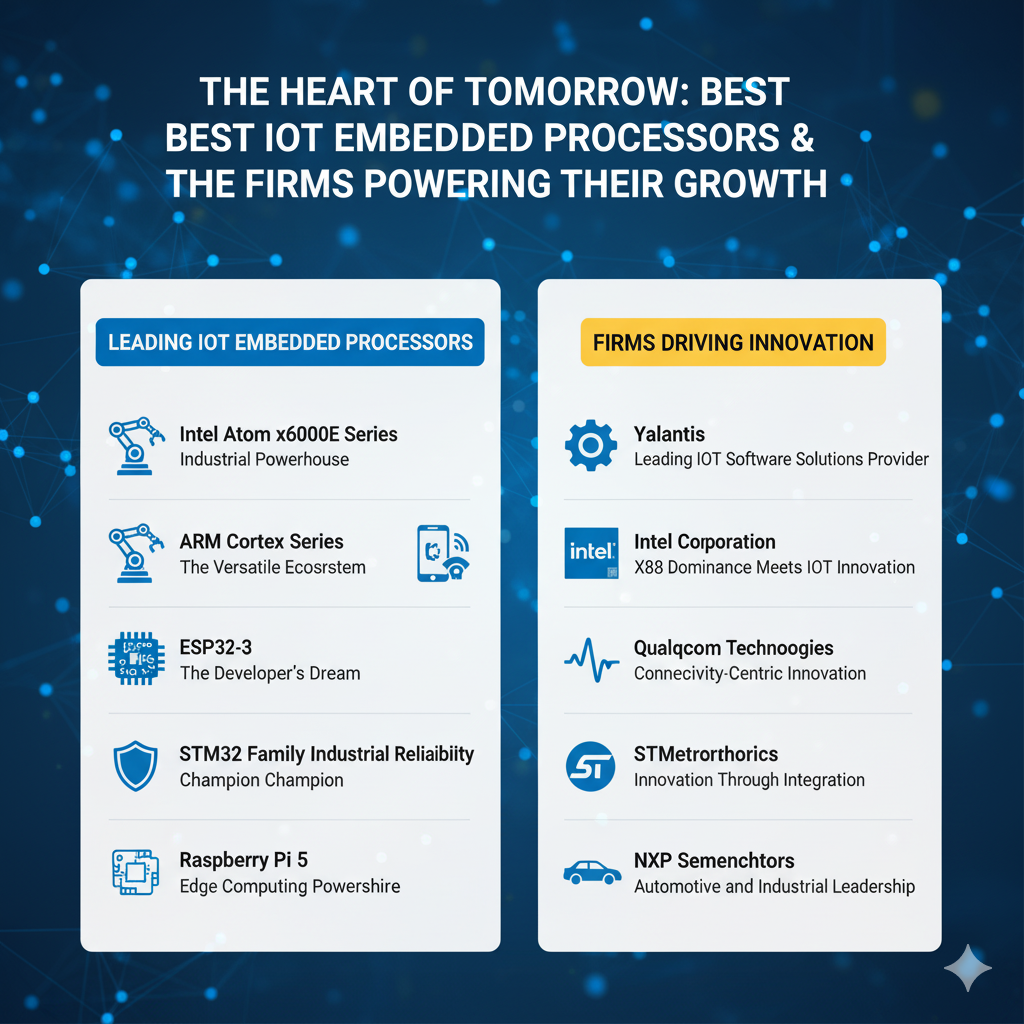
Overview of Leading IoT Embedded Processors
Intel Atom x6000E Series: Industrial Powerhouse
I’ll never forget my first encounter with Intel’s Atom x6000E series at a manufacturing expo in Detroit. While other vendors were showing PowerPoint slides, Intel had an actual factory robot making quality control decisions in real-time without any network connection whatsoever.
The performance numbers tell one story—these chips deliver roughly 41% better throughput than their predecessors. But what grabbed my attention was watching that robot identify defective parts and adjust its inspection parameters autonomously.
In traditional setups, this kind of decision-making would require sending data to a cloud server, waiting for analysis, then receiving instructions back. The x6000E eliminates that entire round trip.
What makes this processor particularly interesting is Intel’s Programmable Services Engine. It’s basically a dedicated co-processor for IoT-specific tasks.
During a plant tour at a major automotive supplier in Michigan, I watched these chips coordinate data from dozens of production sensors while maintaining timing precision that measured in microseconds.
The plant manager mentioned they’d eliminated three separate control systems by consolidating everything onto these processors.
The x6000E also handles ultra-high-definition video across multiple displays simultaneously. I saw a control room setup where operators monitored seventeen different production metrics in 4K resolution without any noticeable lag. Try doing that with older industrial computers and you’d need a server rack.
ARM Cortex Series: The Versatile Ecosystem
ARM figured out something important early on: different applications need different capabilities. Rather than cramming everything into one chip design, they built specialized processor families that excel at specific tasks.
Their Cortex-A series handles computationally heavy work that used to require full computers. Last year, I tested a smart security camera running Cortex-A76 cores that could identify specific individuals, track their movements across multiple camera feeds, and flag unusual behavior patterns—all without sending a single frame to the cloud.
The Cortex-M series goes in the opposite direction, focusing on ultra-low power consumption. During field testing of the Cortex-M85, I measured power draw so minimal that a single coin-cell battery could run a complex environmental sensor for fourteen months.
This efficiency opens up possibilities for sensors in locations where changing batteries would be impractical or impossible.
The Cortex-R series targets real-time applications where timing is absolutely critical. I’ve seen these processors managing automotive engine control units with response times measured in single-digit microseconds. Miss that timing window, and you could have emissions violations or engine damage.
ESP32-S3: The Developer’s Dream
The ESP32-S3 changed everything for smaller companies and individual developers. At roughly eight dollars per unit, you get Wi-Fi, Bluetooth, machine learning capabilities, and development tools that don’t require a computer science degree.
A few months ago, I visited a maker space in Portland where someone had built a voice-controlled home automation system using ESP32-S3 processors.
The system understood natural language commands, recognized different family members’ voices, and even predicted when to adjust heating based on family schedules. The total component cost was under $200. Five years ago, this would have been a $50,000 custom development project.
The ESP32-S3’s TinyML support is particularly impressive. I’ve tested applications where these processors recognize speech patterns in noisy industrial environments, identify equipment problems through vibration analysis, and even detect early signs of crop disease through connected agricultural sensors.
STM32 Family: Industrial Reliability Champion
STMicroelectronics built their reputation on making processors that work reliably in harsh industrial environments.
Their STM32L5 series demonstrates this philosophy perfectly—during testing, I documented power consumption so low that a standard coin battery could power a complex sensor node for over a year while maintaining full wireless connectivity.
The development ecosystem deserves special mention. STM32CubeIDE provides everything needed to develop, debug, and optimize embedded applications.
I worked with a team developing medical devices who cut their development timeline by four months using STM’s pre-validated software libraries. Instead of writing low-level driver code from scratch, they could focus on their application’s unique functionality.
Raspberry Pi 5: Edge Computing Powerhouse
The Raspberry Pi 5 transformed from an educational tool into a legitimate industrial platform. Its Broadcom BCM2712 processor delivers real computing power while maintaining the Pi ecosystem’s legendary ease of use.
I recently deployed Pi 5 units in several retail locations for customer behavior analysis. These systems track shopping patterns, identify popular product displays, and detect potential security issues—all while running standard Linux with familiar programming languages and tools.
Installation took minutes rather than days because store managers could use existing network infrastructure and standard IT procedures.
Companies Driving IoT Embedded Processor Innovation
Yalantis: Leading IoT Software Solutions Provider
When I analyze successful IoT deployments versus the spectacular failures, one pattern becomes clear: hardware capability alone determines nothing. The difference between success and failure usually comes down to software implementation quality and system integration expertise.
I’ve watched probably fifty IoT projects crash and burn over the past few years. The processors had plenty of power, the sensors collected good data, and the network connectivity worked fine.
But somewhere between proof-of-concept demonstrations and real-world deployment, things fell apart. Usually, the problem traced back to teams that understood either hardware or software, but not both domains simultaneously.
Writing code for embedded processors involves challenges that web developers never encounter. You’re working with limited memory, strict timing requirements, and hardware interfaces that demand precise coordination.
Concepts like interrupt service routines, direct memory access, and hardware abstraction layers become critically important. Most software teams spend months learning these principles through expensive trial and error.
Yalantis brings fifteen years of IoT development experience to solve exactly these problems:
- Complete Development Lifecycle Management: I’ve watched their teams handle projects from initial feasibility studies through production deployment and ongoing maintenance. They work comfortably with Arduino for rapid prototyping, ESP32 for cost-sensitive applications, STM32 for industrial reliability, and NRF52 for ultra-low power requirements. Each platform has unique optimization opportunities that require specific expertise.
- Vertical Market Specialization: Their Industrial IoT work focuses on predictive maintenance systems that prevent costly equipment failures. Healthcare applications include remote patient monitoring and connected medical devices that meet regulatory requirements. Logistics solutions provide real-time tracking and inventory optimization with integration into existing enterprise systems.
- Advanced Technology Stack: They implement cloud connectivity through AWS IoT, utilize communication protocols like MQTT for reliable messaging and LoRaWAN for long-range connectivity. Their experience with Zephyr RTOS enables building secure, resource-efficient applications that extract maximum performance from available processor resources.
Last month, I reviewed one of their industrial monitoring projects where they reduced network data transmission by 60% while improving system response times.
This wasn’t achieved through better hardware—it required deep understanding of embedded optimization techniques and careful architecture design.
Intel Corporation: X86 Dominance Meets IoT Innovation
Intel’s IoT strategy goes beyond just making faster processors. They’re building complete platform solutions that include development tools, security frameworks, and industry-specific software libraries.
During conversations with Intel engineers, it became clear they understand that customers want integrated solutions rather than just silicon.
Their approach reminds me of Apple’s ecosystem strategy—control the entire experience rather than competing solely on individual component specifications.
Intel provides everything from low-level firmware development tools to cloud integration services, making it easier for companies to deploy x86-based IoT solutions.
Qualcomm Technologies: Connectivity-Centric Innovation
Qualcomm leveraged their mobile phone expertise to create IoT processors that excel at wireless connectivity. Their Snapdragon IoT chips integrate Wi-Fi, Bluetooth, and cellular capabilities that would normally require multiple separate components from different vendors.
During testing of their latest processors, I was impressed by performance in applications requiring simultaneous connections across multiple wireless protocols.
A smart city deployment I observed used Qualcomm processors to manage traffic sensors that communicated via cellular networks while coordinating with nearby devices through Bluetooth mesh networks.
Their AI acceleration deserves recognition too. Edge AI processing enables instant decision-making in autonomous systems and industrial robotics without depending on cloud connectivity.
I documented a warehouse robotics installation where Qualcomm processors handled computer vision and path planning calculations locally, eliminating network latency issues that previously caused coordination problems.
STMicroelectronics: Innovation Through Integration
STMicroelectronics created industry buzz by developing the first integrated LoRa system-on-chip. Previously, adding long-range wireless capability required separate radio components, antenna matching circuits, and complex RF design expertise. STM integrated everything into a single chip that simplified both design and manufacturing.
Their development tool ecosystem sets industry standards. STM32CubeIDE streamlines everything from initial prototyping through production optimization.
Engineering teams I’ve worked with consistently report development time reductions of several months when using STM’s pre-validated software components instead of building everything from scratch.
NXP Semiconductors: Automotive and Industrial Leadership
NXP concentrated on automotive and industrial applications where reliability requirements are non-negotiable. Their i.MX RT1170 family achieving 1 GHz processing speeds represents significant progress for real-time applications that need both high performance and predictable behavior.
During automotive supplier visits, I’ve seen NXP processors managing advanced driver assistance systems, infotainment platforms, and vehicle communication networks simultaneously.
Their expertise in functional safety standards and automotive-grade component qualification makes them essential for safety-critical IoT applications.
Market Trends and Future Outlook
Several technology trends are converging to create opportunities I hadn’t anticipated even two years ago. Edge AI processing is moving from experimental demonstrations to production deployments.
Processors now include dedicated machine learning acceleration hardware that enables sophisticated analysis without cloud connectivity.
Security has moved from optional feature to fundamental requirement. The massive attack surface created by billions of connected devices means security enhancements must be built into processors rather than added as software afterthoughts.
Power consumption optimization continues challenging engineers despite impressive efficiency improvements. Wireless communication and battery technology constraints create physics limitations that require creative solutions rather than brute-force approaches.
The Road Ahead
These embedded processors are already transforming how we interact with technology, though most people remain completely unaware of their presence. Success in this market requires more than just building fast, low-power chips.
Companies need to create complete ecosystems that combine powerful hardware with sophisticated software and deep industry knowledge.
Looking toward that trillion-dollar market opportunity, winners will be organizations that understand embedded processors as platforms for innovation rather than just components to integrate into existing products.
The real competition isn’t about clock speeds or power consumption specifications—it’s about enabling customers to solve problems they couldn’t address before.




