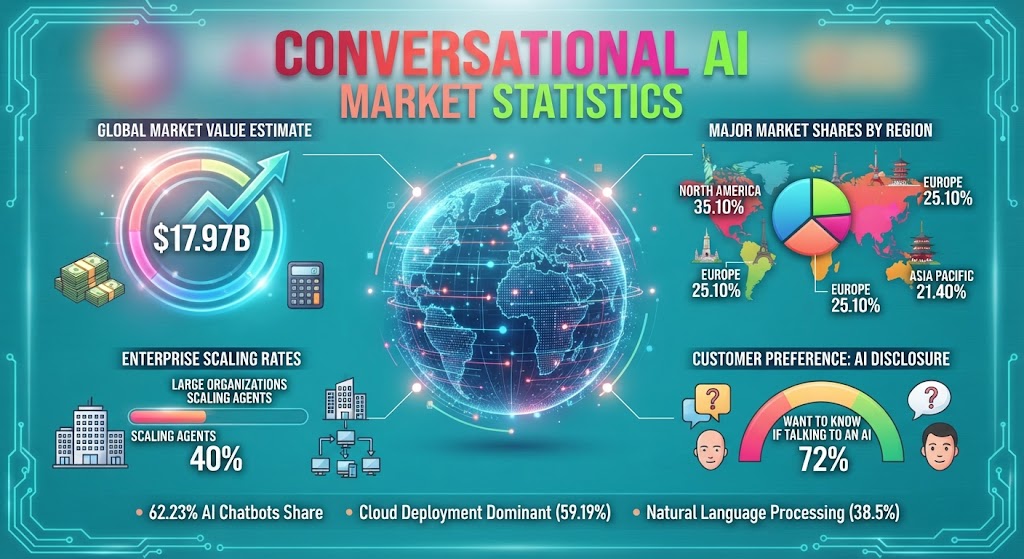
Precedence Research values the conversational AI market at $23.82 billion for 2026. Fortune Business Insights puts the same year at $17.97 billion. Both are current releases, and both count different things. This post sets out 2026 market size by firm, regional and country revenue, segment share, enterprise scaling rates, and what customers say about talking to AI agents.
Conversational AI Market
How Big Is The Conversational AI Market In 2026?
Three research firms published 2026-relevant estimates, and they do not agree. Precedence Research is highest at $23.82 billion. Fortune Business Insights sits at $17.97 billion.
MarketsandMarkets does not publish a 2026 figure at all. It reports $13.77 billion for 2024 and $17.05 billion for 2025.
| Research firm | 2025 size | 2026 size | Forecast | Stated CAGR |
|---|---|---|---|---|
| Precedence Research | $19.21 billion | $23.82 billion | $155.23B by 2035 | 23.24%, 2026–2035 |
| Fortune Business Insights | $14.79 billion | $17.97 billion | $82.46B by 2034 | 21.00%, 2026–2034 |
| MarketsandMarkets | $17.05 billion | Not stated | $49.80B by 2031 | 19.60%, 2025–2031 |
Each row is one firm’s own vendor-revenue estimate under its own scope definition. The rows are not slices of a single market and cannot be blended. Source: Precedence Research, updated January 2026; Fortune Business Insights, updated August 2026; MarketsandMarkets, May 2025.
The growth rates sit closer together than the totals do. All three land between 19.60% and 23.24% a year, over different horizons.
Conversational AI Market Growth To 2034
Fortune Business Insights publishes three points on one basis: $14.79 billion in 2025, $17.97 billion in 2026, and $82.46 billion by 2034. Adjacent chatbot market size figures track a narrower slice of the same category.
Conversational AI Market Size By Region And Country
North America led 2025 with 35.10% of revenue, or $5.19 billion, rising to $6.24 billion in 2026. Europe took 25.10% and Asia Pacific 21.40%.
Europe outranking Asia Pacific is the detail most summaries skip. Fortune Business Insights expects Asia Pacific to record the highest growth rate over the forecast period.
| Region | 2025 share | 2025 revenue | 2026 revenue |
|---|---|---|---|
| North America | 35.10% | $5.19 billion | $6.24 billion |
| Europe | 25.10% | $3.72 billion | $4.54 billion |
| Asia Pacific | 21.40% | $3.16 billion | $3.93 billion |
| Middle East & Africa | 10.90% | $1.61 billion | $1.95 billion |
| Latin America | 7.50% | $1.11 billion | $1.31 billion |
| Total | 100% | $14.79 billion | $17.97 billion |
Source: Fortune Business Insights, 2025 actual and 2026 estimate, updated August 2026.
Conversational AI Market Revenue By Country, 2026
The United States is forecast to reach $4.28 billion in 2026. Germany follows at $1.07 billion and the United Kingdom at $0.96 billion.
These six countries are the ones Fortune Business Insights breaks out. They are not a complete list, so they do not sum to any regional total.
| Country | 2026 revenue |
|---|---|
| United States | $4.28 billion |
| Germany | $1.07 billion |
| United Kingdom | $0.96 billion |
| China | $0.93 billion |
| Japan | $0.77 billion |
| India | $0.62 billion |
Source: Fortune Business Insights, 2026 country estimates, updated August 2026.
Conversational AI Market Share By Type, Deployment And Technology
AI chatbots are expected to take 62.23% of global revenue in 2026. Cloud deployment is projected at 59.19% and natural language processing at 38.5%.
Precedence Research classifies the same market differently and expects on-premises to hold the largest deployment share across its forecast period. The two firms are measuring installed preference and new spending on different bases, so the readings should not be averaged.
| Breakdown | Leading segment | 2026 share |
|---|---|---|
| By type | AI chatbots | 62.23% |
| By deployment | Cloud | 59.19% |
| By technology | Natural language processing | 38.5% |
Each row is a separate segmentation of the same 2026 total, so the rows do not sum. Source: Fortune Business Insights, 2026 estimates, updated August 2026.
Fortune Business Insights counts automatic speech recognition as its own technology line rather than folding it into NLP, which is why the NLP figure sits below 40%. Underlying speech recognition benchmarks sit in that separate segment.
How Many Organisations Are Scaling Conversational AI?
McKinsey’s 2026 State of AI survey reached 1,719 respondents in 97 nations between 4 May and 8 June 2026. Nearly nine in ten report regular AI use in at least one business function.
Chatbots are the most widely scaled AI tool in the survey, with 47% of respondents saying their organisations have scaled them across the enterprise. About two in ten report the same for AI agents.
| Measure | 2025 survey | 2026 survey |
|---|---|---|
| AI scaling across the enterprise | 38% | 44% |
| AI used in three or more functions | 51% | 56% |
| Large organisations scaling AI agents | 27% | 40% |
Share of survey respondents. Large organisations are those above $1 billion in annual revenue. Source: McKinsey State of AI, 2026 edition, published 25 August 2026.
Smaller organisations did not move. McKinsey reports their agent scaling rate stayed essentially flat at 22%. Cost is now a live constraint: one in five respondents says AI operating costs, including tokens, have limited use, while 60% expect investment to rise over the next year. Broader patterns in AI across business operations follow the same split.
Conversational AI Market Impact On Contact Centre Jobs
Gartner surveyed 321 customer service and support leaders worldwide from September through October 2025. Only 20% had reduced agent staffing because of AI.
Most are redesigning roles instead. Gartner found 85% adding new tasks to frontline agent roles and 75% moving agents into entirely new positions.
| Measure | Share of leaders |
|---|---|
| Expanding human agent responsibilities | 85% |
| Under pressure to make workforce changes | 80% |
| Shifting agents into new roles | 75% |
| Reducing frontline headcount through attrition | 63% |
| Stable staffing while handling higher volumes | 55% |
| Implemented or planning AI-driven layoffs through 1Q27 | 31% |
| Reduced agent staffing due to AI | 20% |
Share of 321 customer service and support leaders. Options overlap and do not sum. Source: Gartner, survey conducted September–October 2025, released December 2025 and April 2026.
Gartner separately projects that more than 50% of customer service organisations will double technology spend by 2028 without an equivalent reduction in talent. Telephony volumes behind that spend appear in these voice call volume figures.
What Customers Think About Conversational AI Agents
Salesforce surveyed 16,585 consumers and business buyers for its State of the AI Connected Customer report, published 29 July 2026. Disclosure is the recurring ask: 72% say it matters to know whether they are talking to an AI agent.
Comfort depends entirely on the task. It runs at 38% for agents creating personalised content and 17% for an agent making financial decisions.
| Customer measure | Share |
|---|---|
| Say companies treat them as an individual | 73% |
| Want to know if they are talking to an AI agent | 72% |
| Feel increasingly protective of personal information | 71% |
| Believe companies are reckless with customer data | 64% |
| Say AI advances make trustworthiness more important | 61% |
| Comfortable with agents creating personalised content | 38% |
| Comfortable with an agent making financial decisions | 17% |
Share of surveyed customers. Source: Salesforce State of the AI Connected Customer, published 29 July 2026, 16,585 consumers and business buyers.
Business buyers split from consumers on speed. Salesforce reports 46% of business buyers would work with an AI agent to get faster service. Buying behaviour around those channels shows up in conversational commerce spending.
Trust in recommendations still favours people. A separate Gartner survey of 5,801 US customers, run in January and February 2025, found 54% trust human agents more than AI for product or service advice, against 32% who trust AI more. Vendor concentration in this category resembles enterprise software adoption by company size.
FAQs
How big is the conversational AI market in 2026?
Fortune Business Insights estimates $17.97 billion for 2026, up from $14.79 billion in 2025. Precedence Research puts 2026 at $23.82 billion. The gap comes from different scope definitions, not different years.
Which region leads the conversational AI market?
North America. It held 35.10% of global revenue in 2025, worth $5.19 billion, and Fortune Business Insights projects $6.24 billion for 2026. Europe was second at 25.10%.
Are companies actually scaling conversational AI?
Partly. McKinsey’s 2026 survey found 44% scaling AI across the enterprise, up from 38%. Chatbots are the most scaled tool at 47%, while about two in ten report scaling AI agents.
Is Reddit a reliable source for conversational AI market statistics?
Reddit threads often repost market figures without the period or scope attached, which is where most errors start. Every number here traces to a Fortune Business Insights, Precedence Research, McKinsey, Gartner or Salesforce release.
Do Reddit users prefer chatbots or human agents?
No dataset measures Reddit users specifically. Gartner surveyed 5,801 US customers in January and February 2025: 54% trust human agents more than AI for product or service recommendations, and 32% trust AI more.
Sources
https://www.fortunebusinessinsights.com/conversational-ai-market-109850
https://www.precedenceresearch.com/conversational-ai-market
https://www.mckinsey.com/capabilities/quantumblack/our-insights/the-state-of-ai
https://www.gartner.com/en/newsroom/press-releases/2026-04-28-gartner-survey-finds-eighty-five-percent-of-service-and-support-leaders-are-expanding-human-agent-responsibilities-despite-expectations-of-mass-ai-layoffs