
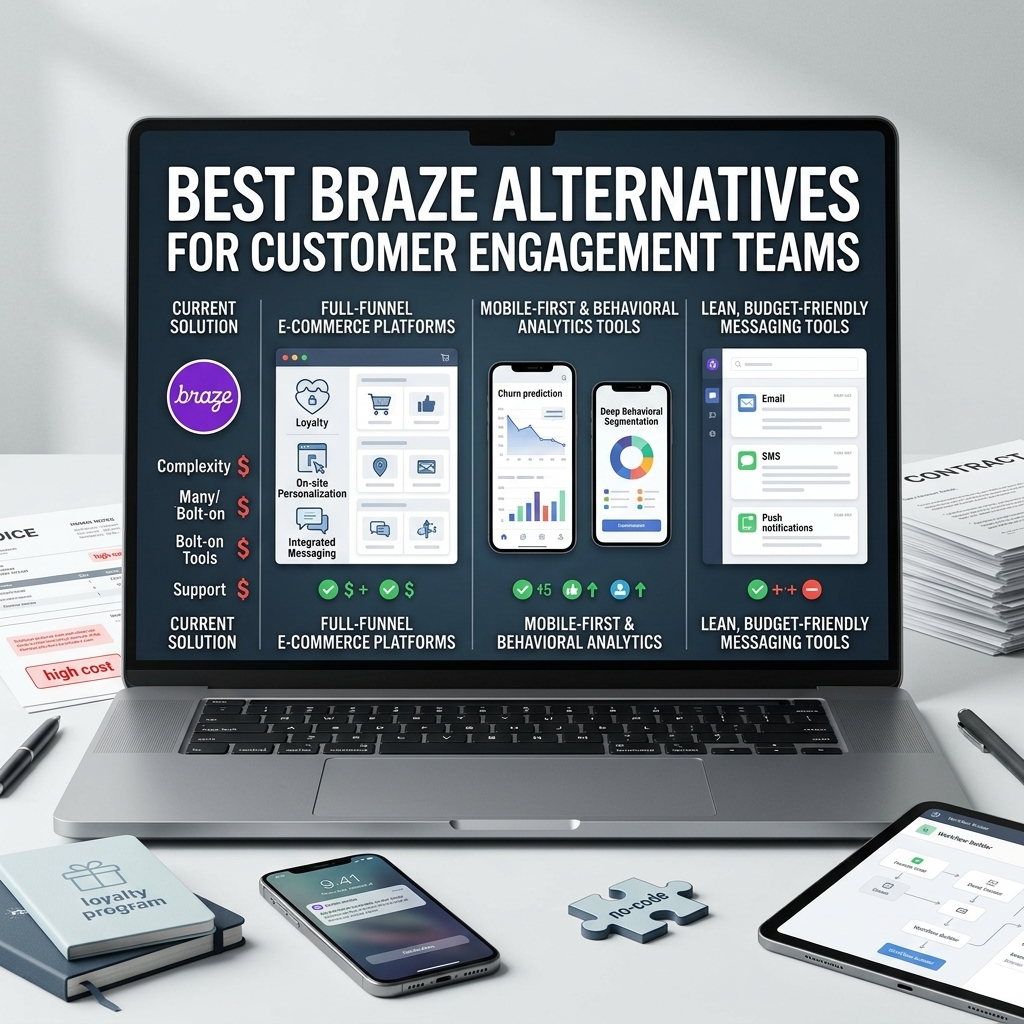
At some point, a lot of marketing teams sit down with Braze open in one tab and their invoice open in another, and the math just doesn’t feel right. Maybe it’s the price, maybe it’s a ticket sitting unanswered for days, maybe it’s the fifth tool bolted on just to run a loyalty program.
Whatever the reason, if you’re already looking into Braze Alternatives, you’re not imagining the problem; plenty of teams hit this same wall.
None of this is really an argument against Braze. It’s a genuinely capable platform, and for large mobile-first brands sending millions of messages a day, it does a lot right.
The issue tends to show up for smaller and mid-sized teams that don’t need, or can’t afford, that much horsepower, and end up paying enterprise prices for a Canvas builder that still feels clunky day-to-day.
Why Teams Start Shopping Around?
It’s rarely one dramatic breaking point. It’s usually a stack of smaller annoyances that eventually add up to a real decision.
The Cost Doesn’t Always Match the Value
Braze contracts are custom, which sounds flexible until you realize there’s no published rate card and no way to know what you’ll actually pay until you’re deep in a sales call.
- Pricing is usually tied to data volume and usage, which can punish exactly the brands relying most heavily on their data.
- Annual contracts routinely land well into five figures before you’ve added a single extra module.
- You’re often still paying for a second analytics tool on top, since Braze’s own reporting rarely feels deep enough for the price tag.
Support When You Need It Most
Dedicated, hands-on support tends to get reserved for the biggest enterprise accounts. Everyone else is working through a ticket queue, and when an automation breaks mid-campaign, a slow response isn’t just frustrating; it’s actual revenue slipping away while you wait.
Gaps That Force You to Stack More Tools
Braze covers messaging well, but there’s no native loyalty engine, no on-site personalization, and a handful of small “why isn’t this here” gaps, things like countdown timers in emails or a proper campaign calendar view.
- Need loyalty? That’s a separate vendor, a separate contract, a separate login.
- Need on-site personalization? Same story, another tool bolted on.
- Each new tool brings its own bugs, its own bill, and one more thing that can break.
None of these gaps is fatal alone. It’s the accumulation that eventually costs more than switching would.
The Learning Curve Never Really Flattens
Braze gives you a lot of control, but that control comes with real complexity. Segments, Liquid templating, connected data sources, message variants- there’s a lot to learn before a team can use the platform confidently, and for a lean CRM team of two or three people, that ramp-up time is expensive on its own.
What Actually Matters in an Alternative?
Ask questions around logos before comparing them; get specific around what’s not working. The noise often heard from these problems is cost or support complaints; the problem may be missing features, or there is a mismatch between the complexity of the platform and your team size.
Match the Platform to Your Team, Not Just Your Channel List
You can’t assume that a platform designed for enterprise engineering teams will be better for a lean marketing team; it is simply differently shaped.
If most of your team is marketers and not developers, be sure to find a real no-code builder, not one that is simply assuming you’ll have engineering support on demand.
Match the Platform to What You’re Actually Missing
If there is a lack of loyalty and on-site personalization, then a platform with those capabilities will save you the trouble of managing three vendors to run one retention strategy. A platform focused on behaviour and behavioural scoring is more appropriate than an all-purpose messaging platform if mobile analytics is the goal.
Where the Options Actually Differ?
Not every alternative is trying to be a smaller Braze, and knowing the rough categories saves a lot of evaluation time.
Full-Funnel E-Commerce Platforms
These integrate both messaging and a real-time customer data layer, native loyalty, promotions, and on-site personalization to replace Braze plus the additional tools that most teams end up using around Braze.
Mobile-First and Behavioral Analytics Tools
Built for teams where the product lives mostly inside an app, these lean heavily into predictive scoring, churn prediction, and deep behavioral segmentation.
Lean, Budget-Friendly Messaging Tools
These are purely about greatness with email, SMS, or push without trying to be an all-in-one platform.
The right choice is to choose the one that corresponds not only in the name, but in the actual gap you have as well.
Making the Switch Easier
Feeling a little nervous about migrating is normal. You’ve put real time into your segments, flows, and sender reputation, and nobody wants to blow that up for nothing.
Audit What You’re Actually Using
Before signing anything new, take an honest look at what’s happening inside your current setup.
- A lot of accounts are paying for advanced features, like predictive analytics, that nobody on the team has touched in months.
- Some things you really do need, like native loyalty or on-site personalization, might just not exist in your current plan.
The more obvious indicator that it is time to seek a different alternative is the gap: the pay cut of unused services combined with the lack of the ones you need.
Test Before You Commit Fully
Solid alternatives will usually help with migration and list cleanup, sometimes with free onboarding thrown in.
- Compare your recent Braze months with the actual number of engagements, NOT contacts.
- Test out a real process on the new platform, be it a welcome process or an abandoned cart process, before making the entire migration.
- Take note of the amount of developer effort required to configure each workflow
Conclusion
That’s not the point; there is not just the one “best” replacement. For a mobile-first app, a platform that focuses on behavioral analytics may be the best.
A lean e-commerce team that’s constantly drowning in point solutions might find more value in a single platform solution that wraps loyalty and personalization into one. If you have a small technical team, you may only need something simpler and less expensive that will do messaging and nothing more.
Platform switching is no one-size-fits-all process and should not be finished in an afternoon. If your current solution isn’t working for you and your team, or your budget, then maybe take the time to determine what will.




