
Every expanding company runs up against a brick wall sometime. The product is ready and available for a new market, but the website is still “speaking” in one language. That difference can cost more than people think.
CSA’s research put a number on it once: roughly three out of four shoppers say they’d rather buy from a site written in their own language.
So it’s not really a surprise that more companies are looking seriously at website translation as an actual growth lever now, not just a box to check later.
The hard part isn’t deciding whether to translate. Most teams get there eventually. It’s figuring out how to do it without turning into a six-month engineering project, or worse, a maintenance headache where the translated version quietly falls three releases behind every time the site changes.
Why So Many Teams End Up Stuck Here?
There’s usually an actual reason behind the decision, whether it’s reaching new customers, keeping up with competitors, or finding new growth opportunities abroad.
The Cost Problem
Traditional localization pricing tends to punish exactly the kind of site that’s growing fast.
- Agencies will often re-translate whole pages instead of just the bits that actually changed.
- Repeated content, your nav, your footer, that “Book a demo” button, gets billed again on every page it shows up on.
- A few hundred pages can quietly turn what looked like a small project into a five-figure invoice.
The Engineering Problem
Every new language used to mean a ticket for the dev team. Duplicate the templates, wire up new routing, rebuild the nav. Then the site changes on a random Tuesday, and suddenly the translated version is weeks behind, because nobody wants to reopen that whole project again.
The Visibility Problem
A translated page search engines can’t actually crawl might as well not exist for organic traffic. Plenty of quick-fix tools translate text right in the visitor’s browser, which looks fine to a human but is basically invisible to Google, since nothing there ever gets indexed.
- No hreflang tags, and search engines have no idea which language version to show which visitor.
- Untranslated meta titles and descriptions mean your French listing still shows up in English.
- No indexable URLs means none of that content shows up in search results at all.
What a Good Setup Should Actually Do?
Before picking a tool, get clear on what you’re in fact solving. Speed to launch matters, sure, but so does what happens six months later when the site’s still changing every week.
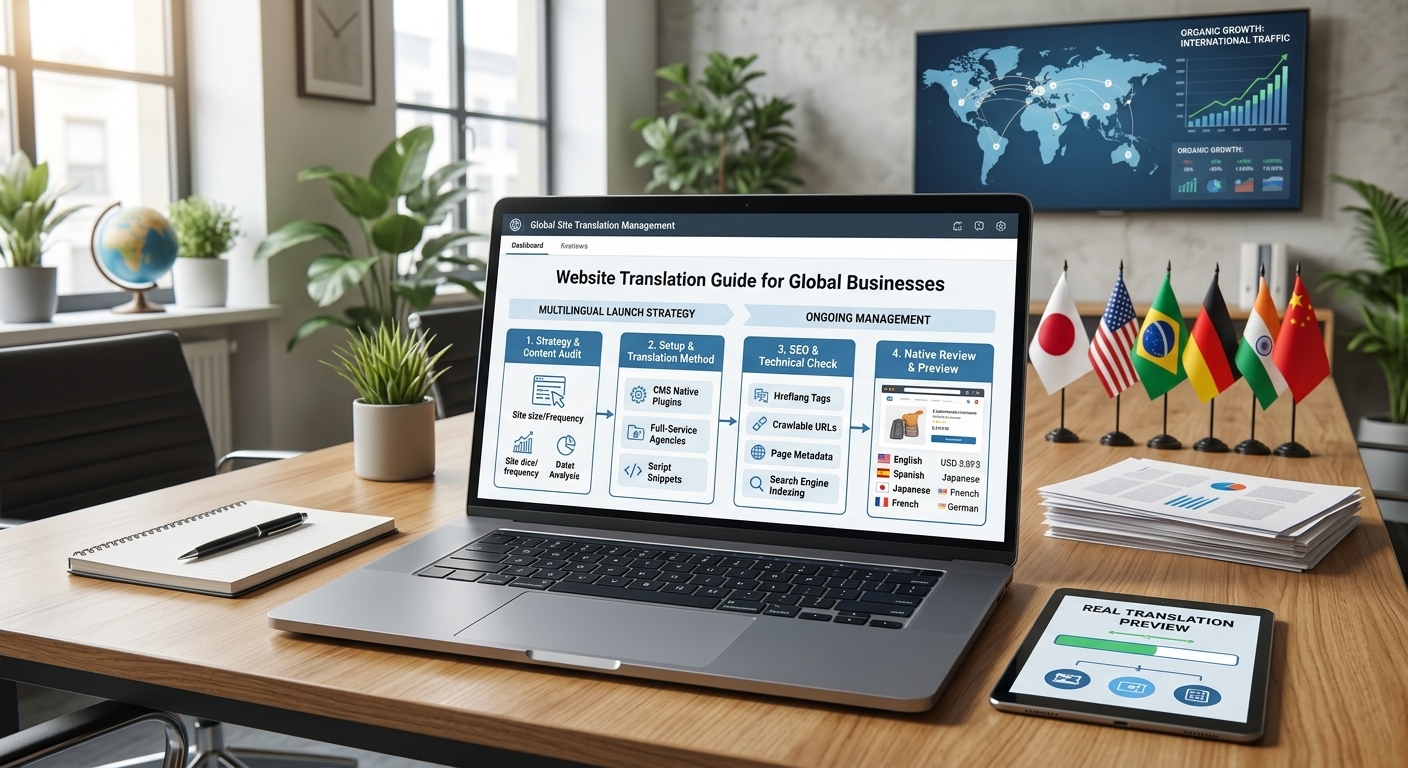
Match the Approach to Your Site Size and Update Frequency
A site that barely changes can probably get away with a one-time translation project. If you have access to a computer, check the size and frequency of your site and compare them with the approach.
If it is a static site with little to no changes, it may be feasible to have a one-time translation project. For a site that updates weekly, it’s important to add pages as it changes, but not necessarily translate the entire site frequently.
Match the Approach to Your SEO Goals
If organic traffic in new markets is indeed important, then browser-based translation simply won’t cut it. You should have translated pages representing each language at real, crawlable URLs, within a subdirectory, a subdomain, whatever, and you should have hreflang tags correctly placed and translated page metadata as well. Then search engines will consider each language version a real, indexable page.
Lightweight Snippet Tools
Add one script tag; translations render live in the browser, no rebuild, no DNS changes. Fast to get live, and honestly fine when a staging site or internal tool just needs to be readable in another language.
CMS-Native Plugins
If your content already lives in WordPress, Webflow, Contentful, whatever, translating right at the source through a plugin keeps everything inside the workflow your team already uses, with updates syncing automatically as the source content changes.
Full-Service Agencies
However, for very specific or regulated content, there are times when a dedicated human translation service is still the best option. That trade-off is often worth the more expensive and slower transmission in cases where an error is quite literally a big deal for the content.
It really depends on your site’s frequency of change and your traffic’s needs in each market for organic search.
Rolling It Out Without Creating a Mess
Feeling a bit cautious before touching a live site’s infrastructure is completely normal. Nobody wants to break pages that already work fine.
Start With a Real Preview, Not a Sales Deck
Before committing to anything, look at your actual pages translated, not some generic demo site. Most proper tools can enable you to insert your own URL and see a real preview prior to signing up for a thing.
- Do not translate the entire website blind; it is best to write a few key pages first.
- Get a native speaker to review at least a sample before it goes live to real visitors.
- Confirm product names and brand terminology actually stay consistent across pages.
Test the SEO Side Before You Rely on It
If ranking in new markets is the whole point, verify the mechanics work before scaling anything up.
- Check that translated pages actually get their own crawlable URL, not just a browser-side swap.
- Confirm hreflang tags are generated correctly and point both ways between language versions.
- Check whether titles and meta descriptions get translated too, not just the visible page content.
Conclusion
There are no set rules for this. The size of the site, the frequency of changes, and whether new markets are the objective or a bonus in the form of organic search are really the deciding factors. You may have something that is a small, comparatively static site that will suffice with a one-time project.
In a high-speed ecommerce catalog, you may want to use something automated that recognizes changes that occur in real time and maintains the translated pages correctly indexed.
In any event, the businesses that carry this out well tend to deal with it more like a continuous piece of running the site, instead of as a solitary task.
You can’t just add a multilingual option as an afterthought and expect it to work the first time around; it’s an investment and needs to run well.




