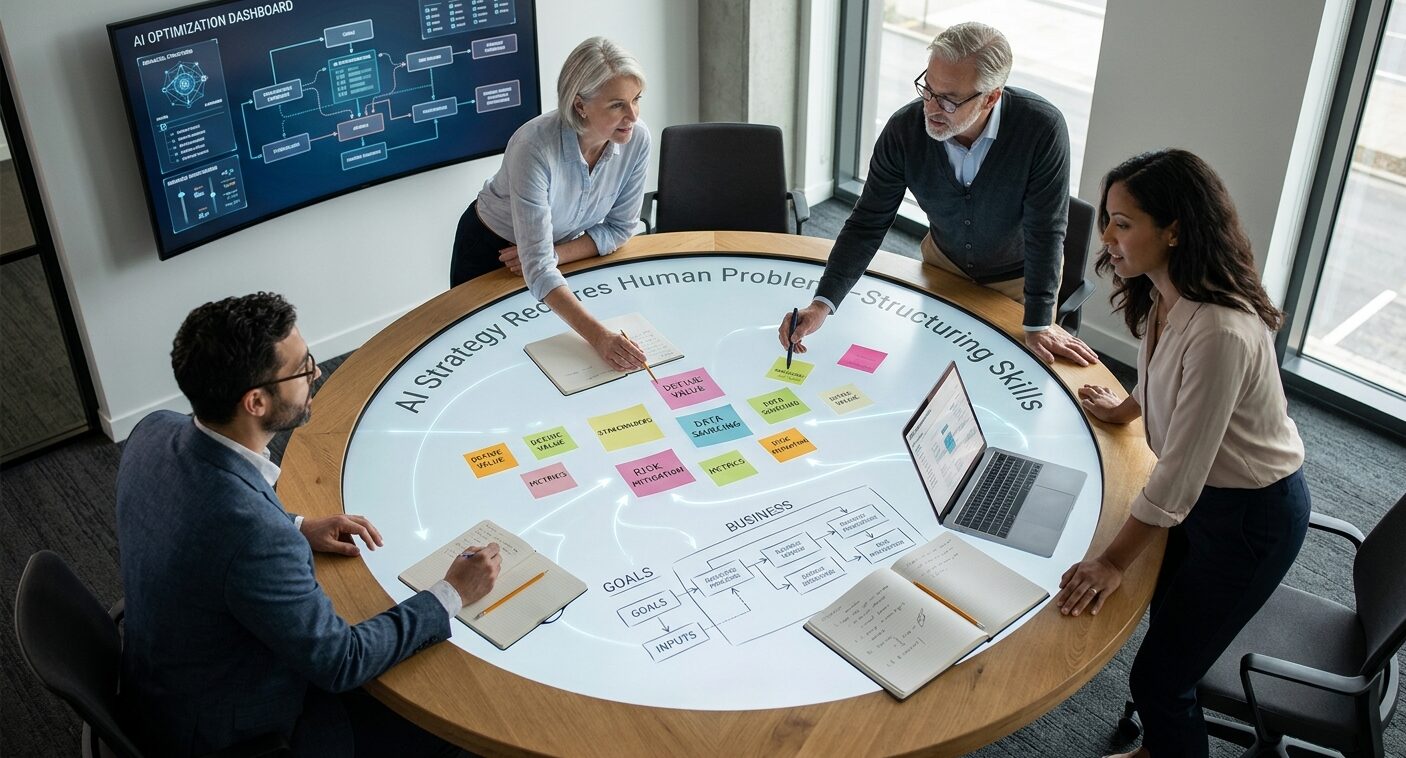
Ask an AI model for a strategic recommendation, and it will hand you one in seconds, complete with supporting rationale and a confident tone.
That confidence says nothing about whether the underlying question was framed correctly in the first place. Most conversations about AI strategy focus on how fast the tool can think. Few ask whether anyone actually checked what it was thinking about.
This gap only grows as AI improves. When answers were slow and expensive, teams naturally spent real time defining a problem before starting the work.
When answers are instant, that discipline can quietly disappear. AI can synthesize large volumes of research, surface patterns, and generate an initial range of strategic options far faster than traditional manual workflows.
Deciding which problem deserves attention, which constraints matter, and which trade-offs are acceptable remains a leadership responsibility.
What AI Actually Speeds Up?
Modern models are useful for synthesis, pattern-finding, and option generation. AI can dramatically accelerate the first pass at scenario generation, giving teams more time to test assumptions, compare possibilities, and interpret what the scenarios mean.
AI can also act as a sparring partner. A model can argue against a leader’s favored strategy, surface assumptions inside a forecast, and generate options the team has not considered. Used this way, AI broadens the range of ideas available for review.
A model can surface and compare possible trade-offs. The organization’s purpose, risk tolerance, and accountability for the outcome still belong to its leaders. AI can widen the option set and challenge assumptions. Leaders decide which trade-offs to accept.
What Leaders Still Have to Define?
Before AI-assisted analysis becomes decision-ready, leaders need to define the frame it will work within. What decision is being made, and by what date? What outcome would count as success, and for whom? What constraints cannot be crossed? Which parts of the business, workforce, and operating model are in scope, and which are deliberately excluded?
This boundary-setting work belongs at the start of the analysis. It typically covers:
- The decision itself, who owns it, and the deadline it’s tied to
- The constraints: budget, regulatory requirements, capacity, values or other non-negotiables
- The system boundary: what’s in scope, out of scope, connected to the problem, and which affected groups sit inside it
- The stakeholders whose trade-offs matter and how much weight each carries
- The evidence threshold: how much certainty is needed before acting
- The time horizon the decision needs to hold up over
Skipping this step still produces AI-assisted analysis quickly. It just answers a question nobody actually asked. Once these boundaries exist, AI has something worth working with. A well-structured problem turns AI’s raw output into something a leadership team can act on with confidence.
AI can help challenge the frame, identify missing questions, and expose hidden assumptions. Leaders still own the problem definition and the consequences of the decision.
A Five-Part Method for Human-Plus-AI Strategy
One practical way to combine structured thinking with AI speed is a five-part method that keeps humans in charge of the parts that matter most.
- Frame the decision: Leaders define the choice, owner, timing, desired outcome, and non-negotiable constraints. AI can stress-test the wording, surface missing questions, and challenge whether the frame is too broad or too narrow.
- Set the system boundary: Leaders decide what’s in scope, out of scope, and connected to the problem, including the people and functions affected. AI can map dependencies and flag interfaces or stakeholders the team may have overlooked.
- Map evidence and uncertainty: Leaders set the evidence threshold and distinguish what’s verified, assumed, weak, or still unknown. AI can synthesize research, organize the evidence, and surface contradictions. The team remains responsible for source quality and interpretation.
- Build and stress-test options: AI can expand the option set, generate adjacent scenarios, and surface counterarguments. Leaders judge plausibility, downstream consequences, and trade-offs.
- Align, decide, and revisit: Leaders make the decision, document the trade-offs, assign accountability, and set review points. AI can help track assumptions and new signals that could justify reopening the decision later.
A useful division of work is to let AI take on more of the low-value cognitive load around synthesis and option generation. Leadership attention can then stay on framing, verification, trade-offs, and accountability.
In our own AI experiments, an admissions prediction model underperformed when the available data was limited, and we expected it to improve as more admissions and employment outcomes accumulated.
That experience points to a broader strategy rule: confidence in an AI-supported recommendation should stay proportional to the evidence behind it.
A disciplined approach to AI-supported structured problem solving begins before the first prompt: leaders must define the decision, its boundaries, and the evidence that would justify action.
The method above isn’t a one-time checklist. Foresight and strategy work is iterative by nature, and a new signal or a shift in stakeholder priorities can send a team back to step one.
An Illustrative Scenario: When the Frame Has to Change?
The scenario below is entirely hypothetical, built to show how a shifting frame changes a decision.
A company is deciding how far to redesign its customer operations function around AI-assisted workflows. Initial analysis suggests automating case triage, knowledge retrieval, and first-draft responses while keeping complex exceptions with employees. The team frames the decision around cost, service quality, implementation capacity, and a 12-month rollout.
Then workforce consultation reveals that many cases labeled routine rely on tacit judgment to identify vulnerable customers, policy exceptions, or escalation risk. That signal changes the frame.
The system boundary now includes role design, training, employee consultation, quality assurance, and customer safeguards. The evidence threshold for automating a workflow also rises because the team needs to understand which judgments can be standardized safely.
AI can generate alternative operating models and stress-test the assumptions behind each one. Those scenarios are alternatives to test, not predictions of what will happen.
The leadership team may still choose extensive automation, with the decision now evaluated against a different set of stakeholders and constraints.
A team that revisits the frame can document what changed, test the new evidence, and decide whether the rollout scope, sequencing, or governance needs to change. The decision remains connected to the work and people it will actually affect. That review can also change the evidence threshold.
A reversible pilot may justify acting with less certainty, while a decision that materially changes roles, employee responsibilities, or customer safeguards needs stronger evidence before implementation.
Governance Keeps the Process Honest
None of this works without basic governance around how AI-assisted analysis gets challenged and approved. Five elements matter most:
- Clear decision rights: who can approve action based on an AI-assisted recommendation
- A named challenge role: someone responsible for stress-testing the analysis before it moves forward
- Affected groups: which employees, managers, customers, partners, or regulators are touched by the decision, and how their input will be considered
- An assumptions and evidence record: what the recommendation currently rests on
- Planned review points: when the decision will be revisited and which signals are strong enough to reopen it
The NIST AI Risk Management Framework offers a useful reference point here, particularly its emphasis on mapping context and evaluating AI systems against the specific decision they’re meant to support, instead of treating an AI-generated output as sufficient justification on its own.
Knowing when to stop testing a hypothesis is ultimately a judgment call, weighing how convincing the current evidence is against the practical cost of chasing more of it. That judgment sits with a named person.
Organizations moving toward heavier AI involvement in strategic work are increasingly building hybrid decision models where humans retain the strategic calls, and AI orchestrates the surrounding workflow.
Getting the governance right now, while the tools are still relatively new, is easier than retrofitting it once AI-assisted recommendations are already embedded in how decisions get made.
Five Questions Before Acting on AI-Supported Strategy
Before treating an AI-assisted analysis as ready for a strategic decision, leaders can ask:
- What question did we actually frame, and does the AI-generated analysis still answer that same question?
- What’s the system boundary, and has anything happened recently that would change it?
- Which parts of this analysis are verified, which are assumptions, and which are weak signals we’re treating as stronger than they are?
- Who has the authority to approve this decision, and have they seen both the recommendation and the trade-offs behind it?
- What evidence would be enough to make us revisit this call in three months?
Answering them requires someone taking ownership of the decision the technology was asked to support.
The Principle That Doesn’t Change
As AI accelerates the mechanics of analysis, leaders still need to invest real time in framing the problem. AI-generated output is only as useful as the question and evidence behind it.
AI can propose trade-offs. Leaders remain accountable for deciding which ones to accept, applying human judgment to the organization’s purpose, risk tolerance, and stakeholders.
Leaders who treat framing as core strategic work end up with decisions built on evidence they trust, boundaries they chose deliberately, and trade-offs everyone involved actually signed up for.
| Author Bio
Flavio Soriano is an entrepreneur, educator and former Arthur D. Little and McKinsey consultant. As founder of High Bridge Academy, he leads a global faculty of 60+ former McKinsey, Bain and BCG consultants, helping professionals strengthen structured problem-solving, executive communication, stakeholder management and the practical use of AI at work. |