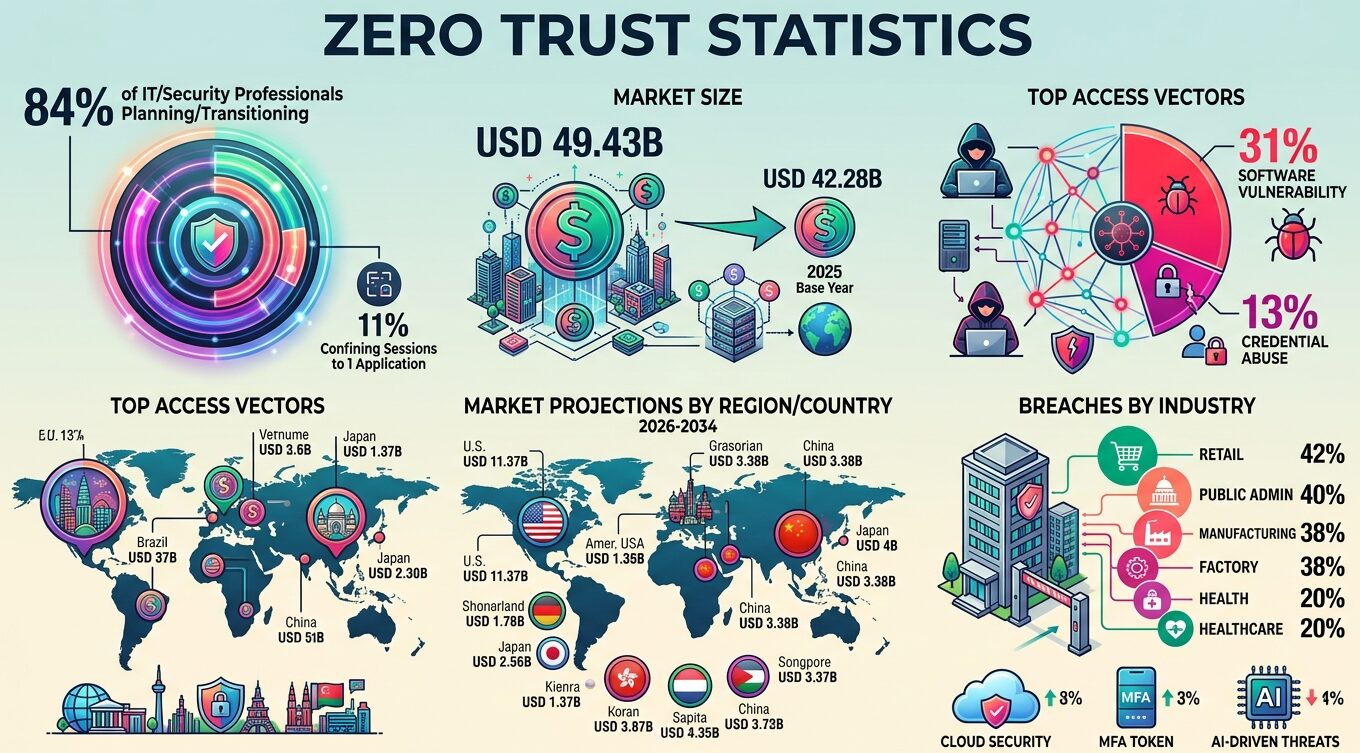
Eighty-four percent of the 822 IT and security professionals in Zscaler’s 2026 VPN Risk Report said they are planning or transitioning to zero trust. Just 11% could confine a compromised session to one application. These zero trust statistics cover adoption, VPN gaps, market size, breach entry points and vendor results, using reports published through September 2026.
Zero Trust Statistics
How Many Organizations Use Zero Trust in 2026?
Share of respondents planning or transitioning to zero trust
Zscaler’s 2026 VPN Risk Report put the share of respondents planning or transitioning to zero trust at 84%. Zscaler said that figure stood at 78% two years earlier.
The survey covered 822 IT and cybersecurity professionals and was run by a zero trust vendor with Cybersecurity Insiders. Its results describe that sample, not all companies.
Source: Zscaler ThreatLabz 2026 VPN Risk Report, 822 respondents, findings published March 2026
What did Gartner’s 2024 adoption survey find?
Gartner’s 2024 State of Zero-Trust Adoption Survey ran in the fourth quarter of 2023. It found 63% of organizations had fully or partially implemented a zero-trust strategy.
All 303 security leaders polled worked at organizations that had implemented zero trust or planned to. For 78% of implementers, the program took less than 25% of the cybersecurity budget.
Coverage was narrow. Gartner said a typical strategy addresses half or less of an organization’s environment and mitigates a quarter or less of enterprise risk.
Fifty-six percent pursued zero trust mainly because it is cited as an industry best practice. Another 35% reported a failure that disrupted implementation, and 79% of implementers track progress with strategic metrics.
Source: Gartner, survey conducted Q4 2023, published April 22, 2024
In January 2023, Gartner predicted that 10% of large enterprises would have a mature and measurable zero-trust program by 2026, up from less than 1% at the time.
Source: Gartner prediction, January 23, 2023
VPN Gaps in 2026: What 822 IT Pros Reported About Zero Trust
Zscaler’s 2026 survey tested how VPN-based access holds up after an attacker gets in. Seventy-seven percent said they cannot contain lateral movement after a compromise.
Speed is the top fear: 79% said AI lets attackers exploit vulnerabilities faster than patches can be deployed. Another 70% have limited or no visibility into AI-enabled threats moving over VPN.
One in three organizations inspects none of its encrypted VPN traffic. Just 8% can inspect virtually all of it.
Patching lags as well. Fifty-four percent need a week or more to fix a critical VPN vulnerability, and 56% rank patching as their top operational challenge.
AI-enabled attacks reached 61% of organizations in the past 12 months, while 24% have deployed AI-powered monitoring.
These figures describe enterprise remote access, while broader VPN usage trends track consumer and business adoption as a separate measure.
Source: Zscaler ThreatLabz 2026 VPN Risk Report, 822 respondents, findings published March 2026
Why do users bypass VPN controls?
Sixty-three percent of respondents said users bypass VPN controls to reach apps faster. Zscaler linked that behavior to performance complaints.
| Top VPN complaint | Share of respondents |
|---|---|
| Slow connections | 29% |
| Inconsistent device behavior | 23% |
| Frequent disconnections | 19% |
Zscaler did not state whether respondents could pick more than one complaint.
Source: Zscaler ThreatLabz 2026 VPN Risk Report, findings published March 2026
$49.43 Billion: Zero Trust Market Size Statistics for 2026
| Year | Market size (USD billion) | Figure type |
|---|---|---|
| 2025 | 42.28 | Base-year valuation |
| 2026 | 49.43 | Projection |
| 2034 | 148.68 | Projection, 14.76% CAGR (2026–2034) |
Fortune Business Insights values the global zero trust security market at $42.28 billion in 2025 and projects $49.43 billion for 2026. Its forecast reaches $148.68 billion by 2034.
The figures measure vendor revenue inside Fortune’s scope. That scope covers network, data, cloud, endpoint and application security sold to BFSI, retail, IT and telecom, government, healthcare and other industries.
Source: Fortune Business Insights, Zero Trust Security Market report, base year 2025, forecast 2026–2034, page updated September 28, 2026
Regional split: North America vs Asia Pacific
North America held 34.84% of the 2025 market, worth $14.73 billion. Asia Pacific followed with $11.77 billion, or 27.83%.
For 2026, Fortune projects $16.83 billion for North America and $14.16 billion for Asia Pacific.
| Region | 2025 value (USD billion) | 2025 share | 2026 projection (USD billion) |
|---|---|---|---|
| North America | 14.73 | 34.84% | 16.83 |
| Asia Pacific | 11.77 | 27.83% | 14.16 |
| Europe | 9.87 | 23.35% | 11.54 |
| Middle East & Africa | 3.39 | 8.03% | 4 |
| Latin America | 2.51 | 5.94% | 2.9 |
Source: Fortune Business Insights, Zero Trust Security Market report, 2025 values and 2026 projections, updated September 28, 2026
Which countries have the largest zero trust markets?
Fortune projects the U.S. market at $11.37 billion for 2026. All of Europe is projected at $11.54 billion.
China (3.38billion),Japan(2.76 billion) and India ($2.47 billion) are the Asia Pacific countries with published 2026 projections. The UK and Germany come in at $2.28 billion and $2.24 billion.
Source: Fortune Business Insights, Zero Trust Security Market report, 2026 country projections, updated September 28, 2026
MFA, cloud security and BFSI shares
Multi-factor authentication is projected to hold 52.59% of the 2026 market by authentication type.
Cloud security is projected at 26.50% of 2026 revenue by application. Spending on the platforms it protects appears in these cloud computing industry statistics.
BFSI is expected to lead industries with 25.11% of the 2026 market. Healthcare is forecast to post the highest industry CAGR.
Data security is the application Fortune expects to grow at the highest CAGR, a field where cloud data security platforms are ranked on coverage and remediation speed.
The report names Akamai, Cisco, Palo Alto Networks, IBM, Zscaler, Broadcom, CrowdStrike, Forcepoint, Skyhigh Security and Check Point among its top companies.
Source: Fortune Business Insights, Zero Trust Security Market report, 2026 segment projections, updated September 28, 2026
What Verizon’s 2026 DBIR Shows About Breach Entry Points
Vulnerability exploitation was the initial access vector in 31% of breaches with a known vector in Verizon’s 2026 DBIR. Credential abuse, the previous leader, fell to 13%.
The 2026 edition, published in May 2026, examined more than 22,000 confirmed breaches across 145 countries.
Remediation slowed. Organizations fully remediated 26% of critical vulnerabilities in CISA’s Known Exploited Vulnerabilities catalog in 2025, down from 38% a year earlier.
Median time to full resolution rose to 43 days, from 32.
Among the industries Verizon profiled, Retail (42%) and Public Administration (40%) had the highest exploitation shares. Manufacturing (38%), Educational Services (34%) and Financial and Insurance (22%) came next, with Healthcare lowest at 20%.
Source: Verizon 2026 Data Breach Investigations Report, published May 2026
Ransomware, third parties and MFA exposure
| Share of all breaches | 2026 DBIR | Prior edition, as cited by Verizon |
|---|---|---|
| Ransomware involved | 48% | 44% |
| Human element present | 62% | 60% |
| Third-party involvement | 48% | Up 60% (prior share not restated) |
Verizon also found that 23% of third-party organizations fully remediated missing or improperly secured MFA on their cloud accounts.
Source: Verizon 2026 Data Breach Investigations Report, published May 2026
How Fast Are Zero Trust Vendors Growing in 2026?
Palo Alto Networks, whose portfolio includes enterprise firewall lines, reported fiscal 2026 revenue of $11.48 billion against $9.221 billion in fiscal 2025. Fourth-quarter revenue rose 34% to $3.41 billion.
Its Next-Generation Security ARR grew 63% to $9.10 billion as of July 31, 2026. The release’s footnotes list CyberArk acquisition costs in the same fiscal year.
Zscaler’s fiscal 2026 revenue grew 25% to $3.353 billion, or 20% to $3.209 billion excluding Red Canary. ARR reached $3.771 billion, up 25%, and $3.630 billion without Red Canary.
Identity provider Okta reported revenue of $805 million for the quarter ended July 31, 2026, up 11%. Its remaining performance obligations rose 17% to $4.858 billion.
Both firewall-to-SASE vendors guide to slower ARR growth for fiscal 2027: 22% to 23% for Palo Alto Networks’ NGS ARR and about 16.6% to 17.4% for Zscaler. Each company defines ARR differently.
Source: Palo Alto Networks (September 1, 2026), Zscaler (September 3, 2026) and Okta (August 2026) earnings releases, periods ended July 31, 2026
AI-Generated Data and Gartner’s 2028 Zero-Trust Forecast
Gartner predicts that by 2028, 50% of organizations will implement a zero-trust posture for data governance because of unverified AI-generated data. The forecast was published January 21, 2026.
Gartner cited its 2026 CIO and Technology Executive Survey, in which 84% of respondents expected their enterprise to increase GenAI funding in 2026.
Verizon’s 2026 DBIR found 45% of employees are now regular AI users on corporate devices, up from 15% the previous year.
Gartner frames the posture around authenticating and verifying data. Proving a claim without exposing the underlying data is the aim of a related method, zero-knowledge proofs.
Source: Gartner press release, January 21, 2026; Verizon 2026 Data Breach Investigations Report, May 2026
FAQs
What percentage of organizations use zero trust?
Eighty-four percent of 822 respondents in Zscaler’s 2026 VPN Risk Report were planning or transitioning to zero trust. Gartner’s Q4 2023 survey found 63% had fully or partially implemented a strategy.
How big is the zero trust market in 2026?
Fortune Business Insights projects $49.43 billion for 2026, up from $42.28 billion in 2025. It forecasts $148.68 billion by 2034, a 14.76% CAGR from 2026.
Is zero trust replacing VPN?
In Zscaler’s 2026 survey, 84% were planning or transitioning to zero trust. Yet 54% still needed a week or more to patch critical VPN vulnerabilities.
Is zero trust just a buzzword, as some Reddit users argue?
Gartner’s Q4 2023 survey shows a gap between label and scope. Fifty-six percent pursued zero trust mainly because it is cited as best practice, and a typical strategy covers half or less of the environment.
What share of breaches start with vulnerability exploitation?
Thirty-one percent of breaches with a known initial access vector, per Verizon’s 2026 DBIR. That made exploitation the top vector, while credential abuse fell to 13%.
Sources
https://www.zscaler.com/blogs/company-news/ai-machine-speed-breaking-vpn-security
https://www.verizon.com/business/resources/reports/dbir/
https://www.quantumrun.com/consulting/cyber-security-market-statistics/