Global VR headset shipments fell 17% year over year in the first quarter of 2026, per Counterpoint Research, while shipments of AR glasses in the same quarter rose 136%. Two datasets are pointing in opposite directions: revenue forecasts keep climbing, unit shipments keep shrinking. This post sets out the verified numbers on virtual reality market size, shipments, vendor share and Meta’s spending.
Virtual Reality Market
How Big Is the Virtual Reality Market in 2026?
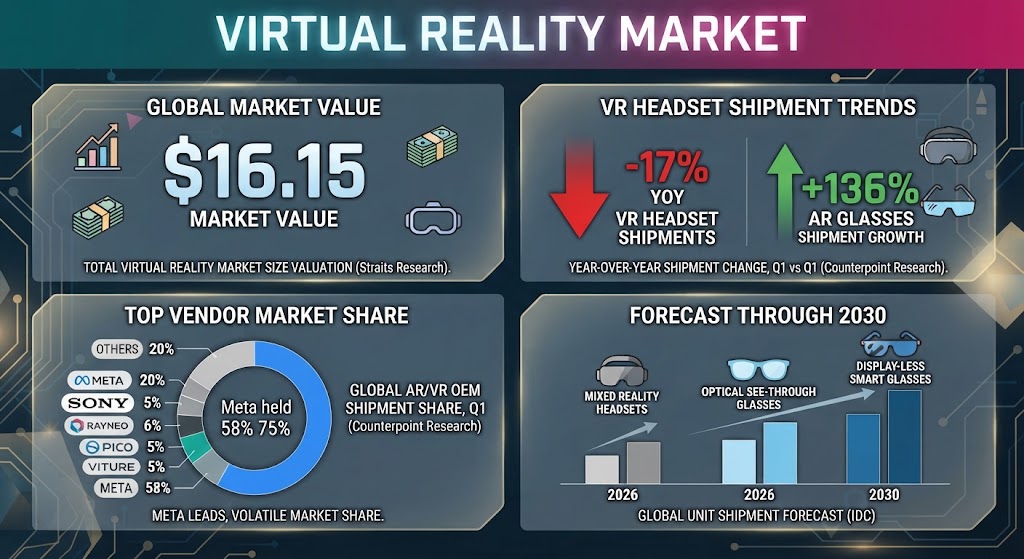
Straits Research values the virtual reality market at USD 16.15 billion in 2026, up from USD 13.23 billion in 2025, and forecasts USD 79.65 billion by 2034 at a 22.08% CAGR over 2026–2034.
Four firms publishing in the same window put the 2025 base anywhere from USD 13.23 billion to USD 20.83 billion. The gap is a scope decision, not a measurement dispute, since each firm draws its own boundary around hardware, software, services and content revenue.
| Research firm | 2025 market size | Published forecast | CAGR |
|---|---|---|---|
| Straits Research | USD 13.23 billion | USD 79.65 billion by 2034 | 22.08% |
| Market Research Future | USD 14.18 billion | USD 82.12 billion by 2035 | 19.2% |
| Polaris Market Research | USD 18.96 billion | USD 87.88 billion by 2034 | 18.5% |
| Fortune Business Insights | USD 20.83 billion | USD 171.33 billion by 2034 | 26.20% |
Source: Straits Research, Market Research Future, Polaris Market Research and Fortune Business Insights; vendor revenue estimates, 2025 base year, report editions current as of 2026. Each firm applies its own scope definition, so the rows are not interchangeable.
Nobody citing a single virtual reality market number is quoting a measurement. They are quoting one firm’s boundary. That ambiguity is a recurring feature of emerging-technology sizing, which is why curated trend lists tend to track direction rather than a headline figure.
Are Virtual Reality Market Headset Shipments Falling?
Yes. Counterpoint Research reports VR headset shipments down 17% year over year and 39% quarter over quarter in Q1 2026, which it attributes to a lack of new product launches and other market stimulus.
Every other eyewear category in the same tracker rose. Counterpoint groups intelligent eyewear into VR headsets, AR glasses and display-less smart glasses.
| Category | Shipment change, Q1 2026 vs Q1 2025 |
|---|---|
| Display-less smart glasses | +210% |
| AR glasses | +136% |
| All intelligent eyewear | +83% |
| VR headsets | −17% |
Source: Counterpoint Research, XR 360 Research Service, Q1 2026 update, published June 2026. Figures are year-over-year unit shipment changes, not revenue or user counts.
IDC recorded the same split across full-year 2025. Total XR device shipments grew 44.4% year over year, while Meta’s Quest headset line fell 42.3%, which IDC attributes to supply chain challenges and softening demand outside core gaming audiences.
IDC’s earlier December 2025 release had forecast 41.6% XR growth for the year, reaching 14.5 million units, with mixed and virtual reality headset shipments expected to decline 42.8%. The March 2026 figures supersede that forecast.
Virtual Reality Market Share by Vendor
Meta held 58% of global AR/VR OEM shipments in Q1 2026, down from 66% in Q4 2025, per Counterpoint Research. Sony ranked second at 7%.
| Brand | Q1 2025 | Q2 2025 | Q3 2025 | Q4 2025 | Q1 2026 |
|---|---|---|---|---|---|
| Meta | 71% | 72% | 58% | 66% | 58% |
| Sony | 7% | 6% | 6% | 6% | 7% |
| RayNeo | 3% | 5% | 6% | 5% | 6% |
| Pico | 5% | 4% | 5% | 4% | 5% |
| VITURE | 1% | 1% | 3% | 3% | 5% |
| Others | 13% | 12% | 22% | 16% | 20% |
Source: Counterpoint Research, Global XR (AR & VR Headsets) Market Tracker, Q1 2025 to Q1 2026, published June 2026. Shares are of unit shipments and are rounded to whole numbers, so columns can total 101%.
Meta’s Q3 2025 reading of 58% shows the series is volatile rather than trending in one direction. No challenger has gained more than four points across the five quarters, while the unnamed remainder moved from 13% to 20%. A fuller vendor breakdown sits in this VR headset market share data.
Where the Volume Went
IDC reports the global smart glasses category up 167% year over year in Q1 2026, at roughly 2.25 million units in the quarter. Meta led that category with 69.2% share.
Source: IDC, Worldwide Quarterly Wearable Device Tracker and Worldwide Quarterly Augmented and Virtual Reality Headset Tracker, Q1 2026 smart glasses vendor shipment share, page updated 1 July 2026.
Display-less smart glasses shipped roughly as much volume in Q1 2026 alone as the entire category managed across all of 2024, per IDC. The shift toward everyday eyewear was flagged in long-range internet forecasting well before the shipment data caught up.
What Meta Spends on the Virtual Reality Market
Reality Labs, the Meta segment covering virtual and augmented reality hardware, software and content, recorded a USD 19,193 million operating loss on USD 2,207 million of revenue in FY 2025.
| Metric | FY 2024 | FY 2025 |
|---|---|---|
| Reality Labs revenue | USD 2,146 million | USD 2,207 million |
| Reality Labs operating loss | USD 17,729 million | USD 19,193 million |
| Q4 revenue | USD 1,083 million | USD 955 million |
| Q4 operating loss | USD 4,967 million | USD 6,021 million |
Source: Meta Platforms, Fourth Quarter and Full Year 2025 Results, segment information, published 28 January 2026.
The 2026 picture has not changed direction. Reality Labs posted USD 431 million of revenue and a USD 4,619 million operating loss in Q2 2026, against USD 370 million and USD 4,530 million a year earlier.
For the six months to 30 June 2026, segment revenue was USD 833 million and the operating loss was USD 8,647 million. Meta has told the market it plans to reduce Reality Labs expenses by up to 30% amid layoffs while stating it is not exiting VR, per Counterpoint Research.
Virtual Reality Market Forecast Through 2030
IDC forecasts mixed reality headsets, the category anchored by Meta’s Quest series, growing from 3.2 million units in 2026 to 10.4 million by 2030.
| Segment | 2026 units | 2030 units | CAGR |
|---|---|---|---|
| Display-less smart glasses | 13.6 million | 27.3 million | 18.9% |
| Optical see-through display glasses | 3.0 million | 12.2 million | 41.9% |
| Mixed reality headsets | 3.2 million | 10.4 million | 34.4% |
Source: IDC, Augmented and Virtual Reality Headsets Market Insights, unit shipment forecasts, page updated 1 July 2026.
Headsets are forecast to stay the smallest of the three segments by volume through 2030. IDC expects display-equipped glasses to overtake VR and MR headsets in shipment volume by 2027, and separately puts XR shipment growth at 33.5% for 2026 with a 26.5% CAGR over 2026–2030.
Average selling prices for display-less smart glasses currently sit near USD 376 and are forecast to compress to roughly USD 229 by 2030, per IDC. Whether headsets recover inside that shift is the open question in most technology forecasts for 2030, and near-term expectations are collected in the 2026 predictions timeline.
Ownership and usage measures tell a separate story from shipments, covered in these VR gaming headset ownership figures. Wider context on where immersive hardware sits among other computing shifts runs through Quantumrun’s special reporting series and its account of how interfaces change across generations.
FAQs
How big is the virtual reality market in 2026?
Straits Research values it at USD 16.15 billion in 2026, up from USD 13.23 billion in 2025, with a forecast of USD 79.65 billion by 2034. Other firms put the 2025 base as high as USD 20.83 billion using wider scope definitions.
Are VR headset sales going up or down?
Down. Counterpoint Research recorded VR headset shipments falling 17% year over year and 39% quarter over quarter in Q1 2026. IDC reported Meta Quest shipments down 42.3% year over year across full-year 2025.
Reddit threads keep saying VR is dying. What does the shipment data show?
Reddit discussion tracks one real number. VR headset shipments fell 17% year over year in Q1 2026, per Counterpoint. But total XR shipments grew 44.4% in 2025, per IDC, so the category grew while headsets shrank.
Is Meta quitting VR, as some Reddit users claim?
No. Counterpoint Research reports Meta has reiterated it is not exiting VR, while planning to cut Reality Labs expenses by up to 30% amid layoffs. Reality Labs lost USD 19,193 million in FY 2025.
Who has the largest virtual reality market share?
Meta. It held 58% of global AR/VR OEM shipments in Q1 2026, down from 66% in Q4 2025, per Counterpoint Research. Sony ranked second at 7%, followed by RayNeo at 6%.
Sources
https://straitsresearch.com/report/virtual-reality-market
https://www.idc.com/promo/arvr/
https://counterpointresearch.com/en/insights/global-xr-ar-vr-headsets-market-share-quarterly
https://investor.atmeta.com/investor-news/press-release-details/2026/Meta-Reports-Fourth-Quarter-and-Full-Year-2025-Results/default.aspx