Adaptive bitrate streaming (ABR) lets a video player change picture quality while the programme continues. Instead of receiving one fixed version of a live feed, the player chooses among prepared versions as viewing conditions change.
A change in sharpness can therefore reflect a different version being delivered, rather than a change to the camera or the event being filmed. The choice happens during playback, segment by segment.
Live-dealer entertainment provides an ongoing physical subject for streaming: a dealer conducts activity at a table while viewers follow it remotely. The event continues as it is filmed. Its presentation involves preserving a recognisable view of the table and delivering new pictures throughout the session.

What a live casino stream needs to show?
At a live-dealer table in Australia, the pictures carry information about the game in progress. Players follow the dealer’s actions, distinguish the objects on the table, and recognise when the round moves on. Card ranks, dealing movements, and a turning roulette wheel give the video specific details to convey throughout play.
The live-dealer games available through a live casino in Australia include blackjack, roulette, and baccarat, with access on mobile and desktop devices.
Their live character comes from a dealer conducting the physical game as Australian players take part remotely. The video shows cards being dealt or a wheel spinning, connecting the game’s rules with the activity happening at the table.
In blackjack, cards are dealt to the player and the dealer, and players can request another card or keep their existing hand. Those choices are called hitting and standing. The aim is to reach 21, or get close without going over, while playing against the dealer’s hand.
Readable card ranks let players follow the hand’s value, while the dealer’s movements show how the deal progresses. The picture carries both small details and an unfolding sequence.
Baccarat organises the card action around two hands, labelled Player and Banker. These labels identify the hands being dealt, rather than two people competing through the stream. Following the round involves keeping those positions distinct as the dealer reveals their cards.
The placement and values of the cards give the table its structure, so a useful view needs to preserve the relationship between the two hands and ensure players are able to clearly differentiate between them at all times.
Roulette introduces a different visual requirement. The dealer spins the wheel and sends the ball around it before it settles in a numbered pocket.
Following the round involves watching that movement develop and then identifying the final pocket. The picture moves from showing continuous motion to presenting a stationary detail that completes the spin and determines whether a bet has won.
Across these formats, continuity and readable detail serve connected purposes. Players follow the sequence of the physical game while identifying the cards or numbers involved.
In services using adaptive bitrate streaming, the player selects among prepared video versions as viewing conditions change. Those selections concern how the pictures are delivered while the underlying table activity continues.
One live feed, several encoded versions
Encoding converts captured video into compressed data suitable for delivery. For adaptive streaming, that material is prepared in several versions, called renditions. These commonly differ in bitrate and resolution, giving the player a set of choices, rather than one fixed stream.
Bitrate measures the amount of encoded video data used per second. Resolution gives the picture’s pixel dimensions, expressed as width and height.
A resolution label identifies the size of the image grid, while bitrate describes the data rate of the encoded version. Reading both gives a fuller description of a rendition.
The versions represent corresponding material from the same programme timeline. That relationship allows the player to move between them while following the broadcast, rather than joining a different programme when quality changes.
A collection of renditions is often called an encoding ladder. The ladder defines what can be requested, but it does not decide what each viewer receives. Mux’s explanation of how players select and report renditions locates that decision in the player, who selects according to their conditions.
The player chooses the next segment
In segment-based adaptive streaming, video is delivered in successive pieces. The player can request the next segment from a different available rendition while continuing the same programme. Quality selection therefore operates within playback, rather than requiring a fresh start each time the chosen version changes.
Available bandwidth and device conditions at the receiving end will influence that selection. The player chooses from the versions offered, and different players can weigh those conditions differently.
Successive requests can continue to select the same rendition. The player keeps making choices as it requests new segments, including during periods without a visible quality switch. Adaptation allows a response to changing conditions without requiring the picture to change quality with every segment.
Selection remains bounded by the versions the service provides. A player cannot request a rendition that is absent from the available set.
Preparing those options and choosing between them are separate jobs: the encoding process creates the alternatives, while the player determines which available version to request for the next segment.
Available quality and delivered quality
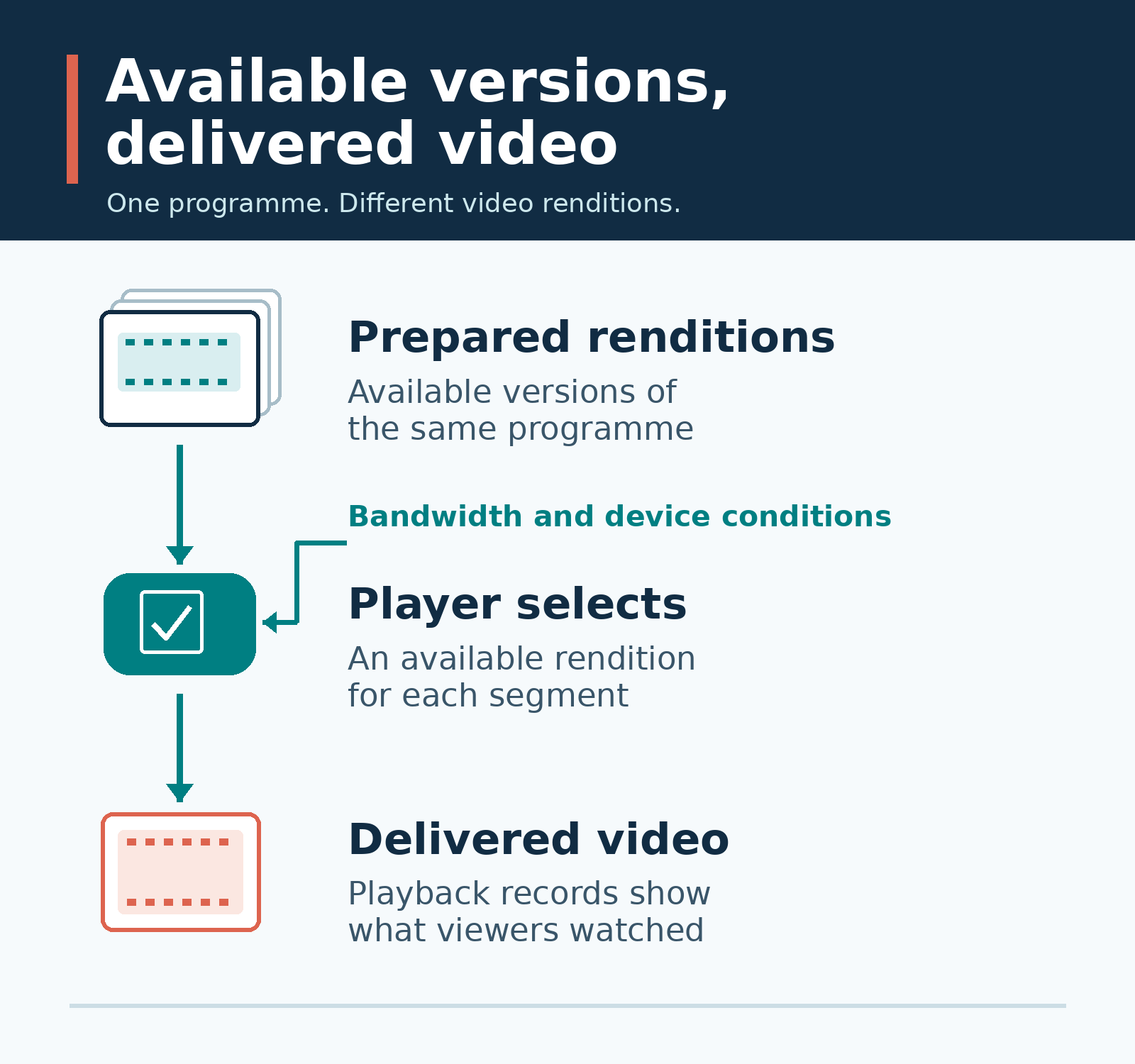
An encoding ladder shows the versions a service makes available. Establishing what people watched requires playback data. The two records answer different questions, so inspecting the versions on a server cannot establish how much time viewers spend watching each one.
Mux’s playing-time-by-rendition metric measures actual viewing time associated with a rendition. It excludes time spent paused, rebuffering, or seeking. That definition keeps time spent watching a particular version separate from other parts of the session.
Renditions can also be grouped by different attributes. Grouping only by resolution combines versions with the same picture dimensions, even when other encoding properties differ. A resolution-based view consequently answers a narrower question than a record retaining those other properties.
Playback records can also be examined by device category. An overall view combines activity across supported screens, while a device-specific breakdown describes the renditions delivered within that group. Keeping the population clear allows a report about one category of device to be read within its actual scope.
The picture is one part of playback quality
Picture detail sits alongside continuity and device behaviour in the overall viewing experience. In a discussion of livestream performance and viewing quality, engineers from NBCUniversal and Warner Bros. Discovery discuss the relationship between technical measurements and the experience delivered to viewers across different devices.
NBCUniversal’s Seb Emin describes using viewing data to inform development and optimising for individual platforms. Warner Bros. Discovery’s Subhrendu Sarkar notes that programme popularity complicates attempts to connect engagement with a bitrate increase.
An audience response reflects more than a single technical measurement, so stronger engagement cannot automatically be credited to a higher bitrate.
A larger bitrate figure alone cannot describe whether playback was consistent or suited to the device. Adaptive selection supplies a way to choose among available video versions; assessing its result requires people to look at the presentation that actually reached the screen.