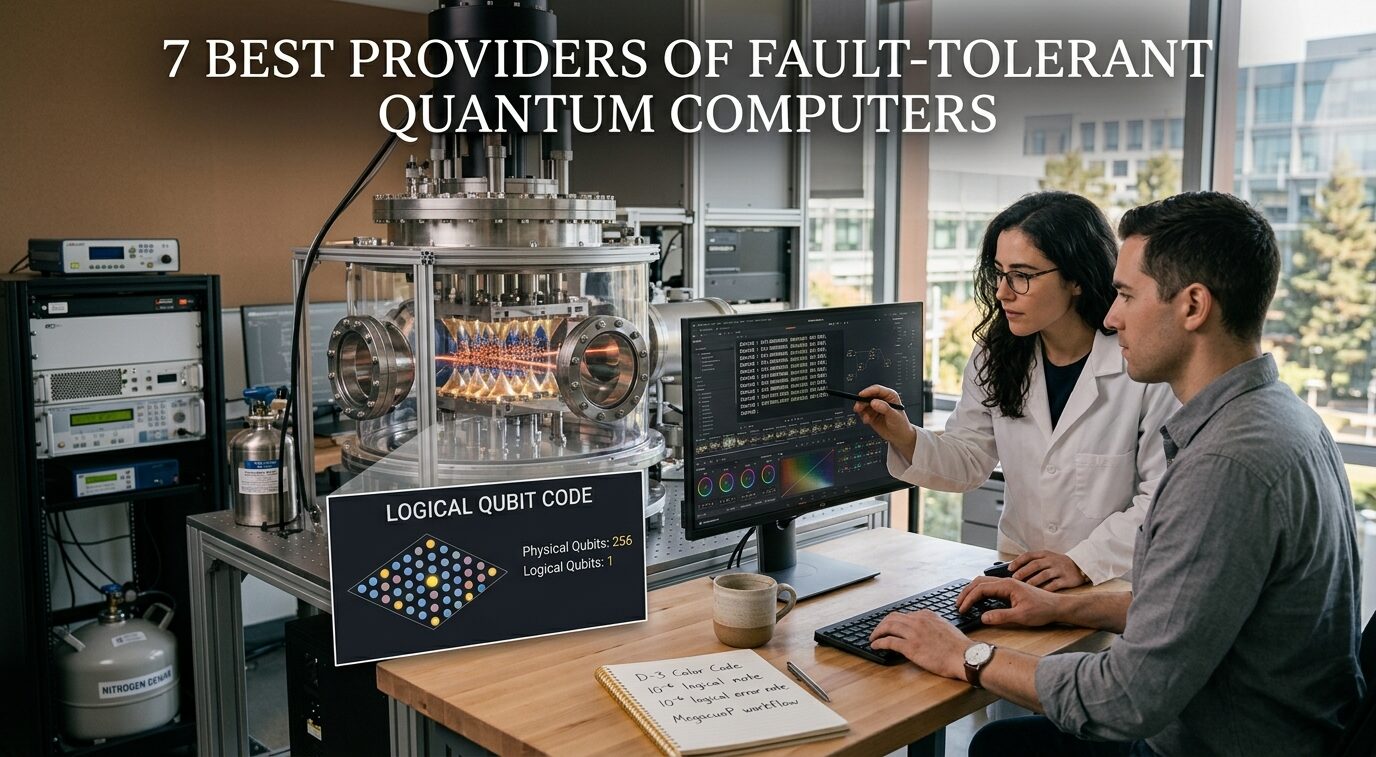
Every quantum computer sold today makes errors faster than most useful algorithms can tolerate. Fault tolerance is the fix: encode each logical qubit across many physical ones, detect errors as they occur, and correct them in real time so a computation can run millions of steps.
Buyers in pharma, energy, finance and national research programs are being asked to pick the vendor whose machine will reach that regime first, and to prepare workloads years before delivery.
Comparing candidates is hard because the evidence comes in incompatible forms. One vendor reports a logical memory with a very low per-cycle error rate on a hundred physical qubits.
Another publishes a dated architecture for a 200-logical-qubit machine that does not yet exist. A third has sold a 50-logical-qubit system still being installed. Vendors rarely report physical-to-logical ratio, error rate per cycle and reliable operations per run together.
This guide mentions seven providers of fault-tolerant quantum computers, evaluating each on published logical-qubit experiments on operating hardware, the specificity and date of its first fault-tolerant system, and the access path it offers customers today.
In Brief
The short version for anyone deciding where to place early bets:
- No vendor ships a fault-tolerant quantum computer yet. First-system targets cluster between 2027 and 2029, and every date here is a target unless stated as a measured result.
- Trapped ions and neutral atoms currently hold the best published logical-qubit results; superconducting vendors lead on engineering scale and manufacturing.
- QuEra has the earliest dated system on this list at the million-operation scale: Libra, targeted for Amazon Braket in 2028 with 256 logical qubits, plus an on-premises route through HPE.
- Early access programs, not hardware, are what customers can buy in 2026.
How This List Was Built?
We considered only companies building their own quantum processors with a public commitment to a fault-tolerant system. Each needed at least one peer-reviewed or formally published logical-qubit experiment run on its own hardware, so that roadmap claims rest on measured error-correction behavior rather than simulation.
We then required a named first fault-tolerant system with a stated logical-qubit count, a target date, and at least one intermediate milestone customers can check.
We weighed how customers reach the technology now, through cloud services, on-premises contracts or co-design programs, and whether the vendor separates targets from results in its own materials. Modality, valuations and funding totals were not criteria.
Side by Side
The seven span four modalities and three different ideas of what “first fault-tolerant system” means.
| Provider | Modality | Best published logical result | First fault-tolerant system | Access today |
|---|---|---|---|---|
| QuEra | Neutral atoms | Logical magic-state distillation on Gemini | Libra, 256 logical qubits, Amazon Braket 2028 | Aquila via Braket; Gemini via NERSC program; co-design |
| Quantinuum | Trapped ions | 99.9995% logical memory fidelity per cycle on Helios | Apollo, 2029; Sol with 100 logical qubits in 2027 | Helios cloud and on-premises |
| IBM | Superconducting | Loon connectivity demo; decoder prototypes | Starling, 200 logical qubits, 2029 | Heron and Nighthawk via IBM Quantum |
| Google Quantum AI | Superconducting | Below-threshold surface code on Willow | Long-lived logical qubit next; no dated product | Research collaborations only |
| Atom Computing | Neutral atoms | 24 entangled logical qubits with Microsoft | Magne, 50 logical qubits, spring 2027 | None yet |
| PsiQuantum | Photonics | Omega chipset fidelities in Nature | Utility-scale system in Brisbane; test system in Chicago | None yet |
| Pasqal | Neutral atoms | Logical qubits demonstrated 2025 | 200 logical qubits by 2029 | Orion analog systems, cloud and on-premises |
3 Numbers to Ask Every Vendor For
Language around fault tolerance is loose, so insist on comparable figures. Three matter most:
- Logical error rate per cycle. The probability that a logical qubit fails during one round of error correction, with the code and distance stated.
- Physical-to-logical ratio. How many physical qubits each logical qubit consumes, which determines how large the first useful machine has to be.
- Reliable operations per run. How many logical gates a computation can execute before an uncorrected error is expected, the figure behind terms like “megaquop.”
The Top 7 Fault-Tolerant Quantum Computers Providers
Ranking reflects how far each provider has moved from demonstration toward a deliverable system, and how usable its access path is now.
1. QuEra
QuEra builds its quantum computers from individually trapped neutral atoms held in optical tweezers and entangled through Rydberg interactions.
The architecture suits error correction because atoms can be physically rearranged during a computation, so the connectivity a code requires is created on demand rather than fixed in silicon. The system runs at room temperature, with the atoms laser-cooled inside a vacuum cell.
The experimental record behind the roadmap is published rather than projected. With collaborators at Harvard and MIT, QuEra has demonstrated logical-level magic-state distillation on its Gemini system using distance-3 and distance-5 color codes, producing output states of higher fidelity than the inputs.
That protocol bridges error-corrected memory and universal fault-tolerant computation, and it had not previously been executed on hardware. QuEra calls these results architectural ingredients, not a finished machine.
Libra is the product those ingredients feed. Planned for availability on Amazon Braket in 2028, it targets 256 logical qubits built from more than 10,000 physical qubits and about a million reliable logical operations per computation, with a 10−6 logical error-rate target. A following system is built for about a billion reliable operations with more than 1,000 logical qubits.
Customers can act before Libra ships. Its 256-qubit analog machine Aquila has been live on Amazon Braket for four years, its 260-qubit gate-model machine Gemini operates at Japan’s AIST, and NERSC’s 2026 allocation program includes both.
For fault-tolerant hardware inside a customer’s own facility, QuEra and HPE announced in September 2026 a collaboration to integrate QuEra’s systems with the HPE Cray supercomputing platform. Co-design programs pair QuEra scientists with customer teams to select workloads and estimate resources ahead of delivery.
Key features:
- Libra targeted for Amazon Braket in 2028: 256 logical qubits, more than 10,000 physical qubits
- Target of about one million reliable logical operations at a 10−6 logical error rate
- Logical magic-state distillation demonstrated on Gemini with color codes
- Room-temperature operation; atoms laser-cooled in a vacuum cell
- Reconfigurable connectivity through atom movement, suited to high-rate codes
- Aquila live on Amazon Braket since 2022 and Gemini running at AIST
- On-premises path through the HPE Cray supercomputing platform
- Co-design programs for preparing applications before fault-tolerant hardware arrives
2. Quantinuum
The best published logical-qubit numbers in the industry currently come from Quantinuum’s Helios system. In October 2026 the company reported a logical memory fidelity of 99.9995 percent per error-correction cycle using a distance-7 color code on Helios, with each increase in code distance cutting logical errors by an average factor of 12, a month after demonstrating its Helix code on the same hardware at 10 physical qubits per logical qubit.
Helios launched commercially in late 2025 with 98 barium-ion qubits, available through Quantinuum’s cloud and on-premises. Sol, due in 2027, is specified at 192 physical and 100 logical qubits with a 10−5 logical error rate, and Apollo, the universal fault-tolerant machine, is scheduled for 2029.
The trade-off is scale and timing. Helios has 98 physical qubits, Sol fewer than 200, and the fully fault-tolerant system arrives a year after some competitors’ dates. Quantinuum suits buyers who prioritize measured logical accuracy today and can wait for scale.
Key features:
- 99.9995 percent logical memory fidelity per cycle on Helios
- Helix code at 10 physical qubits per logical qubit
- Sol in 2027 with 100 logical qubits; Apollo in 2029
- Helios available via cloud and on-premises
3. IBM
IBM has published more engineering detail on its first fault-tolerant machine than any other vendor. Starling, planned for 2029 in Poughkeepsie, is designed to run 100 million gates on 200 logical qubits using quantum low-density parity-check codes that need far fewer physical qubits than surface codes.
The intermediate steps are dated: Loon arrived in 2025 with the longer-range couplers those codes require, Kookaburra in 2026 is meant to pair a logical processing unit with quantum memory, and in August 2026 IBM joined and cooled two cryogenic modules into one environment below 15 millikelvin, the enclosure intended to hold thousands of qubits per module by 2029. Nighthawk, a 120-qubit processor with four-way connectivity, is the near-term platform.
The caveat is that IBM’s logical-qubit evidence is mostly architectural so far: couplers, decoders and code design rather than large multi-logical-qubit experiments on hardware, and the system needs extensive cryogenic infrastructure. IBM fits enterprises standardized on Qiskit that want named hardware at every roadmap step.
Key features:
- Starling in 2029: 200 logical qubits, 100 million gates
- qLDPC codes with reduced physical overhead
- Loon (2025) and Kookaburra (2026) as dated intermediate processors
- Two cryogenic modules joined and cooled in August 2026
4. Google Quantum AI
Google’s Willow experiment is the reference point other vendors measure against. On the 105-qubit Willow processor, Google ran surface codes at distances 3, 5 and 7 and showed the logical error rate falling by a factor of about 2.14 at each step, the first below-threshold demonstration at scale.
The distance-7 logical qubit used 101 physical qubits and reached roughly 0.14 percent error per cycle. Since then Google has published dynamic surface codes needing fewer couplers per qubit, color-code operation on Willow, and a reinforcement-learning method that trims logical error rates further. Its next milestone is a long-lived logical qubit at about a 10−5 error rate, then modular systems with logical gates.
The limitation is commercial. Google offers no customer-accessible machine and no dated product, so its roadmap is a scientific benchmark rather than a procurement option. It suits research institutions with collaboration agreements and anyone calibrating what “below threshold” should mean.
Key features:
- Below-threshold surface-code error correction on Willow
- Distance-7 logical qubit at about 0.14 percent error per cycle
- Dynamic surface codes and color codes demonstrated on the same hardware
- Next milestone: a logical qubit at about 10−5 error rate
5. Atom Computing
Atom Computing has the most concrete near-term delivery here: a sold machine with a name, a buyer and a site. Magne, purchased by Denmark’s QuNorth for 80 million euros, is specified at 1,225 physical neutral-atom qubits producing 50 logical qubits, with Atom supplying hardware and Microsoft the error-correction software.
Installation is underway, and full operation is expected in spring 2027. The design rests on a 2024 experiment in which Atom and Microsoft entangled 24 logical qubits on a 256-atom system.
The trade-off is that Magne is not yet operating, and its 50 logical qubits remain a specification until the system runs real-time error correction at full scale.
Delivery slipped from late 2026 to 2027, and access runs through Azure with Nordic priority. Atom suits organizations that want early time on a logical-qubit machine within the Microsoft ecosystem.
Key features:
- Magne: 1,225 physical and 50 logical qubits, spring 2027
- 24 entangled logical qubits demonstrated with Microsoft in 2024
- Neutral-atom hardware with Microsoft error-correction software
- Access via Azure, operated by QuNorth in Copenhagen
6. PsiQuantum
PsiQuantum is skipping intermediate products and building directly toward a utility-scale machine. Its Omega chipset, made on GlobalFoundries’ production line, was described in Nature in February 2025 with fidelities of 99.22 percent for two-qubit fusion and 99.72 percent for chip-to-chip links over 42 meters of fiber.
The company raised a billion dollars in 2025, broke ground in Chicago for an intermediate test system, opened a test lab in Brisbane in May 2026, and began construction of its first utility-scale site at Moreton Bay, Queensland, in June 2026. It is one of two companies to reach the third stage of DARPA’s Quantum Benchmarking Initiative.
The trade-off is that nothing is available to customers. The Brisbane cryoplant is due in the second half of 2027, and PsiQuantum has said the facility, not a working computer, is what becomes operational first. It suits governments and large enterprises comfortable with a long-dated bet on manufacturing scale.
Key features:
- Photonic Omega chipset manufactured at GlobalFoundries
- Published fidelities of 99.22 percent for fusion and 99.72 percent for interconnects
- Utility-scale site under construction in Brisbane; test system site in Chicago
- Third stage of DARPA’s Quantum Benchmarking Initiative
7. Pasqal
Pasqal reaches fault tolerance by scaling the neutral-atom platform it already sells. It has delivered systems with more than 1,000 physical qubits, ships Orion machines of up to 200 qubits for analog computation, and demonstrated logical qubits on its hardware in 2025.
Its 2026 roadmap targets 200 logical qubits at a 10−6 error rate by 2029 on machines of at least 10,000 physical qubits, with generations named Vela, Centaurus and Lyra marking the steps from quantum-advantage use cases to full fault tolerance. Slurm and CUDA-Q support reflect its European HPC customer base.
The trade-off is that today’s Pasqal products are analog, and the error-corrected generations are future releases, with about 20 logical qubits as the near-term target. Pasqal suits European centers and industrial customers that want one supplier from analog work through to fault tolerance.
Key features:
- Systems with more than 1,000 physical qubits delivered
- Logical qubits demonstrated on neutral-atom hardware in 2025
- Roadmap to 200 logical qubits at 10−6 error rate by 2029
- Slurm and CUDA-Q integration for HPC environments
FAQs
What is a logical qubit?
A logical qubit is an error-protected unit of quantum information encoded across several physical qubits using an error-correcting code. Measurements on helper qubits reveal errors without destroying the data, and a classical decoder works out the fix. Logical qubits are only useful if their error rate is lower than the physical qubits they are built from.
What does “megaquop” mean?
Megaquop describes a quantum computer able to run about a million logical operations before an uncorrected error is expected, which requires logical error rates near one in a million. It is a capability threshold, not a speed. Platforms like QuEra’s Libra and Quantinuum’s planned systems use it to define their first fault-tolerant generation.
How many logical qubits does a useful application need?
It depends on the problem. Many chemistry and materials simulations are expected to need 100 to a few hundred logical qubits running millions to billions of operations, while breaking current encryption would need thousands. ARPA-E’s QC3 program is validating energy applications at roughly 100 logical qubits.
Can you access a fault-tolerant quantum computer through the cloud?
Not yet, because none has shipped. Several vendors have announced cloud delivery for their first systems: QuEra’s Libra is targeted for Amazon Braket in 2028, and Atom Computing’s Magne will be reached through Azure. Until then, cloud access covers today’s pre-fault-tolerant machines, which is where most teams build and test workflows.
How do you tell a fault-tolerance roadmap from a demonstration?
A demonstration is a published experiment with a stated code, distance, qubit count and measured logical error rate. A roadmap is a dated commitment to a future system. Strong vendors have both and label them separately. Ask for the paper behind every result and the intermediate milestone behind every date.