The online gambling industry has historically been a quiet early adopter of consumer technology.
It was among the first sectors to move transactional experiences entirely to mobile, one of the earliest mainstream use cases for real-time video streaming at scale, and a consistent early mover on payment innovation — largely because its competitive pressure to reduce friction and increase trust forces continuous technology investment.
That pattern continues into 2026, and several converging technology trajectories are reshaping what online gambling for real money looks like and where it is heading.
This piece takes the longer view — mapping the technology trends that will define the space over the next three to five years.

AI-Driven Personalization: The Netflix Problem Applied to Gambling
The personalization challenge in online gambling is structurally similar to the one streaming platforms solved in the previous decade.
A platform with thousands of game titles needs to surface the right content for each user without overwhelming them, while simultaneously managing the behavioral signals that distinguish engaged entertainment users from at-risk players.
AI systems in this space are developing in two parallel directions. On the engagement side, recommendation engines from operators like Evolution Gaming and Playtech are beginning to function more like entertainment algorithms — analyzing session behavior, game completion rates, and player preferences to surface titles with higher predicted engagement. The outcome is a game lobby that adapts to the individual user rather than presenting a static catalog.
The second direction is more consequential: behavioral AI for responsible gambling intervention.
Operators licensed under the Malta Gaming Authority and the UK Gambling Commission are increasingly required to implement automated monitoring of player behavior patterns — deposit frequency, session length changes, loss-chasing sequences — and trigger proactive interventions before a player self-identifies a problem.
The technology is evolving from reactive (responding to a self-exclusion request) to predictive (flagging risk patterns before they escalate).
The regulatory pressure driving this is significant. The UKGC’s 2024 compliance framework explicitly references AI-assisted harm prevention as an expected operator capability, not an optional feature. Operators who cannot demonstrate this capability face license review.
Blockchain and the Verification Layer
Cryptocurrency payment adoption in online gambling is not a new story — Bitcoin deposits have been available on offshore platforms since the early 2010s. What is changing is the application of blockchain technology at the verification layer of the gambling experience itself.
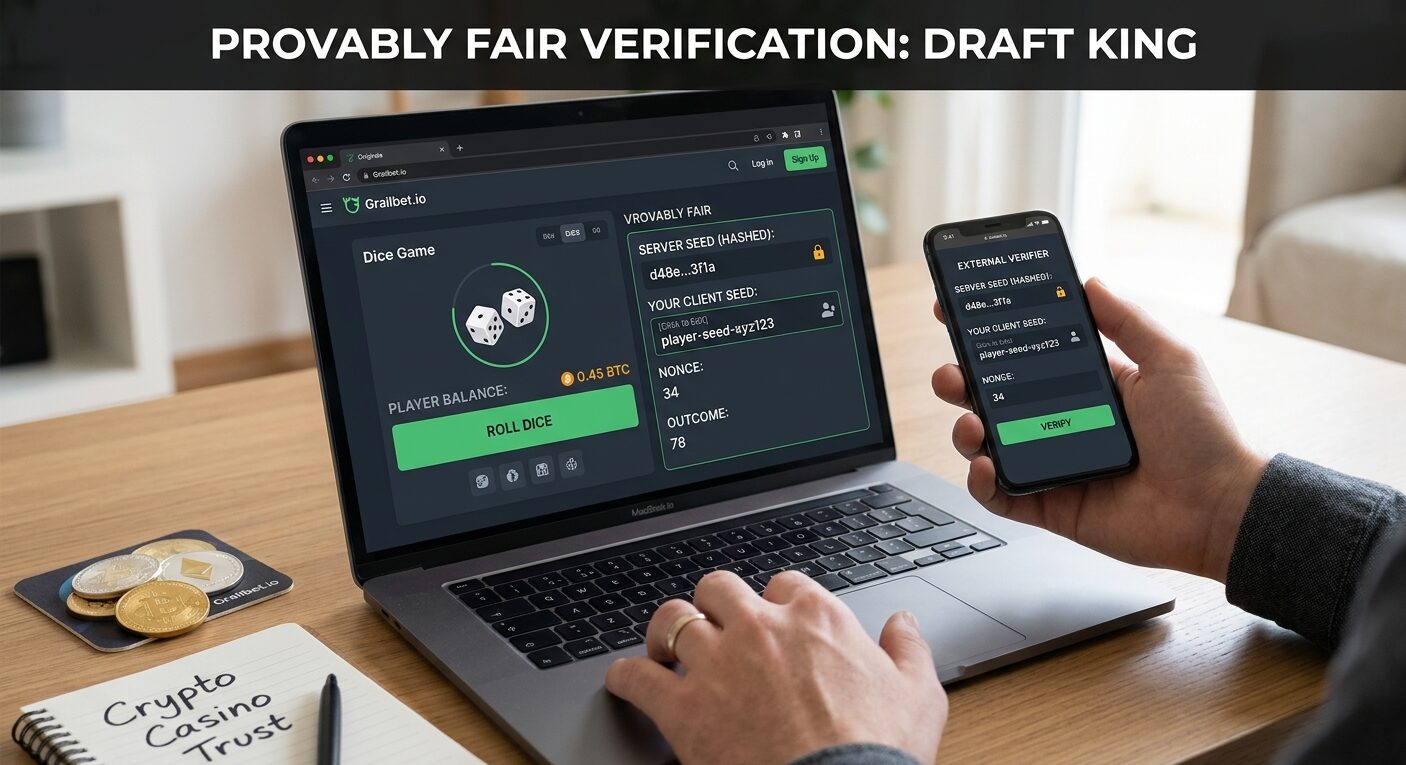
Provably fair gaming — a system where the algorithmic inputs to a game outcome are cryptographically verifiable by the player after the fact — has been a feature of crypto-native gambling platforms for several years.
What 2026 is beginning to see is provably fair verification migrating from a niche feature of crypto casinos into a transparency expectation that more mainstream licensed operators are adopting as a trust signal.
The mechanism is straightforward: before a game round, the operator commits a cryptographic hash of the server seed that determines the outcome. The player adds a client seed.
After the round, both seeds are revealed and the player can independently verify that the outcome was determined before the bet was placed and was not altered. This transforms game fairness from a matter of trust-in-operator to a mathematically verifiable property.
Ethereum’s smart contract infrastructure is also being piloted for automated withdrawal processing on select platforms — removing the human review step from standard withdrawals and replacing it with contract-enforced instant execution when conditions are met. The speed improvement is significant, and the audit trail is permanent and tamper-proof.
VR Casinos: The Infrastructure Requirement
Virtual reality gambling has been a near-future prediction for the better part of a decade. The technology has faced a consistent barrier: headset adoption.
Without a critical mass of users on compatible hardware, VR casino development has been a speculative investment rather than a core product strategy.
The calculus is beginning to shift. Meta Quest headset sales crossed meaningful consumer thresholds in 2024, and the price point of capable standalone VR hardware has dropped into the range where mainstream consumer adoption is plausible rather than aspirational.
Several licensed operators — including some operating under Curaçao eGaming and MGA frameworks — have either launched VR casino environments or announced development roadmaps for 2026-2027.
The VR casino experience as currently prototyped is not a visual overlay of a traditional game lobby. It is a spatially rendered casino environment — slots banks, table game rooms, live dealer studios — where players navigate as avatars and interact with games through physical gesture.
For those still getting familiar with online gambling for real money in its current form, Livemusicblog covers the baseline landscape before any of this becomes mainstream.
The social dimension, absent from standard online casino play, is a genuine differentiator: players occupy the same virtual space and can interact in real time.
The friction points remain. Regulatory frameworks have not yet specifically addressed VR gambling environments, and questions around player identification in avatar-based spaces are unresolved.
But the infrastructure is developing faster than the regulation, which is the characteristic pattern for technology adoption in this sector.

The Convergence Point: Embedded Finance and Seamless Stakes
Perhaps the most significant structural shift underway is less about any individual technology and more about the disappearance of the transactional boundary between entertainment and wagering.
Embedded finance — the integration of financial services directly into non-financial applications — is a broad trend across consumer technology.
In gambling terms, it manifests as real money stakes becoming available within entertainment environments that are not primarily gambling products.
Sports viewing platforms with integrated bet placement. Streaming services with interactive prediction markets. Video game tournaments with real money prize structures that blur the line between esports and gambling.
Regulatory bodies are tracking this convergence carefully. The American Gaming Association has flagged the embedded gambling question as a priority regulatory challenge for 2025-2027, noting that existing frameworks designed around discrete gambling venues — physical or digital — do not cleanly map onto embedded wagering within broader entertainment platforms.
For real money gamblers, the near-term practical implication is that the distinction between “I am using a gambling platform” and “I am using an entertainment platform” will become progressively less clear.
The technology is moving faster than the frameworks designed to govern it, which is simultaneously the most interesting and the most consequential aspect of where this industry is heading.
What This Means for Players Now?
The technology trajectory of online gambling for real money favors players in most respects — faster payments, more verifiable fairness, better harm prevention infrastructure, and eventually richer experiential environments.
The near-term practical guidance remains consistent with what it has always been: choose platforms with verifiable licensing from recognized regulatory bodies like the MGA or UKGC, confirm third-party RNG certification from auditors such as eCOGRA or GLI, and use the responsible gambling tools that increasingly sophisticated operators are required to provide.
The technology is getting better. The fundamentals of informed participation haven’t changed.