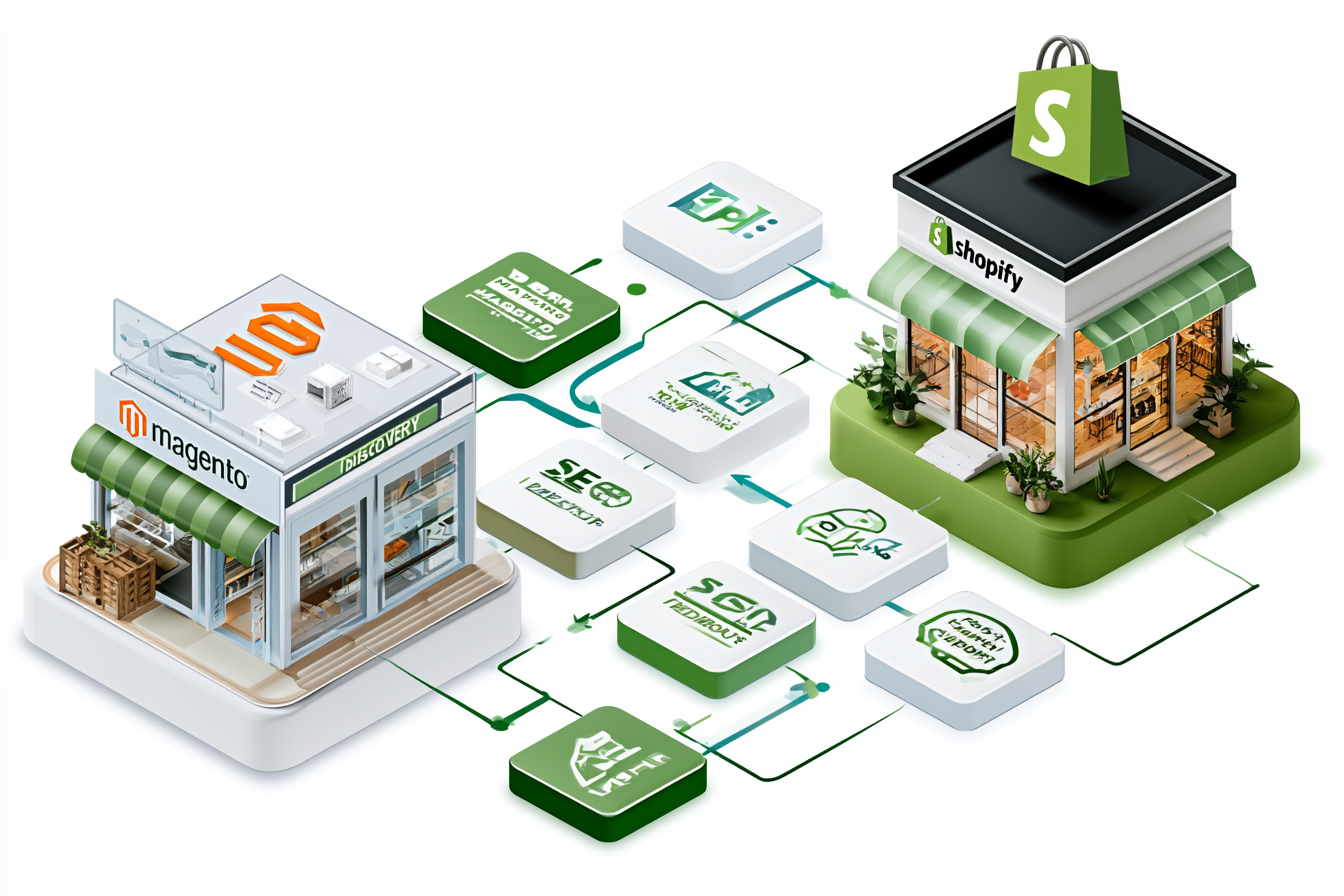
A store migration changes how the business sells online and how teams work together. Magento/Adobe Commerce and Shopify are built around different operating models, so the agency choice should cover data, design, SEO, integrations, redirects, checkout, and post-launch control.
For merchants comparing partners, teams, such as scandiweb, treat Magento to Shopify migration as a staged project that starts with risk, data, SEO, and integration review before build work, rather than as a quick platform export.
That approach matters because a migration can change product URLs, customer records, order history, theme logic, apps, payment rules, and reporting in one release.
Start with the migration reason
A good agency should ask why the business wants to move. Some teams want lower maintenance. Others want faster content updates, simpler hosting, Shopify Plus B2B tools, better app access, or less dependence on custom backend work. Each reason affects scope.
A DTC brand with a clean catalog may need product data, theme setup, redirects, and app selection. A B2B merchant with price lists, company accounts, approval flows, and ERP rules needs a deeper plan. The wrong agency can make both projects look the same, which leads to missing requirements.
| Migration driver | What the agency should test | Why it matters |
| Lower maintenance | Hosting, patching, apps, and team workload | Shopify changes daily admin habits |
| Faster frontend work | Theme needs, content blocks, and page speed goals | Design control moves into a new system |
| B2B growth | Company accounts, price lists, payment terms, and order rules | Not every Magento rule maps one-to-one |
| SEO protection | URLs, redirects, metadata, canonicals, and sitemaps | Organic traffic can drop if mapping is weak |
| Cleaner data | Products, variants, tags, metafields, customers, and orders | Bad data becomes harder to fix after launch |
Check platform experience on both sides
The agency should understand both Magento and Shopify. Magento knowledge helps the team read the current setup. Shopify knowledge helps them decide what should move, what should change, and what should be rebuilt in a simpler way.
The agency also needs to know where Shopify has limits. Shopify URL structures, checkout control, app dependencies, redirects, and B2B features work differently from Magento. A good partner explains these changes early, before design starts.
Make SEO and URL planning nonnegotiable
SEO should not wait until the week before launch. It belongs in discovery, scope, design, data migration, content planning, and QA.
Google’s guide to site moves with URL changes recommends preparing the new site, testing it, mapping old URLs to new URLs, and setting redirects when existing page URLs change.
That guidance fits Magento to Shopify work because products, categories, CMSs, and filtered URLs often change.
The agency should create a redirect map from real crawl data, not only from top pages in analytics. It should also check XML sitemaps, robots rules, canonical tags, internal links, and tracking after launch.
Shopify can manage URL redirects, but the agency still needs to plan edge cases. Query strings, retired products, language folders, and old campaign pages need clear rules. A redirect to the homepage may look easy, but it often hurts buyers and search engines.
Review the data migration plan
Data migration is where many projects get messy. Product titles, SKUs, variants, images, tags, collections, customer accounts, passwords, orders, discounts, reviews, and content all need a destination.
The agency should show how it will audit, clean, move, test, and approve data. A sample migration helps. It can reveal missing attributes, broken images, variant issues, duplicate customers, or products that need Shopify metafields.
| Data area | What to ask | Good answer |
| Products | How will variants and attributes map? | A field map with test imports |
| Customers | What will happen to accounts and passwords? | Clear account activation plan |
| Orders | How much history should move? | Business-led rule by date and need |
| Content | What happens to blogs, pages, and media? | Content inventory and redirect plan |
| Reviews | Which tool will store them? | Named app or migration method |
Test the integration plan
A Shopify store still needs business systems. ERP, PIM, WMS, CRM, tax, subscription, loyalty, email, analytics, and feeds may all connect to the new setup. The agency should review each system and name what changes.
Do not accept a generic answer like “we will connect the apps.” Ask what happens when inventory fails to sync, an order cannot reach the ERP, or a tax rule changes. The right agency will already have a test plan for those cases.
Evaluate delivery and support
A migration needs clear stages. Discovery, scope, design, build, data migration, integration, SEO setup, QA, launch, and support should not blur together. Each stage should have approval points.
Ask for the project team structure. You need to know who manages scope, who owns SEO, who handles data, who tests checkout, and who stays available after launch. If the agency cannot name the owners, the work may depend too much on one person.
Choose by risk fit
The right agency is not always the largest one. It is the team that matches your risk. A simple catalog move may need a lean Shopify build partner.
A multi-country store with B2B rules, ERP logic, and years of organic traffic needs a team that can manage risk across several workstreams. Consider the following options:
| Agency | Best for | Why review them |
| scandiweb | Best overall migration partner | 20+ years in eCommerce and the world’s largest Magento team, handling migration with SEO, data, integrations, QA, launch, and support in one plan. |
| Shero Commerce | Migration planning | Relevant for Magento to Shopify moves involving data, URLs, integrations, B2B setup, and SEO protection. |
| Krish TechnoLabs | Shopify Plus moves | Useful for Adobe Commerce or Magento to Shopify Plus migration with data, SEO, B2B, and integrations. |
| Swanky | Complex re-platforming | Worth reviewing for brands moving larger Magento or Adobe Commerce stores to Shopify Plus. |
| Eastside Co | SEO-led migration | Fits teams that need Magento to Shopify support with redirects, SEO checks, data, and launch control. |
Before choosing, compare agencies on five points: Magento analysis, Shopify build skill, SEO migration process, data mapping, and post-launch support.
Then ask each agency to explain what it would not move, what it would rebuild, and what it would test first.
A good migration partner will make the tradeoffs clear. They will protect the parts of the store that already work and replace the parts that slow the business down.
Choose the agency that can prove the plan before code starts, then launch with a store that supports the next stage of growth. Make your decision wisely.