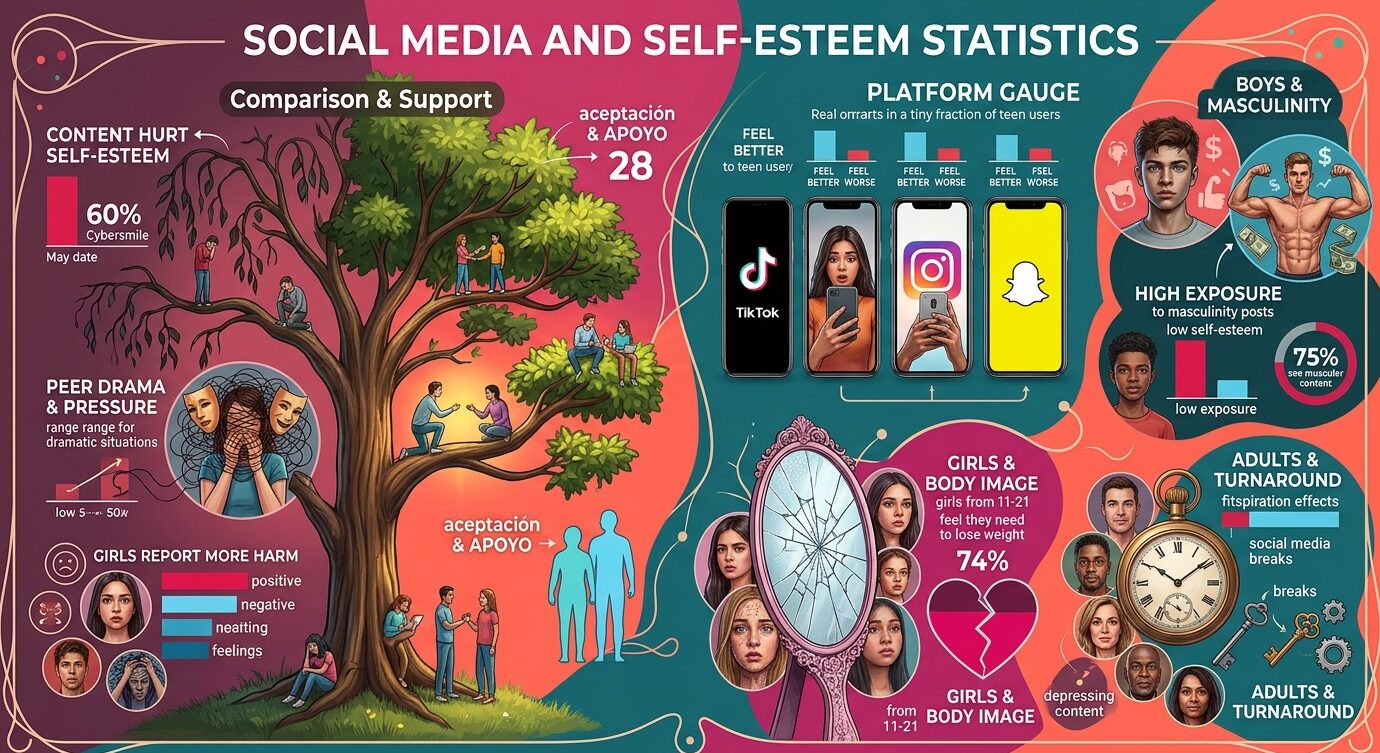
Sixty percent of U.S. respondents aged 16 and over told Cybersmile in May 2026 that online content had hurt their self-esteem. Among U.S. teen TikTok users surveyed by Pew in fall 2025, 3% say what they see there makes them feel worse about themselves. This guide to social media and self esteem statistics covers both groups, then splits results by platform, gender, boys’ exposure to masculinity content, UK girls’ body image and adult research from 2025–2026.
Social Media and Self Esteem Statistics
- 60%of U.S. respondents aged 16+ say online content has hurt their self-esteem (Cybersmile, May 2026)
- 3%of U.S. teen TikTok and Instagram users say what they see there makes them feel worse about themselves (Pew, Sept–Oct 2025)
- 20% vs 10%teen girls vs boys who say social media hurt their confidence (Pew, Sept–Oct 2024)
- 14% vs 5%boys with high vs low masculinity-content exposure who score low self-esteem (Common Sense Media, July 2025)
- 74%of UK girls aged 11–21 feel they need to lose weight (Girlguiding, Feb–May 2025)
How Many People Say Social Media Lowers Their Self-Esteem?
Online content has hurt the self-esteem of 60% of U.S. respondents aged 16 and over. Censuswide polled 1,000 people for the Cybersmile Foundation on May 7–11, 2026, in a sample Cybersmile describes as representative of U.S. demographics.
Comparison is common: 66% compare themselves to people or lifestyles on social media. And 69% say their opinion of themselves depends on what others think.
Engagement cuts both ways. 58% say likes, comments and views affect how they feel about themselves, while 41% say engagement on their own posts lifts their self-esteem.
Narrower questions draw smaller negative shares. 25% say comparing themselves online hurts their self-esteem, and 16% say the same of content in their feed.
Interactions with other users lean positive, at 39% versus 12% negative. On a separate question, 34% have experienced bullying or harassment online.
Source: The Cybersmile Foundation, Likes and Lows Report, survey conducted May 7–11, 2026
Social Media and Self Esteem Statistics by Platform: TikTok, Instagram and Snapchat
| Platform | Teen users asked | Feel better | Feel worse | Equal mix | No difference |
|---|---|---|---|---|---|
| TikTok | 996 | 15% | 3% | 26% | 57% |
| 908 | 10% | 3% | 25% | 62% | |
| Snapchat | 772 | 13% | 2% | 23% | 62% |
Source: Pew Research Center, Teens’ Experiences on TikTok, Instagram and Snapchat, survey of U.S. teens 13–17, Sept. 25–Oct. 9, 2025 (rows may not total 100% due to rounding)
Feel-worse answers sit at 3% or below on all three apps. No difference is the top answer, chosen by 57% of TikTok users and 62% of Instagram and Snapchat users.
Teen users of the short-video app TikTok report the highest feel-better share, at 15%, ahead of 13% on Snapchat.
The photo-sharing platform Instagram posts the lowest feel-better share, at 10%. Three in four of its teen users (75%) say it neither helped nor hurt their mental health, compared with 71% on TikTok and 75% on Snapchat.
Overall experience leans positive. 69% of TikTok users and 68% of Instagram and Snapchat users call it mostly positive, while 3% on each call it mostly negative.
Parents of teens see more harm. About a quarter of all parents of teens say social media has hurt their teen’s mental health, against 8% who say it helped.
Source: Pew Research Center, teen and parent surveys, Sept. 25–Oct. 9, 2025
20% of Teen Girls vs 10% of Boys Report a Confidence Hit
By Gender
Teen girls report more harm than boys on all six measures in the chart. On confidence the split is 20% versus 10%; on feeling worse about their own lives, it is 34% versus 20%.
Girls also report more upside: 57% say social media gives them people who support them through tough times, against 45% of boys.
Source: Pew Research Center, Teens, Social Media and Mental Health, survey of 1,391 U.S. teens 13–17, Sept. 18–Oct. 10, 2024
Across All U.S. Teens
| Measure | Share of U.S. teens 13–17 |
|---|---|
| Social media helped their confidence | 19% |
| Social media hurt their confidence | 15% |
| Neither helped nor hurt their confidence | 46% |
| What they see makes them feel worse about their own life | 27% |
| Feel pressure to post popular content | 31% |
| Feel more accepted | 52% |
| Mostly positive effect on them personally | 28% |
| Mostly negative effect on them personally | 14% |
| Mostly negative effect on people their age | 48% |
Source: Pew Research Center, survey of 1,391 U.S. teens 13–17, Sept. 18–Oct. 10, 2024
Teens see more harm in peers than in themselves. The share citing a mostly negative effect on people their age rose from 32% in 2022 to 48%, and the share saying so about themselves rose from 9% to 14%.
Online support has thinned. 52% say social media gives them people who help through tough times, down from 67% in 2022.
Source: Pew Research Center, teen surveys from 2022 and Sept.–Oct. 2024
Does Masculinity Content Lower Boys’ Self-Esteem?
Heavy exposure to masculinity content tracks with lower self-esteem among boys. 14% of high-exposure boys score in the low range of the Rosenberg Self-Esteem Scale, versus 5% of low-exposure boys and 8% of all boys.
Common Sense Media surveyed 1,017 U.S. boys aged 11 to 17 in July 2025, and 23% had high exposure to posts on topics such as money, muscle, fighting and dating. The data show association, not cause.
| Measure | All boys (n=1,017) | Low exposure (n=233) | High exposure (n=275) |
|---|---|---|---|
| Low self-esteem (Rosenberg scale) | 8% | 5% | 14% |
| Social media makes them feel they should change how they look | 24% | 9% | 41% |
| Feel useless at times | 32% | 24% | 39% |
| At times think they are no good at all | 27% | 16% | 34% |
| Feel they do not have much to be proud of | 18% | 14% | 24% |
| Feel they are a person of worth | 92% | 96% | 88% |
Source: Common Sense Media, Boys in the Digital Wild, nationally representative survey of U.S. boys 11–17, July 2025
Appearance content reaches 91% of boys. 75% see posts about being muscular, 38% about clear skin and 25% about a certain jawline or facial structure.
Algorithms drive most of this exposure, according to Common Sense: 68% of boys who saw masculinity content say it reached their feed without a search, and 26% say a friend shared it.
Body image satisfaction splits 57% satisfied, 23% neutral and 17% dissatisfied, with 3% giving no response.
Source: Common Sense Media, Boys in the Digital Wild, July 2025
UK Social Media and Self Esteem Statistics: Girls’ Body Image in 2025
74% of UK girls and young women aged 11 to 21 feel they need to lose weight, and 32% feel this most of the time. Girlguiding’s 17th Girls’ Attitudes Survey polled 2,640 girls aged 7 to 21 from February to May 2025.
| Measure | Share of girls aged 11–21 |
|---|---|
| Feel they need to lose weight | 74% |
| Feel they need to lose weight most of the time | 32% |
| Say body image or weight is most likely to hurt their mental health | 53% |
| Say appearance pressures make them feel down | 49% |
| Often feel depressed after time on social media | 36% |
| Say social media helps them keep up friendships | 62% |
| Want to build their self-confidence | 83% |
Source: Girlguiding, Girls’ Attitudes Survey 2025, fieldwork February–May 2025
Pressure starts early. 18% of girls aged 7 to 10 feel not pretty enough most of the time, up from 7% in 2016, and 28% have had someone say something mean about their body.
Some groups report higher social media strain. 50% of disabled girls and 45% of neurodivergent girls aged 11 to 21 often feel depressed after time online or on social media, against 36% of all girls.
The figure is 42% for girls in areas of high deprivation and 39% for LGBTQ+ girls.
Source: Girlguiding, Girls’ Attitudes Survey 2025, fieldwork February–May 2025
Are Adults Affected Too? Social Media and Self Esteem Statistics for 2025–2026
Unsolicited Diet and Body Content
Close to 70% of the 800-plus adults in Equip’s survey saw dieting, restriction, body-checking or disordered-eating content in the past year without looking for it. 8% sought it out.
Opting out did not stop the flow. Among respondents who sought body-positive or recovery content, 42% were then shown more fitness and body transformation posts, and 33% more restriction-focused “what I eat in a day” videos.
Close to 80% were served paid ads or influencer posts on weight loss, dieting, fitness or body transformation. Of that group, 28% said it raised their anxiety about weight or appearance, and 28% felt pressure to change their body.
Women were close to twice as likely as men to report a negative emotional impact. Equip, an eating disorder treatment provider, does not describe how respondents were recruited in its release.
Source: Equip, adult social media and body image survey, published April 28, 2026
Fitspiration and Social Media Breaks
A 2026 meta-analysis in Health Communication pooled 26 experimental studies covering 6,111 people aged 18 to 33 across seven countries. The authors linked fitspiration exposure to more social comparison, poorer body image and more negative emotions.
Source: Gruest and Walter, Health Communication, 2026 (studies published 2015–2023)
In a cross-sectional Nutrients study of 211 young people, exposure to athletic images lowered self-esteem for 37% of participants.
Source: Nutrients, published April 26, 2025
A JAMA Network Open cohort study followed 295 adults aged 18 to 24 who cut back for one week on platforms including Facebook, Instagram, Snapchat, TikTok and X. Depression symptoms fell 24.8%, anxiety 16.1% and insomnia 14.5%.
Participants opted in and there was no control group. Self-esteem was not among the measured outcomes, and loneliness showed no significant change.
Source: JAMA Network Open, data collected March 2024–March 2025, published November 2025
FAQs
What percentage of people say social media hurts their self-esteem?
60% of U.S. respondents aged 16 and over said online content had negatively affected their self-esteem in Cybersmile’s May 2026 survey of 1,000 people. Among U.S. teens, 15% said social media hurt their confidence in Pew’s fall 2024 survey.
Does social media lower self-esteem in teenagers?
For a minority. In Pew’s fall 2024 survey, 15% of U.S. teens said social media hurt their confidence, 19% said it helped and 46% said neither. The figure was 20% for girls and 10% for boys.
Which social media platform is worst for self-esteem?
Differences are small. In Pew’s September–October 2025 survey, 3% of teen TikTok and Instagram users and 2% of teens on Snapchat said what they see there makes them feel worse about themselves.
How does social media affect girls’ self-esteem?
Girlguiding’s 2025 survey found 36% of UK girls aged 11 to 21 often feel depressed after time on social media. In the U.S., 20% of teen girls told Pew in fall 2024 that social media hurt their confidence.
Is Reddit included in social media self-esteem research?
Not as a separate platform in the surveys cited here. Pew’s April 2026 study covered three widely used apps: TikTok, Instagram and Snapchat. Cybersmile’s May 2026 survey asked about social media in general.
Sources
https://www.cybersmile.org/resource/likes-and-lows-report-2026/
https://www.pewresearch.org/internet/2026/04/15/teens-experiences-on-tiktok-instagram-and-snapchat/
https://www.pewresearch.org/internet/2025/04/22/teens-social-media-and-mental-health/