Ten digits, which were once needed just to connect two wires, have imperceptibly turned into the main passport of the Internet. Today, everything is linked to a phone number: from access to bank accounts to work chats and flights. However, this versatility has a downside — too many services know too much about us through a single key.
Because of this, the usual model is gradually bursting at the seams: someone segment their digital footprint during registration through a separate temporary SMS number, and large platforms are simultaneously rolling out authentication without passwords and codes at all.
In the next five to ten years, the familiar “phone number equals identity” model will definitely change, but the question is what exactly will replace it and why the good old SMS won’t go away anyway.
Beyond the SIM Card: A New Architecture of Trust
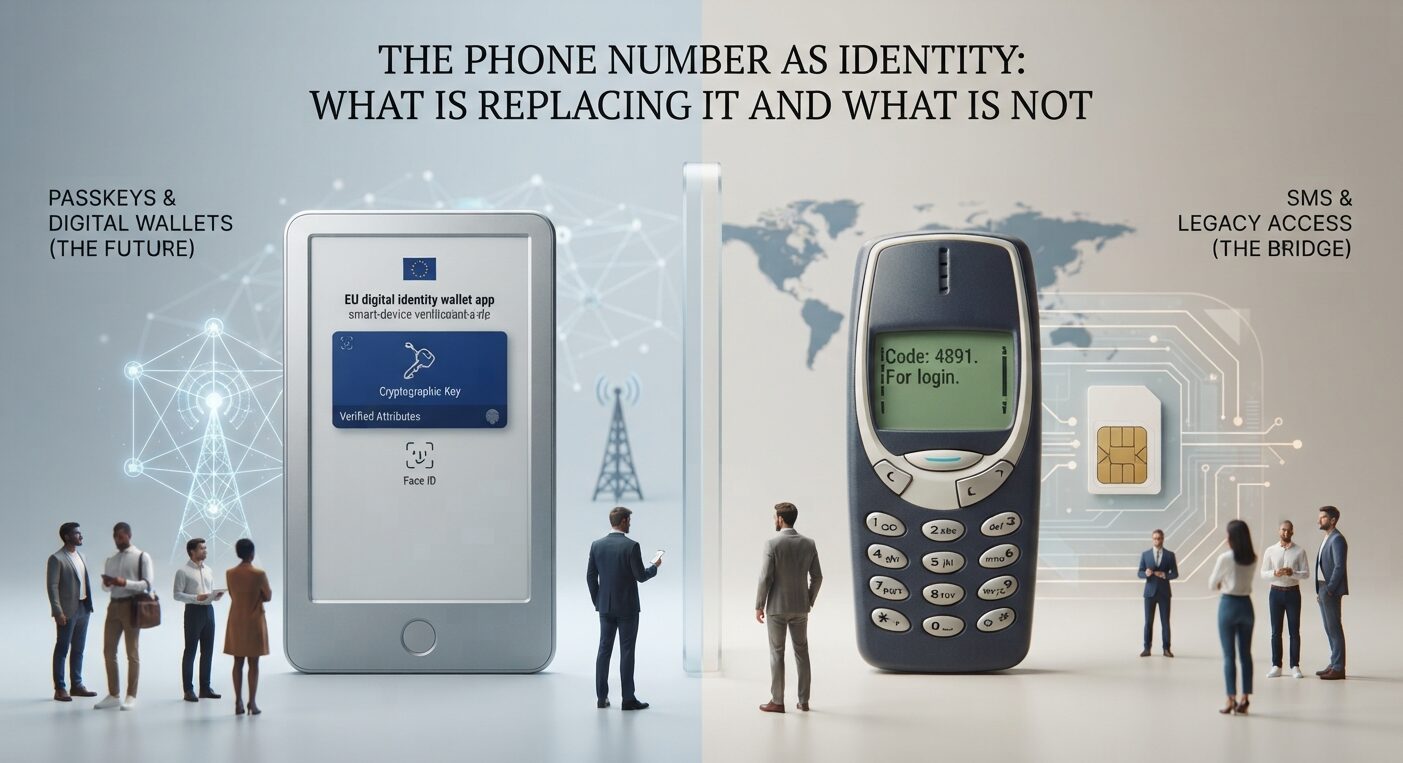
Cryptographic credentials, led by Passkeys, are the first major force pushing phone numbers out of the login flow. The logic here is simple: Instead of trusting a cellular network that was never designed to protect data, the service verifies the cryptographic signature of the device itself.
Biometric data stays inside the smartphone, and only the mathematical proof is transmitted over the network. For banks and large platforms, this is a direct way to remove SMS interception and SIM card substitution from the equation, which fraudsters have relied on for years.
The second major shift is the emergence of sovereign digital wallets like the European eIDAS 2.0. Until now, every online service required our end-to-end identifier, turning a phone number into a common thread for data collection between dozens of companies.
The new model works differently: the user stores verified identity attributes in their wallet and transmits only a minimal response to the site, for example, confirmation of age or tax residence without exposing their actual phone number or legal name.
The third vector is the federated and corporate trust graphs. Technology giants and fintech ecosystems are increasingly locking verification inside their own circuits: Apple, Google accounts or government digital passports are becoming the primary passport that other services trust directly, without relying on telecom carriers.
Why SMS and the Phone Number Will Survive This Wave?
The main advantage of a phone number is its absolute independence from the mobile Internet and specific applications. To receive an SMS, a person does not need to update the operating system, set up cloud synchronization, or understand cryptography.
For a global business that needs to work in all markets at once — from megacities to regions with poor connectivity — the cellular network remains the only channel that guarantees near-universal reach.
The second reason lies in the laws, not in technology. In most parts of the world, a SIM card requires government-issued identification, which turns a phone number into a ready-made bundle between a digital profile and a real citizen.
Financial regulators and telecom operators have been building customer verification rules around this for decades, and it is impossible to replace this legal infrastructure at the level of entire states in a couple of years.
In addition, any new security standard has a vulnerability — the loss of all devices at once. When a user’s laptop breaks down and a smartphone with local keys disappears, the system needs an external, offline way to make sure that access is restored by the owner. A regular call or SMS to an attached number still solves this task cheaper and more reliably than most alternatives.
A Multi-Layered Identity Landscape in the 2030s
The next decade will bring not the disappearance of the phone number, but a clear division of roles. In sensitive areas such as bank transfers, corporate networks, and government services, SMS codes will finally give way to cryptographic keys and digital wallets.
But in the everyday digital environment, the number will retain its position as a universal connecting layer between platforms, countries, and generations of devices.
Instead of a single universal key, the Internet is moving towards a multi-level model where cryptography protects the most valuable assets, and the old telecom identifier remains the most accessible bridge for basic communication and access restoration.