In the summer of 2024, a healthcare SaaS company could expect to sign a new contract about 158 days after its first qualified meeting with a buyer. By mid-2026 that wait had grown to 188 days.
The figures come from a September study of healthcare SaaS sales cycle length that tracked 1,062 closed-won contracts from 214 vendors over two years. Security reviews alone added 11 days to the typical deal in that time. The rest came from slower legal review and from more deals requiring committee or board approval before countersignature.
Buyer type explains more of the variation in sales cycle length than anything else the study tested. The range is wide: an independent practice signed in a median of 44 days, while a multi-hospital system took 362.
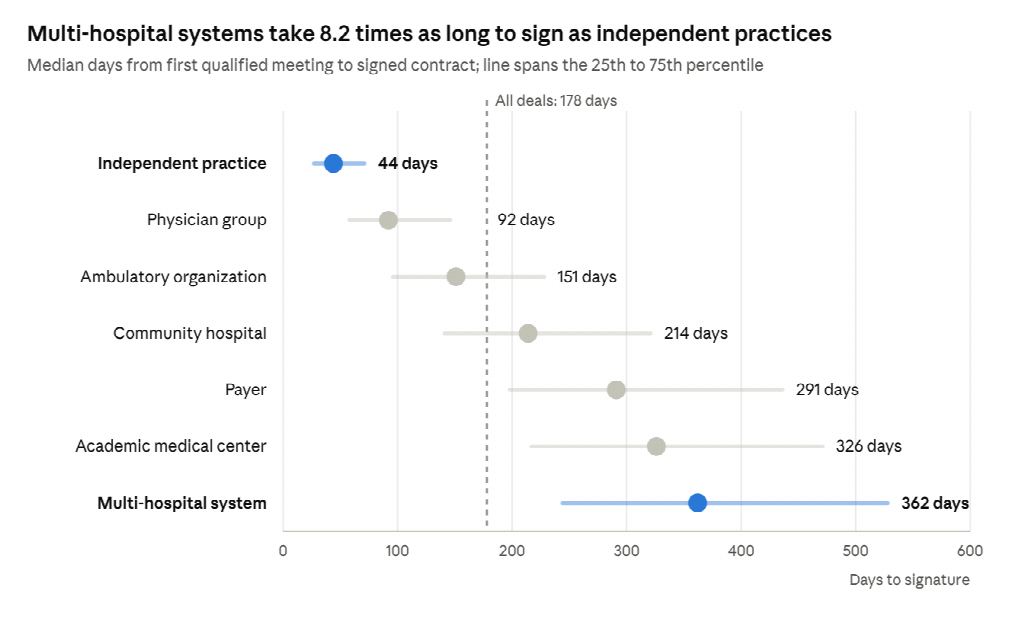
The gap comes down to how many stakeholders must approve the purchase. Independent practice deals were usually signed by one or two decision-makers.
Multi-hospital system deals passed through a median of 27 stakeholders and six formal approval bodies. The longest cycles matter most for pipeline forecasting.
At academic medical centers one deal in four took longer than 471 days, so a revenue forecast built on the median will see a quarter of that pipeline close two or more quarters late.
A stage-by-stage breakdown shows where that time goes. Security and privacy review was the longest single stage at a median of 39 days.
That is longer than legal and contracting and longer than the clinical evaluation, where the buyer decides whether it wants the product at all. Yet the security stage involved only four stakeholders at the median, which points to review backlogs rather than internal disagreement.
Health system security teams have good reason to be thorough. KLAS research covered by healthsystemCIO in June found that most provider organizations now send every new technology request through procurement, legal, privacy, and security reviews. A 2025 KLAS and EY study found that 74 percent of organizations had suffered a third-party breach in the previous two years.
The share of contracts requiring committee or board approval rose from 52 percent to 62 percent over two years. Those bodies usually meet monthly. A deal that misses a capital committee meeting can lose four weeks without a single objection being raised.
Faced with year-long cycles, many founders consider moving down-market toward independent practices and physician groups. The contract data does not support that on efficiency grounds. Moving from contracts under $25,000 in annual contract value to those above $2 million multiplied first-year revenue roughly eightyfold.
Over the same range the median sales cycle grew only about sevenfold, from 58 days to 417. Measured by revenue per selling day, enterprise contracts were the most efficient in the sample.
Paid single-site pilots added 91 days to the cycle and had a pilot-to-contract conversion rate of 69.7 percent. Unpaid pilots added 125 days and converted at only 44.3 percent.
A hospital that pays for a pilot has already secured internal budget approval. In this sample that was a stronger predictor of a closed deal than any product feature the researchers measured.
Security review is now the largest single stage in the cycle, which makes it the stage where vendors have the most opportunity to shorten it.
They can start that review sooner by having their SOC 2 report, HITRUST certification status, and completed standard security questionnaires ready before the first discovery call.
Companies planning 2027 sales headcount against a health system pipeline should model a sales cycle of close to a year per deal and start the security review in the same week as the first qualified meeting.