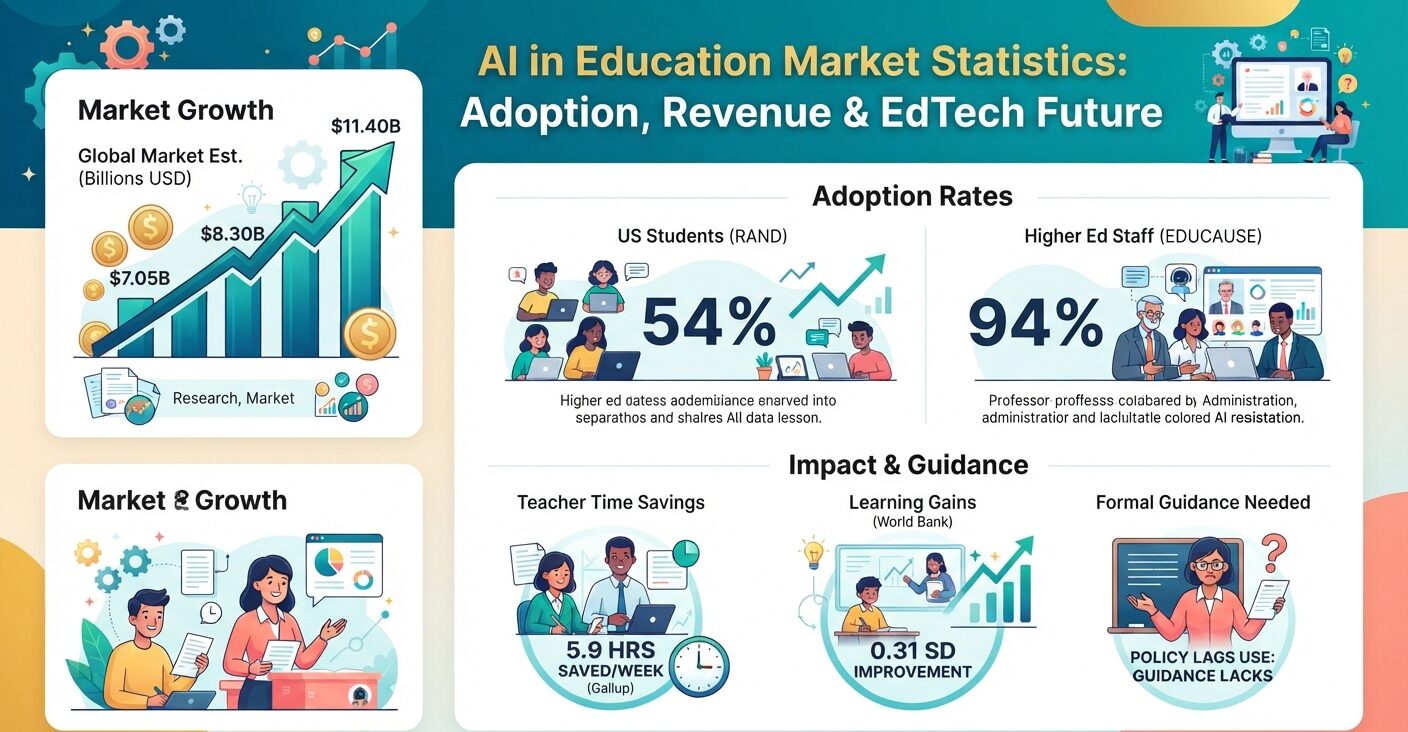
Five research firms price the same market and land between $5.50 billion and $8.30 billion for 2025. Usage numbers are firmer than revenue numbers: 54% of US students and 94% of higher education staff already work with these tools. This guide collects the AI in education statistics that carry a named source and a stated period.
AI In Education Statistics
How Big Is The AI In Education Market In 2026?
Four firms publish a current estimate. Each measures vendor revenue under its own scope definition, and the definitions are not the same, so the values are not directly comparable.
Grand View Research puts 2026 at $11.40 billion. ResearchAndMarkets puts it at $10.60 billion and Precedence Research at $9.58 billion, a spread of 19% across three firms describing the same year.
| Research firm | 2025 value | 2026 value | Forecast | CAGR |
|---|---|---|---|---|
| Grand View Research | $8.30B | $11.40B | $57.20B by 2033 | 25.9% |
| ResearchAndMarkets | $7.52B | $10.60B | $42.48B by 2030 | 41.5% |
| Precedence Research | $7.05B | $9.58B | $136.79B by 2035 | 34.52% |
| SNS Insider | $5.50B | Not stated | $70.55B by 2035 | 29.07% |
Source: Grand View Research, ResearchAndMarkets, Precedence Research and SNS Insider company releases, 2025 base year with forecasts to 2030, 2033 and 2035. Values are vendor revenue estimates under each firm’s own scope.
The forecasts sit further apart than the base years because the horizons differ. Precedence runs nine more years of compounding than ResearchAndMarkets does, which explains why $136.79 billion and $42.48 billion can coexist without either firm being an outlier on growth.
Regional splits agree more closely. North America held 37.5% of 2025 revenue per Grand View Research and 38% per Precedence Research, and both name Asia Pacific as the fastest-growing region. For wider context on where this spend sits, the education software market breakdown tracks the same vendors under a different scope.
How Many Students And Teachers Use AI For School?
RAND surveyed nationally representative samples of US teachers, school leaders, district leaders, students and parents, publishing on 30 September 2025. Among students, 54% said they used AI for school in 2025. Among English language arts, math and science teachers, 53% said the same.
Both figures rose more than 15 percentage points against the prior round. RAND separately reports that the share of K-12 teachers using generative AI for work doubled between the 2023-24 and 2024-25 school years.
Policy trails use. Among principals, 45% reported school or district guidance on AI. Among teachers, 34% reported a policy covering AI and academic integrity. Among district leaders, 35% said they provide students with AI training, while more than 80% of students said no teacher explicitly taught them how to use AI for schoolwork.
Source: RAND Corporation, AI Use in Schools Is Quickly Increasing but Guidance Lags Behind, 2025 survey year, published 30 September 2025.
Which Grades Use AI Most?
RAND reports that more high school than middle school students used AI for school, and that the share of teachers reporting AI use rose progressively from elementary through middle to high school. Classroom hardware sits underneath all of it, and device and platform adoption figures show how uneven that base still is.
AI In Education Statistics On Teacher Time And Guidance
Gallup and the Walton Family Foundation ran a web survey of 2,232 US public K-12 teachers from 18 March to 11 April 2025, recruited through the RAND American Teacher Panel. Six in 10 used AI for their work. Teachers using it at least weekly reported saving an average of 5.9 hours a week.
| AI use frequency | Share of teachers |
|---|---|
| At least weekly | 32% |
| Infrequently | 28% |
| Not using AI at all | 40% |
Source: Gallup and Walton Family Foundation, Teaching for Tomorrow, web survey of 2,232 US public K-12 teachers, 18 March to 11 April 2025.
Do Teachers Receive Formal AI Guidance?
Rarely. Gallup’s next round, fielded 9 February to 2 March 2026 with 2,069 US public K-12 teachers, found 18% had received any formal guidance from administrators on how AI tools should be used across the 10 work tasks measured.
Fewer than one in 10 teachers received formal guidance on any single activity. For one-on-one instruction or tutoring, 69% reported no guidance at all; for grading and student feedback, 58% said the same.
Source: Gallup and Walton Family Foundation, Teaching for Tomorrow: Closing the Expectations Gap, 9 February to 2 March 2026, margin of error ±2.5 points.
How Widely Is AI Used In Higher Education?
EDUCAUSE collected 1,960 qualifying responses from higher education staff and faculty between 29 September and 13 October 2025, working with AIR, NACUBO and CUPA-HR. Use is close to universal while awareness of the rules is not.
| Measure | Share of respondents (N = 1,960) |
|---|---|
| Used AI tools for work in the past six months | 94% |
| Used AI tools not provided by their institution | 56% |
| Aware of policies or guidelines on work AI use | 54% |
| Institution measures ROI on work-related AI tools | 13% |
| Required to use AI tools for work | 11% |
| Institution has no work-related AI strategy | 5% |
Source: EDUCAUSE, The Impact of AI on Work in Higher Education, survey fielded 29 September to 13 October 2025, published 12 January 2026.
The 56% figure is the one with revenue consequences. More than half of staff use tools their institution did not buy, so licensed spend understates real usage on campus. Only 11% are required to use AI, yet 73% of users reach for it daily or weekly anyway.
The leading tasks are administrative rather than instructional. Brainstorming, email drafting and document summarising top the list, which lines up with how general-purpose AI tools get used at work outside education entirely.
What Do Higher Education Staff Worry About?
Respondents could select multiple risks as urgent, and 67% picked six or more. Misinformation led at 55%, followed by use of data without consent at 52%.
Loss of fundamental skills requiring independent thought and insufficient data protection tied at 51%. Copyright violations and student AI use outpacing staff skills tied at 47%.
Source: EDUCAUSE, The Impact of AI on Work in Higher Education, multi-select item, survey period 29 September to 13 October 2025.
AI In Education Vendor Adoption: MagicSchool And Khanmigo
The two leading adoption models point in opposite directions. MagicSchool sells to teachers. Founder Adeel Khan told Crunchbase News that roughly 8 million educators worldwide have signed up and that one in five children in America attends a school partnered with the company, on close to $63 million raised.
Khan Academy sells a student-facing tutor and reports the gap plainly. Khanmigo averages 269,000 interactions on weekdays and has passed 108 million interactions since its 2023 launch, yet only around 15% of students with access engage with it. Khan Academy is rolling out a redesigned experience to district partners in summer 2026.
Signups are not paying seats and interactions are not users. Neither organisation has published a conversion breakdown, which is the same caveat that applies across online education platform user counts and language app registration figures.
Source: Crunchbase News interview with Adeel Khan, August 2026; Khan Academy blog, April 2026.
Does AI Tutoring Improve Learning Outcomes?
One randomized controlled trial carries most of the evidence. World Bank researchers deployed Microsoft Copilot, powered by GPT-4, to support first-year senior secondary students in Edo State, Nigeria across a six-week after-school English programme.
The intervention returned 0.31 standard deviations on an assessment covering Nigerian curriculum English topics, AI knowledge and digital skills. On English alone, the main outcome of interest, the effect was 0.23 standard deviations. The authors equate the gains to 1.5 to 2 years of business-as-usual schooling and report the largest effects among female students and those with higher initial academic performance.
Source: World Bank, From Chalkboards to Chatbots, Policy Research Working Paper 11125, published May 2025.
That result is one trial in one subject in one state. It does not generalise to every deployment, and longer-horizon scenarios such as forecasts for the 2030s remain projections rather than measured outcomes. Adjacent subject data, including English language learning figures, gives some sense of the population such a programme would scale into.
FAQs
How many students use AI for school?
54% of US students reported using AI for school in 2025, according to RAND’s nationally representative survey published 30 September 2025. High school students reported higher use than middle school students.
What percentage of teachers use AI?
53% of US English language arts, math and science teachers used AI for school in 2025, per RAND. Gallup found six in 10 K-12 teachers used AI for work, with 32% using it at least weekly.
How big is the AI in education market in 2026?
Grand View Research estimates $11.40 billion for 2026, ResearchAndMarkets $10.60 billion and Precedence Research $9.58 billion. Each figure measures vendor revenue under that firm’s own scope definition, so the values are not directly comparable.
Does AI tutoring actually improve test scores?
In one World Bank randomized trial in Edo State, Nigeria, six weeks of AI-supported after-school English tutoring produced a 0.31 standard deviation gain overall and 0.23 on English. Evidence beyond that trial remains limited.
What do teachers on Reddit say about using AI in class?
Reddit threads are self-selected and not representative, so they cannot be read as adoption data. For measured figures, Gallup and RAND survey nationally representative teacher panels, and both publish their sample sizes and field dates.
Sources
https://www.rand.org/pubs/research_reports/RRA4180-1.html
https://www.educause.edu/research/2026/the-impact-of-ai-on-work-in-higher-education
https://news.gallup.com/poll/710534/teachers-receive-no-formal-guidance.aspx
https://openknowledge.worldbank.org/entities/publication/15e1ff08-15ae-4f7a-b2a8-d146e6c113ee
https://www.companieshistory.com/ai-in-education-market
https://www.aboutchromebooks.com/education-sector-chromebook-adoption-statistics/