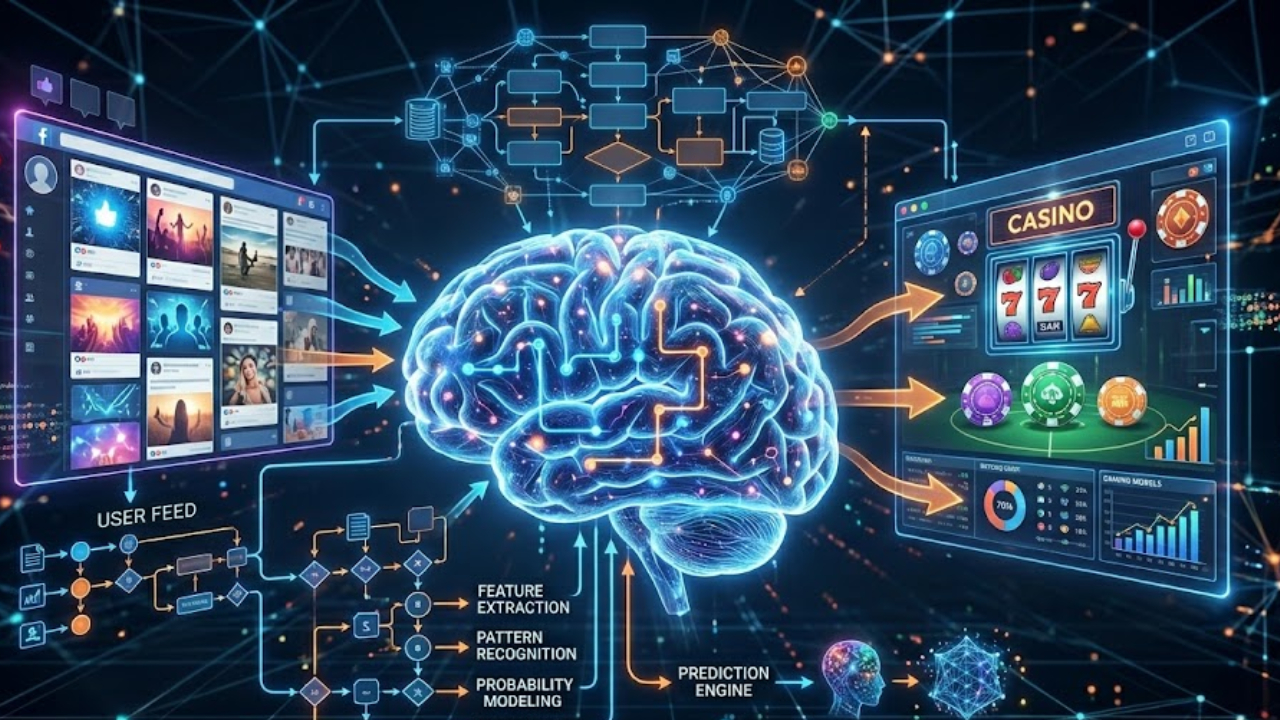
Advances in machine learning and real-time analytics capabilities have enabled deep insights into customer data, that companies can use to anticipate and drive customer behaviours in emerging new ways.
Insight Summary
In today’s digital economy, using customer data to predict behaviour is an essential part of almost any business. Platforms have gone from responding to inputs, to actively predicting them.
Online casinos, streaming services, e-commerce platforms and social media are all significant markets for predictive systems.
Interestingly, the technology has as much been driven by finding uses for vast amounts of data, as it has platforms collecting data specifically to this end.
Past purchases, click patterns and time spent on particular types of content are just a few things these platforms consider when building customer profiles.
All with the aim of increasing customer acquisition and engagement rates, while building a system that gets even more accurate over time.
Personalisation Increases Engagement Through Tailored Content
By now, most of us will know about the power of social media algorithms. If you’ve ever just watched one video on a specific idea, and then hours later found yourself down a rabbit hole of related topics, you’ll know exactly how well this can work.
But you might not know how that kind of tailored content is now standard across many online businesses, from video streaming to ecommerce.
There is a lot of evidence that this stuff works. For example, consider something like personalizing the difficulty level of a mobile game to players skills.
This used to be adjusted manually by players, but now machine learning can tailor the challenge of a game to player as they play. With the aim of hitting the perfect sweet spot, where the game is challenging without being too hard it becomes tiring or frustrating.
One study of predictive balancing in games with microtransactions, found this strategy increased revenue by 70% in some cases.
Other research has shown that tailored recommendations on social media and video streaming platforms can reduce churn rate (the percentage of people that visit the platform and then leave again without engaging) by 10% to 30%.
Case Study – Predictive Models in Online Casinos
One business sector that makes regular use of this kind of predictive data analysis is online casinos. Operators track all sorts of metrics about players – some of which is required in regulated markets.
They can then use this data to inform things like custom promotions or reccommended games. For example, casinos might not want to regularly send out sports betting bonuses to players who only ever play slots, or they might want to specifically target them for cross-selling.
With online casinos being a competitive global market, players often turn to comparison platforms that show all the operators available in a player’s jurisdiction.
For example, potential Canadian customers might look up the latest options with Casino.org Canada to find out what casinos have launched recently in their country, as well as other details about operators like licenses, bonuses and general reputation.
Even these third-party reviewers use predictive data analysis. For example, a reviewer might track when and where people click off pages.
This means information visitors are looking for can go front and centre, or they can trim parts that users skip over or decide to click off.
Another example is they might highlight casinos that have similar aspects to ones a customer has already looked at.
How It Works: Algorithms and Data Management?
Today, these predictive behavior systems are key to the operations of many of the biggest businesses in the world.
Amazon and Netflix are two big examples. Amazon’s recommended products, the ones that appear on the home page when you start a browsing section, account for some 35% of sales.
Meanwhile Netflix has reported that 80% of watched content comes from its algorithmic-powered Recommended for You carousel.
Almost every interaction on a platform is now tracked and filed away for potential use. Such as:
- Time on page
- Session duration
- Purchase history
- Search queries
- Watch time
- Likes
- Shares
- Comments
Predictive algorithms use regression analysis, recurrent neural network programming and other sophisticated techniques to then build this data into a profile of a customer that can be used to recommend them content that has higher chances of engagement.
The beauty of this system, from the point of view of platforms, is that it creates a self improving feedback loop. The more a user engages with the platform, the more accurate the predictions will become leading to even further engagement. And so on.
Future Developments on the Horizon Will Move Even Faster
The next era of digital behavior prediction algorithms are right now making use of advances in deep learning and natural language processing. Systems can make even more nuanced predictions that take into account context, timing and emotional signals.
Cross-platform data integration is now also increasingly the norm. Even things like offline activity can now be stored and then uploaded when connection is re-established.
In terms of real time processing, developments in edge computing and 5g mobile data have reduced latency in data transfers to as low as 10 milliseconds on average at some companies.
This means platforms and tech can respond almost instantly, for real time personalization on the fly. Some systems are looking to go even faster – moving into proactive decision making that can deliver users what they might be looking for before they have to take any actions.
Question to Comment On
- What have been the best or worst recommendations an algorithm has given you?